
Rameshwaram Jyotirlinga
● Somnath ● Mallikarjuna ● Kashi Vishwanath ● Baidyanath ● Kedarnath ● Grishneshwar ●
● Rameshwaram ● Bhimashankar ● Mahakaleshwar ● Trimbakeshwar ● Nageshwar ● Omkareshwar ●
Where Rama Bowed Before Shiva
At the edge of the Indian mainland, where land meets the sea, and the horizon seems to stretch endlessly towards Lanka, stands a sacred place shaped by one of Hindu tradition’s most beautiful expressions of humility. Here, Lord Rama worshipped Lord Shiva. That single idea gives Rameshwaram an extraordinary place in Hindu sacred geography. The shrine is devoted to Shiva, yet its central sacred story is inseparable from Rama, the revered avatar of Vishnu. Shaiva and Vaishnava traditions therefore meet naturally at Rameshwaram.
The sacred centre of this tradition is the Ramanathaswamy Temple, located on Rameswaram Island in Tamil Nadu. It is traditionally revered as one of the twelve Jyotirlingas and is also one of the four Char Dham pilgrimage destinations. The Tamil Nadu Tourism Department describes the shrine as one of India’s major pilgrimage centres and identifies Ramanathaswamy as the principal deity. (Tamil Nadu Tourism) But Rameshwaram is not remembered simply because Rama worshipped Shiva. Its deeper message is about humility before the Divine, devotion before action, and the recognition that even a great hero bows before something greater than himself. That is what makes Rameshwaram such a powerful subject for sacred art.
Who Is Rameshwaram Jyotirlinga?
Rameshwaram Jyotirlinga is the sacred Shiva manifestation worshipped as Ramanathaswamy at the Ramanathaswamy Temple in Rameswaram, Tamil Nadu. It is traditionally counted as the eleventh of the twelve Jyotirlingas. The term Jyotirlinga comes from jyoti, meaning radiant light, and linga, the sacred symbol through which Shiva is worshipped. A Jyotirlinga is therefore understood within Shaiva tradition as a manifestation of Shiva’s luminous and transcendent presence. Rameshwaram has an additional distinction.
Its sacred identity is deeply connected with Sri Rama, the hero of the Ramayana and an avatar of Vishnu. This creates a remarkable devotional meeting point. A devotee may come to Rameshwaram with reverence for Shiva, with love for Rama, or with an understanding of both traditions together. The temple itself is also part of the larger pilgrimage landscape of southern India and the Char Dham tradition.
The Meaning of Rameshwaram’s Name
The name Rameshwaram is commonly connected with Rama and Ishvara.
Ishvara is a name for the Supreme Lord and is especially associated with Shiva in this context. Rameshwaram can therefore be understood devotionally as “the Lord of Rama” or “Rama’s Lord.”
This meaning is especially significant because the name itself expresses the relationship at the heart of the shrine.
Rama worships Shiva.
Shiva becomes Ramanathaswamy.
The devotee approaches the Divine through humility.
There is also an important theological beauty here. Hindu traditions often contain multiple paths and devotional relationships that meet rather than cancel one another. Rameshwaram is a living example of this shared sacred landscape.
The Story of Rameshwaram Jyotirlinga
The most famous Rameshwaram tradition is connected with the Ramayana and the events surrounding Rama’s journey to Lanka. After Sita was abducted by Ravana, Rama, together with Lakshmana, Hanuman, and the vanara forces, eventually reached the southern coast. Lanka lay across the sea. A great challenge remained: how could Rama’s army cross the waters and reach Ravana’s kingdom? Before the great crossing and battle, tradition remembers Rama turning towards Shiva in worship.
The story is preserved in later sacred traditions and Puranic accounts associated with Rameshwaram. The local temple tradition gives this episode a central place in the identity of the shrine. According to the familiar Rameshwaram legend, Rama wished to worship Shiva and asked Hanuman to bring a Shiva Linga from Kashi. Hanuman set out on the journey. But time was passing. The auspicious moment for worship approached before Hanuman could return. Sita then prepared a Linga from the sand available on the seashore. Rama worshipped this Linga with devotion.
This became associated with the Ramalinga, the principal sacred Linga of the Rameshwaram tradition. Hanuman eventually returned with the Linga he had brought from Kashi. In the temple tradition, this became known as the Vishwalinga or Kashi Linga. The story continues with a touching detail. Hanuman was disappointed that Rama had already completed the worship. Yet Rama did not allow Hanuman’s devotion to become a source of hurt. The temple tradition preserves the practice that the Linga brought by Hanuman is worshipped before the principal Ramanathaswamy Linga. (Tamil Nadu Tourism)
The story is therefore not simply about which Linga came first. It is about devotion being honoured in more than one form. Rama honours Shiva. Sita participates in the sacred act. Hanuman brings a Linga from Kashi, and the sacred tradition preserves all these relationships within the temple.
Rameshwaram and the Ramayana
Rameshwaram’s connection with the Ramayana is one of the reasons the shrine has such extraordinary emotional power. The place is traditionally associated with the southern journey of Rama, the sea crossing towards Lanka, and the worship of Shiva before the great confrontation with Ravana. The exact historical relationship between epic geography and present-day locations should be treated carefully. The Ramayana has developed through many regional traditions, languages, and retellings across centuries. For devotees, however, Rameshwaram remains deeply connected with Rama’s sacred journey.The temple’s own official tradition explicitly identifies its setting with the Ramayana era and its island location near the Agni Theertham. (Ramanathaswamy Temple) That living connection between text, pilgrimage and place is what gives Rameshwaram its distinctive character.
The Divine Form of Rameshwaram
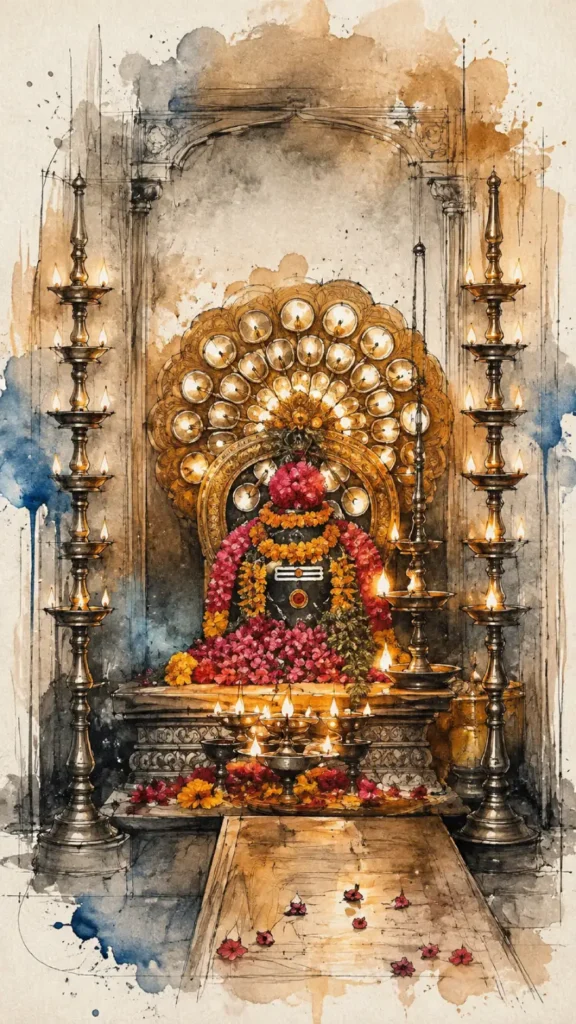
At the heart of Rameshwaram worship is the Shiva Linga of Ramanathaswamy.
The Linga is not a portrait in the ordinary artistic sense.
It is a sacred form through which Shiva is worshipped and contemplated.
For an artist, this creates an interesting distinction.
A Rameshwaram artwork can focus directly on the sacred Linga, or it can place the Linga within a larger visual narrative involving Rama, Sita, Hanuman, and the seashore.
The two approaches communicate different aspects of the tradition.
A close devotional representation emphasises Shiva’s presence.
A narrative painting emphasises Rama’s humility and the Ramayana connection.
A temple-inspired artwork can focus on the monumental Dravidian architecture of Ramanathaswamy Temple.
These should be understood as artistic interpretations rather than claims that every visual detail is prescribed by scripture.
The Symbols and Attributes of Rameshwaram
Rameshwaram has an unusually rich symbolic vocabulary.
The Shiva Linga
The central Linga represents Shiva’s sacred presence and gives the artwork its devotional centre.
Rama
Rama represents dharma, responsibility, self-control and righteous action. His worship of Shiva introduces humility into the story.
Sita
Sita’s role in preparing the sand Linga connects the sacred story with devotion, participation and the simplicity of worship.
Hanuman
Hanuman represents service, loyalty, and unwavering dedication to Rama. His journey to bring the sacred Linga from Kashi adds another layer to the story.
The Sea
The sea surrounding Rameswaram creates a powerful visual metaphor. It is the physical boundary Rama’s forces had to cross and, artistically, can represent the vast distance between intention and accomplishment.
The Temple Corridors
The enormous corridors and carved pillars of Ramanathaswamy Temple provide one of the most recognisable architectural expressions associated with Rameshwaram. Rameswaram Municipality describes the temple’s imposing structure, carved pillars, and celebrated long corridor as major features of the site. (TN Urban Tree) Together, these symbols allow Rameshwaram art to move naturally between mythology, architecture, and devotion.
The Spiritual Meaning of Rameshwaram
The deepest spiritual lesson of Rameshwaram can be expressed in one word: Humility. Rama is celebrated as an embodiment of dharma and as an avatar of Vishnu. Yet even Rama bows before Shiva. That image has immense spiritual power. Greatness does not eliminate reverence. Strength does not eliminate surrender. Leadership does not eliminate the need to seek divine guidance. Rameshwaram therefore speaks to several enduring values.
Humility Before the Divine
The story reminds devotees that even great accomplishments can begin with prayer and surrender.
Dharma Before Victory
Rama does not approach the battle with arrogance. The sacred narrative places worship before action.
Unity in Devotion
Rameshwaram brings Rama and Shiva into one sacred story, reminding devotees that Hindu traditions can honour different manifestations of the Divine within a shared spiritual landscape.
Surrender and Responsibility
Prayer is not presented as an escape from action. Rama worships Shiva and then continues with his duty.
This combination of surrender and action is one of the most meaningful ways to understand Rameshwaram today.
Why Devotees Are Drawn to Rameshwaram
Devotees are traditionally drawn to Rameshwaram for its association with Shiva, Rama, the Ramayana, and the sacred geography of southern India.
The temple’s pilgrimage traditions also include sacred water associated with the temple and surrounding region. The official temple website records 22 sacred theerthams within the temple and provides current visitor information. (Ramanathaswamy Temple)
Many worshippers experience the pilgrimage as a journey of purification, prayer, and remembrance.
But the meaning should not be reduced to a promise that visiting the shrine automatically guarantees health, prosperity, success, or freedom from every difficulty.
Its deeper devotional value lies in the opportunity to pause, pray, and remember the relationship between faith and righteous action.
Rameshwaram in Everyday Life
The story of Rama and Shiva has surprising relevance to modern life.
People today often feel pressure to appear strong all the time.
Professionals may feel that asking for guidance makes them appear uncertain.
Parents may feel responsible for solving every problem.
Entrepreneurs may believe they must control every outcome.
Leaders may struggle to admit that they need help.
Rameshwaram offers another model.
Strength can include humility.
Before beginning an important undertaking, one can pause.
Before making a difficult decision, one can reflect.
Before entering a new phase of life, one can remember the values that should guide the journey.
Rama’s worship of Shiva can therefore become a symbolic reminder that action becomes more meaningful when it is guided by humility, discipline, and dharma.
Famous Temple Associated With Rameshwaram
Ramanathaswamy Temple, Rameswaram, Tamil Nadu
Temple: Arulmigu Ramanathaswamy Temple
City/Town: Rameswaram
District: Ramanathapuram
State: Tamil Nadu
PIN: 623526
Address: East Car Street, Rameswaram, Ramanathapuram District, Tamil Nadu – 623526, India
The temple is dedicated to Ramanathaswamy, the Shiva form traditionally associated with Rama.
The official Tamil Nadu Hindu Religious and Charitable Endowments Department lists the temple at East Car Street, Rameswaram – 623526, Ramanathapuram District, and identifies it as the Arulmigu Ramanathaswamy Temple. (Ramanathaswamy Temple)
The temple is famous for its monumental Dravidian architecture, extensive corridors, sculpted pillars, sacred theerthams, and its position within both Jyotirlinga and Char Dham pilgrimage traditions.
It is also one of the most important places where the stories of Rama and Shiva meet in living Hindu worship.
For official temple information, devotees can consult the Ramanathaswamy Temple’s Tamil Nadu HR&CE page.
Why Rameshwaram Makes Meaningful Sacred Art
Rameshwaram offers something rare in sacred art: two major divine traditions meeting within one image.
A purely Shiva-focused artwork can portray the serene Ramanathaswamy Linga surrounded by temple architecture and sacred light.
A narrative composition can show Rama and Sita worshipping Shiva beside the sea.
Another artistic direction can feature Hanuman carrying the sacred Linga from Kashi, with the ocean and distant horizon creating a sense of pilgrimage.
For ShaktiShraddha, this makes Rameshwaram especially suitable for large canvas artwork and premium framed devotional art.
A wide composition can capture the relationship between Rama, Shiva, and the sea.
A vertical artwork can focus on Ramanathaswamy within the majestic temple environment.
A detailed digital artwork can bring together the temple’s architectural character, the sacred Linga, and subtle Ramayana symbolism.
The strongest commercial opportunity is not simply to sell an image of a famous temple.
It is to offer the viewer a visual story of devotion.
Rameshwaram Sacred Art for the Home
According to commonly followed devotional traditions, sacred artwork is naturally suited to a clean and respectful setting such as a home temple, prayer room or meditation area.
A Rameshwaram artwork can also work beautifully in a living room where Indian spiritual art forms part of the home’s cultural identity.
For someone who has visited Rameswaram, such an artwork can preserve the emotional memory of pilgrimage.
For an Indian family living abroad, it can become a connection to the sacred geography of India.
For someone who has never travelled there, the artwork can introduce the story of Rama and Shiva into everyday surroundings.
Vastu traditions vary by lineage and region, so it is better not to describe a particular placement as universally prescribed by Hindu scripture.
The more enduring principle is simple: sacred art deserves a place where it can be viewed with respect and contemplation.
Why Rameshwaram Is Exceptional in Sacred Indian Art
Imagine the visual possibilities.
The deep blue of the southern sea.
A golden morning sky.
The silhouette of Rama standing in prayer.
Sita beside the sacred Linga.
Hanuman returning from Kashi.
The quiet presence of Shiva.
Behind them, the architectural rhythm of a great Dravidian temple.
Few Jyotirlinga traditions offer such a naturally cinematic combination of mythology, landscape, and sacred architecture.
But the best Rameshwaram artwork should not become merely decorative.
Its beauty should point back to its meaning.
Rama bows before Shiva.
The warrior pauses before action.
The powerful becomes humble.
The devotee remembers that divine grace and human responsibility can exist together.
That is what gives Rameshwaram art its emotional depth.
Rameshwaram — Where Devotion Crosses the Sea
Rameshwaram stands at a remarkable point in Hindu sacred imagination. It is a Jyotirlinga of Shiva. It is a major pilgrimage centre connected with Rama. It belongs to the Char Dham tradition, and its temple rises from an island landscape surrounded by the sea. Yet its most enduring message is not about geography. It is about the moment when a person pauses before a great task and remembers something greater than personal strength. Rama worships Shiva; the Divine bows before the Divine. That image carries a profound lesson for every generation: true strength does not make humility unnecessary. It makes humility more beautiful. This is also why Rameshwaram deserves a special place in sacred art.
A ShaktiShraddha Rameshwaram artwork can preserve the atmosphere of a legendary pilgrimage, the serenity of Ramanathaswamy, the devotion of Rama, and the visual grandeur of India’s southern temple tradition. Placed in a home temple, meditation room, or thoughtfully designed living space, it can become more than an image. It can become a daily reminder: Before the journey begins, bow to the Divine. Then walk forward with faith, humility, and dharma.
FAQs
1. Where is Rameswaram Jyotirlinga located?
Rameswaram Jyotirlinga is located in Rameswaram, Ramanathapuram District, Tamil Nadu. The Jyotirlinga is enshrined in the historic Ramanathaswamy Temple, one of the twelve sacred Jyotirlinga shrines of Lord Shiva. The temple is situated on Rameswaram Island, close to the sacred Agni Theertham.
2. How can I reach Rameswaram from Madurai Airport?
Madurai Airport is the nearest airport to Rameswaram, approximately 175 km away. From the airport, pilgrims can continue to Rameswaram by taxi, private vehicle, or other road transportation. Thoothukudi Airport is another airport option, approximately 195 km from Rameswaram.
3. How can I reach Ramanathaswamy Temple from Rameswaram Railway Station?
Rameswaram Railway Station is conveniently located approximately 1.3 km from Ramanathaswamy Temple. From the station, visitors can reach the temple by auto-rickshaw, taxi, or other local transport, while the short distance also makes it accessible on foot.
4. What are the Ramanathaswamy Temple darshan timings?
Ramanathaswamy Temple generally opens for devotees in the early morning and remains open through the evening, with a break in the afternoon. Temple timings and specific daily rituals can vary, so pilgrims should check the latest temple schedule before planning their darshan.
5. What are the 22 Theerthams at Ramanathaswamy Temple?
The Ramanathaswamy Temple is traditionally associated with 22 Theerthams, or sacred water sources, located within the temple complex. Pilgrims traditionally take water baths at these Theerthams as part of the Rameswaram pilgrimage. The temple’s association with these sacred waters is an important part of its religious significance.
6. What is Agni Theertham and why is it important?
Agni Theertham is the sacred seashore located approximately 100 metres in front of the eastern gopuram of Ramanathaswamy Temple. A traditional pilgrimage to Rameswaram commonly includes a holy dip at Agni Theertham before proceeding with temple worship.
7. What puja and Abhishek services are available at Ramanathaswamy Temple?
Ramanathaswamy Temple conducts various traditional pujas, abhishekam, and daily rituals dedicated to Lord Ramanathaswamy and Goddess Parvathavardhini. Devotees should check the temple’s current arrangements and availability before planning a particular seva or ritual.
8. What is the best time to visit Rameswaram Jyotirlinga?
The cooler months from approximately October to March are generally more comfortable for visiting Rameswaram and exploring its temples and pilgrimage sites. Pilgrims may also choose festival periods such as Maha Shivaratri, although these periods can be considerably more crowded.
9. What other important temples and sacred places can I visit near Rameswaram?
Important pilgrimage and heritage places include:
- Kothandaramaswamy Temple — Dhanushkodi, Rameswaram, Tamil Nadu – 623526. The temple is associated with the Ramayana tradition and is located approximately 18 km from Rameswaram.
- Panchmukhi Hanuman Temple — Rameswaram, Tamil Nadu – 623526.
- Ramar Padam Temple — Gandhamadhana Parvatham, Rameswaram, Tamil Nadu – 623526.
- Jada Theertham Sivan Temple — Rameswaram, Tamil Nadu – 623526.
- Villoondi Theertham — Thangachimadam Road, Rameswaram, Tamil Nadu – 623529.
- Nambunayaki Amman Temple — Rameswaram, Tamil Nadu – 623526.
- Dhanushkodi — Dhanushkodi, Rameswaram Island, Tamil Nadu.
10. What should I know before visiting Ramanathaswamy Temple?
Visitors should plan sufficient time for darshan, the 22 Theerthams and Agni Theertham, particularly during busy pilgrimage periods. Traditional temple etiquette and dress should be followed, and visitors should check the latest rules regarding bathing, photography, mobile phones, special pujas, and other temple services before visiting.
The temple is also architecturally significant, particularly for its enormous corridors and carved pillars.
11. What is the spiritual significance of Rameswaram Jyotirlinga?
Rameswaram is traditionally associated with Lord Rama’s worship of Lord Shiva, making the shrine especially significant as a meeting point of Shaiva and Vaishnava traditions. The Ramanathaswamy Temple is regarded as one of the twelve Jyotirlingas, while the Rameswaram pilgrimage is also deeply connected with the Ramayana tradition.