
Omkareshwar Jyotirlinga
● Somnath ● Mallikarjuna ● Kashi Vishwanath ● Baidyanath ● Kedarnath ● Grishneshwar ●
● Rameshwaram ● Bhimashankar ● Mahakaleshwar ● Trimbakeshwar ● Nageshwar ● Omkareshwar ●
Where the Sacred Om Becomes a Place
What if a sacred sound could become a landscape?
On the Narmada River in Madhya Pradesh lies an island whose traditional form is associated with the sacred syllable ॐ — Om. Upon this island, amid flowing water, ancient temples and centuries of pilgrimage, Lord Shiva is worshipped as Omkareshwar Jyotirlinga.
The name itself carries the mystery.
Om is among the most revered sacred syllables in Hindu thought. Ishwara means Lord. Omkareshwar, therefore, can be understood as the Lord of Omkara — the Divine associated with the primordial sacred sound.
Here, spirituality is not confined to the temple sanctum.
The river is sacred.
The island is sacred.
The mountain is sacred.
The sound of Om is sacred.
And Shiva is worshipped at the centre of it all.
Omkareshwar is traditionally counted as the fourth of the twelve Jyotirlingas of Lord Shiva. The official temple tradition also identifies the shrine as self-manifested and places it on the northern bank of the Narmada at Mandhata, also known as Shivpuri. (Shri Omkareshwar)
Who Is Omkareshwar Jyotirlinga?
Omkareshwar is one of the twelve sacred Jyotirlinga manifestations of Lord Shiva.
The principal shrine stands on Mandhata Island, also called Shivpuri, in the Narmada River in Madhya Pradesh. The district administration describes the island as pranava-shaped — resembling the sacred symbol ॐ — and identifies Omkareshwar as one of India’s twelve Jyotirlinga pilgrimage sites. (Khandwa District)
The official temple tradition identifies Omkareshwar as the fourth Jyotirlinga and says that its glory is associated with the Shiva Purana, Skanda Purana, and Vayu Purana. (Shri Omkareshwar)
The sacred geography of Omkareshwar is particularly distinctive because the pilgrimage also includes the nearby Mamleshwar, whose ancient name is Amreshwar. The two temples stand on opposite sides of the Narmada and are closely connected in the traditional understanding of the Omkareshwar pilgrimage. (Shri Omkareshwar)
Thus, Omkareshwar is not simply a temple.
It is an entire sacred landscape.
The Meaning of the Name Omkareshwar
The name Omkareshwar comes from Omkara and Ishwara.
Omkara refers to the sacred sound or syllable Om, while Ishwara means Lord.
The name can therefore be understood as:
“The Lord of Om”
or
“The Lord associated with Omkara.”
This gives Omkareshwar a philosophical depth beyond its geographical identity.
Om is traditionally associated with the ultimate reality in several Hindu philosophical traditions. The Mandukya Upanishad, for example, opens its teaching with the sacred syllable Om and explores its relationship with the whole of existence.
At Omkareshwar, this profound idea acquires a physical setting.
The sacred sound is represented not only through prayer and mantra, but through the very identity of the place.
The island’s traditional association with the form of Om makes Omkareshwar particularly compelling for visual imagination.
The Story of Omkareshwar
The principal traditional legend associated with Omkareshwar concerns Vindhya, the sacred mountain range.
According to the traditional account preserved in the Shiva Purana tradition, Vindhya undertook intense worship of Lord Shiva. The mountain created a sacred diagram and a Linga and performed penance with deep concentration.
Shiva was pleased with the devotion.
He appeared before Vindhya and granted the desired blessing.
The story then takes another turn.
The gods and sages became concerned about the consequences of the boon and prayed to Shiva. In the traditional account, Shiva manifested in the form of Omkara and remained present in the sacred region.
The official Omkareshwar temple account preserves this Vindhya tradition and explains that, following the prayers of the gods, the sacred manifestation became associated with two forms: Omkareshwar and Mamleshwar. (Shri Omkareshwar)
This is important because Omkareshwar and Mamleshwar are not merely two unrelated Shiva temples.
They belong to a shared sacred tradition.
The second major tradition connects the site with King Mandhata, a ruler of the Ikshvaku lineage. According to this account, Mandhata performed intense devotion to Shiva at this sacred place, and Shiva manifested there as a Jyotirlinga. The official temple tradition preserves this as another explanation for the sacred identity of Omkareshwar. (Shri Omkareshwar)
These traditions need not be treated as competing histories.
They express different dimensions of the sacred place.
One emphasises Vindhya’s tapasya and Shiva’s manifestation as Omkara.
The other emphasises King Mandhata’s devotion and Shiva’s response to sincere worship.
Both lead back to the same spiritual idea:
Where devotion becomes deep enough, the sacred is experienced as present.
The Divine Form of Omkareshwar
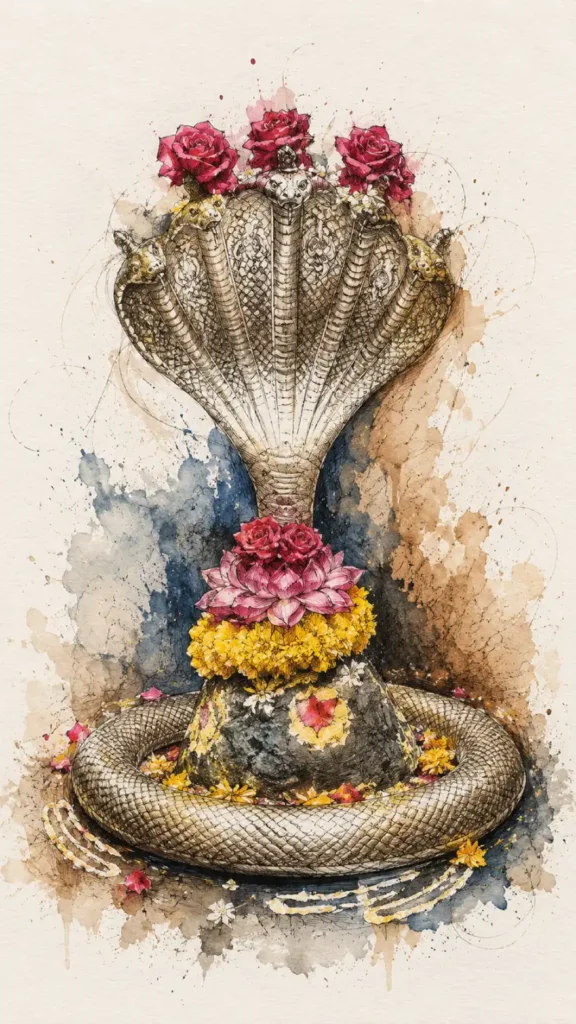
The central form of Omkareshwar is the Shiva Linga.
The official temple tradition describes the Jyotirlinga as self-manifested, or swayambhu. (Shri Omkareshwar)
This is significant because the Linga is not presented merely as an artistic representation of Shiva. It is worshipped as the sacred presence of Shiva Himself.
The visual experience at Omkareshwar is therefore one of simplicity.
The Linga.
The sanctum.
The lamps.
Flowers.
Offerings.
The ancient stone architecture.
And beyond the temple, the Narmada flowing around the island.
In devotional art, artists may choose to represent Omkareshwar through the Linga itself or through a broader composition that combines Shiva with the Om symbol, Narmada River, temple architecture, and the island landscape.
Such broader compositions should be understood as artistic interpretations inspired by the sacred tradition, rather than as literal scriptural descriptions of the deity’s physical appearance.
The Symbols and Sacred Attributes of Omkareshwar
The most powerful symbol associated with Omkareshwar is undoubtedly ॐ.
The sacred syllable can represent the unity of existence, the sacred vibration of reality, and the movement from sound toward silence.
The Narmada River is another essential part of the visual identity of Omkareshwar. The temple stands within a landscape shaped by the river, making water an inseparable part of the pilgrimage experience.
The Mandhata Island provides perhaps the most distinctive geographical symbol. Its traditional association with the form of Om makes the entire island part of the devotional imagination. (Khandwa District)
Nandi, Shiva’s sacred bull, is another familiar feature of Shaiva temple imagery. Devotionally, Nandi can suggest patience, steadiness and unwavering attention toward Shiva.
The nearby Mamleshwar Temple is equally important within the sacred geography. The official temple website notes that devotees visit both Omkareshwar and Mamleshwar for darshan and worship. (Shri Omkareshwar)
Together, these symbols create an unusually rich artistic vocabulary.
The Spiritual Meaning of Omkareshwar
The deepest spiritual message of Omkareshwar is perhaps the unity of sound, consciousness, and the Divine.
The sacred syllable Om is not simply a decorative symbol.
It invites contemplation.
When chanted, Om begins with sound and gradually moves toward silence. That movement can become a metaphor for spiritual life itself: from the noise of the outer world toward inner stillness.
Omkareshwar therefore carries a beautiful lesson for a world that rarely becomes quiet.
The place reminds the devotee to listen.
To pause.
To breathe.
To remember.
The story of Vindhya also introduces another important teaching.
Power without humility can become dangerous.
Vindhya’s desire for greatness is transformed through devotion and divine intervention. The story can therefore be read as a reminder that spiritual strength should not become spiritual pride.
Omkareshwar combines devotion, humility, inner stillness, and surrender.
Why Devotees Are Drawn to Omkareshwar
Devotees traditionally visit Omkareshwar for darshan of Shiva, worship at the Jyotirlinga, and participation in the sacred traditions of the Narmada pilgrimage.
Many also undertake Omkar Parvat Parikrama, circumambulating the sacred island and its associated temples. The official temple website describes the parikrama route as approximately seven kilometres and notes the numerous religious and archaeological sites encountered along the way. (Shri Omkareshwar)
The relationship between Omkareshwar and the Narmada also gives the pilgrimage a special atmosphere.
There is something contemplative about walking beside a sacred river.
The movement of the water continues while the pilgrim moves slowly along the path.
That contrast — movement outside, stillness within — captures much of the spiritual appeal of Omkareshwar.
The official temple tradition also maintains Shayan Darshan, or the evening/night darshan associated with Shiva’s rest. This belongs to the living devotional tradition of the temple and contributes to the distinctive daily rhythm of worship at Omkareshwar. (Shri Omkareshwar)
Omkareshwar in Everyday Life
Modern life is filled with noise.
Messages arrive constantly.
Work follows people home.
Decisions compete for attention.
Even moments of rest can feel crowded.
Omkareshwar offers a different rhythm.
The sacred syllable Om can remind us that silence is not emptiness.
It can be fullness.
A person facing a difficult decision may need less noise and more clarity.
Someone beginning a new chapter may need patience rather than immediate answers.
A family may need a shared spiritual symbol that brings everyone back to a sense of belonging.
For someone living far from India, the image of Omkareshwar can also become a connection to the Narmada River, to Shiva, and to an ancient pilgrimage tradition.
The lesson is beautifully simple:
Not every answer has to be found by speaking. Some are discovered by becoming quiet enough to listen.
Famous Temple Associated With Omkareshwar
The principal sacred site is Shri Omkareshwar Jyotirlinga Temple, located on Mandhata Island in the Narmada River.
Temple: Shri Omkareshwar Jyotirlinga Temple
Town: Omkareshwar / Mandhata
District: Khandwa
State: Madhya Pradesh, India
Public Address: Shri Omkareshwar Mandir Trust, Omkareshwar, Tehsil Punasa, District Khandwa, Madhya Pradesh – 450554. (Shri Omkareshwar)
The temple is famous as one of the twelve Jyotirlingas of Shiva and for its extraordinary setting on the Narmada. The Khandwa district administration describes the island as resembling the sacred ॐ form and identifies both Omkareshwar and nearby Mamleshwar as major Shiva pilgrimage sites. (Khandwa District)
The temple is also part of the wider sacred environment of Mandhata, where pilgrims encounter ancient shrines, ghats, and the Omkar Parvat pilgrimage route.
For official temple information and current pilgrimage services, the Shri Omkareshwar Jyotirlinga official website is the appropriate reference.
For broader destination and heritage information, the Khandwa District Government’s Omkareshwar page provides official local information.
Why Omkareshwar Makes Meaningful Sacred Art
Omkareshwar may be one of the most naturally artistic of the Jyotirlinga traditions.
The reason is simple:
The sacred symbol and the sacred landscape belong together.
A meaningful Omkareshwar artwork could place the Shiva Linga at the centre, surrounded by the flowing Narmada and the curved visual language of Om.
Another composition could show the temple rising above the river, with lamps glowing against the evening sky.
A more contemplative artwork might use the ॐ symbol as a subtle visual element behind Shiva, allowing the composition to express the connection between sacred sound and divine presence.
This makes Omkareshwar especially suited to premium framed artwork, canvas wall art, and home-temple decor.
For a meditation space, a quieter composition may be particularly appropriate.
For a living room, a sophisticated landscape-inspired interpretation can combine Indian spiritual symbolism with elegant interior aesthetics.
For NRI families and international collectors, Omkareshwar artwork can also become a visual connection to India’s sacred geography.
The artwork does not need to promise a supernatural result.
Its value can be found in what it evokes.
A memory.
A prayer.
A sense of stillness.
A connection with Shiva.
Omkareshwar, Sacred Space and Home Placement
There is no universally binding Vastu rule specifically prescribed for Omkareshwar artwork.
According to commonly followed Vastu traditions, devotional images are generally placed in clean, peaceful, and respectfully maintained areas, especially a home temple, prayer room or meditation space.
An Omkareshwar artwork can therefore be especially natural in a dedicated spiritual corner.
Because the symbolism of Om is associated with contemplation and inner stillness, a carefully composed artwork can also suit a meditation space.
If placed in a living room or workspace, it can function simply as a visual reminder of calmness and spiritual grounding.
The important principle is respect.
Sacred art should be treated as sacred imagery rather than merely as an ornamental object.
The Emotional Power of Omkareshwar Sacred Art
A sacred artwork becomes meaningful when it gives the viewer something to return to.
An Omkareshwar painting can become that quiet point.
Perhaps someone sees the Narmada and remembers a pilgrimage.
Perhaps the Om symbol reminds them of morning prayer.
Perhaps the image of Shiva becomes a reminder to slow down after a demanding day.
For a family, it can become part of the visual language of a home temple.
For someone living overseas, it can preserve a connection with a sacred place they may have visited only once — or hope to visit one day.
This is why ShaktiShraddha’s approach to sacred art can be especially meaningful here.
The goal is not simply to reproduce an image of a temple.
It is to translate spiritual meaning into visual beauty.
The Timeless Presence of Omkareshwar
There is something profoundly fitting about Shiva being worshipped here as Omkareshwar.
The river keeps moving.
The seasons keep changing.
Pilgrims come and go.
Temple bells rise into the air and fade into silence.
Yet the sacred presence remains.
Omkareshwar reminds us that the Divine can be encountered not only in dramatic moments, but in sound, silence, water, landscape and stillness.
The stories of Vindhya and Mandhata both point toward devotion.
The Om symbol points toward the deeper unity of existence.
The Narmada reminds us of continuous movement.
And Shiva brings these elements together in one sacred landscape.
For ShaktiShraddha, this makes Omkareshwar more than a subject for a painting.
It becomes an invitation to create art around one of Hindu India’s most beautiful spiritual ideas: the sacred sound of Om, the flowing grace of the Narmada, and the eternal presence of Shiva.
A carefully created Omkareshwar artwork can bring that meaning into a home — not as a promise of worldly miracles, but as a beautiful visual reminder to pause, remember, and return inward. Sometimes, amid all the noise of life, the most meaningful thing we can bring into our surroundings is a symbol of silence.
FAQs
1. Where is Omkareshwar Jyotirlinga located?
Omkareshwar Jyotirlinga is located on Mandhata Island in the Narmada River, in Khandwa district of Madhya Pradesh, India. The island is traditionally associated with the sacred form of the Hindu symbol Om (ॐ), which gives Omkareshwar its distinctive spiritual identity. The main temple is dedicated to Lord Shiva as Omkareshwar, one of the twelve Jyotirlingas. The sacred Narmada River surrounding the island is also an important part of the pilgrimage experience.
2. How can I reach Omkareshwar from Indore Airport?
The nearest major airport is Devi Ahilyabai Holkar Airport in Indore (IDR). Omkareshwar is approximately 80 km from Indore. From Indore Airport, visitors can travel to Omkareshwar by private taxi, cab or other available road transportation. Bus services are also available from Indore toward Omkareshwar. For pilgrims arriving by air, travelling by road from Indore is generally the most practical option.
3. How can I reach Omkareshwar by train?
The nearest railway stations include Khandwa and Indore, depending on the route and train service being used. Khandwa is an important railway junction with connections to several major Indian cities. From Khandwa, visitors can continue to Omkareshwar by road. Another option is to travel by train to Indore and then continue by road to Omkareshwar.
4. What are the Omkareshwar Temple darshan timings?
Omkareshwar Temple follows a daily schedule of darshan and religious rituals. The temple opens early in the morning and worship continues through the day, with different aartis and ceremonies taking place at scheduled times. Timings may vary according to festivals, special occasions and temple arrangements. Devotees should check the latest information from the official temple administration before planning their visit.
5. What is the best time to visit Omkareshwar Jyotirlinga?
The cooler months from October to March are generally more comfortable for visiting Omkareshwar and exploring the surrounding pilgrimage sites. The temple and town can become particularly busy during Mahashivaratri, Shravan and other important Hindu festivals. These periods can provide a vibrant devotional atmosphere but may also involve larger crowds and longer queues. If you prefer a quieter pilgrimage experience, consider travelling outside major festival periods.
6. Can devotees perform Puja and Abhishek at Omkareshwar?
Yes. Various forms of Puja, Abhishek and other religious services are associated with Omkareshwar Temple. The availability, timings, booking procedures and rules for individual rituals can vary. Devotees planning a specific Puja or Abhishek should therefore check the latest information from the temple administration before travelling. It is advisable to use official temple channels for bookings rather than relying on unofficial agents.
7. What is the Omkareshwar Parikrama?
The Omkareshwar Parikrama, or circumambulation of the sacred Mandhata Island, is an important pilgrimage tradition. Devotees traditionally walk around the island while visiting temples, shrines and sacred places connected with the Narmada and Omkareshwar tradition. The exact route and the time required can vary depending on the route followed and the individual’s pace. Pilgrims undertaking the Parikrama should plan for suitable footwear, water, weather conditions and sufficient time.
8. What other temples and sacred places can I visit near Omkareshwar?
Omkareshwar has several important sacred sites that can be visited as part of the same pilgrimage. These include Mamleshwar Temple, located across the Narmada, as well as other temples and shrines around Mandhata Island. The Narmada River and the ghats are also integral to the spiritual landscape of Omkareshwar. Many pilgrims choose to visit both Omkareshwar and Mamleshwar during the same journey because of their close association within the local Shaiva tradition.
9. Is Omkareshwar suitable for a one-day pilgrimage?
Omkareshwar can be visited as a one-day pilgrimage from nearby cities such as Indore, particularly for travellers who are primarily interested in temple darshan. However, allowing more time can provide a more relaxed experience. A longer visit gives pilgrims an opportunity to explore the island, visit Mamleshwar and other temples, experience the Narmada ghats and, if desired, undertake part or all of the traditional Parikrama. Those travelling during major festivals should allow additional time because of increased crowds and traffic.
10. What should I know before visiting Omkareshwar Jyotirlinga?
Omkareshwar is a living pilgrimage centre situated within the sacred landscape of the Narmada River. Visitors should treat the temple and surrounding religious sites with appropriate respect and follow the current temple rules regarding darshan, photography, dress and entry. If you plan to perform a special Puja, Abhishek or other ritual, check the latest official information before travelling, as procedures and timings may change. It is also worth allowing time to experience the wider spiritual landscape of Mandhata Island rather than treating Omkareshwar simply as a temple visit.
For many devotees, the combination of the Jyotirlinga, the Narmada River, the sacred island and the tradition of Parikrama makes Omkareshwar a distinctive Shiva pilgrimage—one where the journey around the sacred landscape becomes part of the spiritual experience itself.