
Nageshwar Jyotirlinga
● Somnath ● Mallikarjuna ● Kashi Vishwanath ● Baidyanath ● Kedarnath ● Grishneshwar ●
● Rameshwaram ● Bhimashankar ● Mahakaleshwar ● Trimbakeshwar ● Nageshwar ● Omkareshwar ●
The Shiva of Fearless Devotion
There are moments when devotion is tested not in a peaceful temple, but in the middle of fear. The story of Nageshwar Jyotirlinga begins in such a moment. A devotee is imprisoned. Darkness surrounds him. The power of an asura appears overwhelming. Yet the devotee does not abandon Shiva. Instead, he remembers Him. That simple act of remembrance becomes the heart of the Nageshwar tradition: when outer circumstances become uncertain, inner devotion can remain steady.
Near the sacred city of Dwarka on Gujarat’s Saurashtra coast stands the Nageshwar Jyotirlinga, traditionally revered as one of the twelve great Jyotirlingas of Lord Shiva. The temple is situated on the route between Dwarka and Bet Dwarka and remains an important pilgrimage destination for Shiva devotees. But Nageshwar is more than a pilgrimage stop. Its story speaks about courage, faith, dharma, and the possibility of finding divine steadiness even when fear seems to have taken control.
Who Is Nageshwar Jyotirlinga?
Nageshwar, or Nageshvara, is a sacred manifestation of Lord Shiva worshipped as a Jyotirlinga. The word Jyotirlinga combines jyoti, meaning light or radiance, with linga, the sacred symbol of Shiva. Within Shaiva tradition, a Jyotirlinga represents Shiva’s radiant, transcendent presence. Nageshwar is traditionally connected with Darukavana, the forest associated with the ancient Nageshvara legend. The Gujarat shrine near Dwarka is widely revered as Nageshwar Jyotirlinga and is today an important part of the Dwarka pilgrimage circuit.
There is, however, an important point of traditional and historical nuance. The precise geographical identification of the ancient Darukavana described in the Puranic narrative has been debated, and other Indian shrines have also been associated with Nageshvara or Nagnath traditions. For devotees visiting Gujarat, Nageshwar near Dwarka remains a major and deeply established living tradition.
The Meaning of Nageshwar’s Name
Nageshwar is commonly understood as “Lord of the Nagas” or “Lord associated with serpents.” The naga has a powerful place in Shiva’s visual and spiritual vocabulary. Serpents appear around Shiva’s body, especially as symbols associated with mastery over fear, mortality, and the forces that can frighten the human mind. The name therefore evokes more than a literal association with snakes. It brings together the mysterious, the powerful, and the fearsome under the still presence of Shiva. Nageshwar can thus be contemplated as Shiva who remains steady in the presence of forces that ordinarily create fear.
The Story of Nageshwar Jyotirlinga
The principal Nageshwar legend is connected with Darukavana and the devotee Supriya.
According to the Puranic narrative, the forest became a place where powerful rakshasas caused suffering and disrupted the lives of others. Daruka and Daruka’s wife, Daruka/Daruka, are described in different retellings, with the story emphasizing the power obtained through devotion and the consequences of that power being misused. The Shiva Purana tradition connects Darukavana with the western ocean.
Among those caught in this turmoil was a Shiva devotee named Supriya.
He was imprisoned along with others.
The situation seemed hopeless. The captives were under the control of their captors, and ordinary resistance could not free them.
Yet Supriya did something profound.
He encouraged the prisoners to remember Shiva and repeat His sacred name. Instead of allowing fear to destroy their faith, he turned their attention towards devotion.
The prisoners began worshipping Shiva.
Their prayer became an act of inner resistance.
The story then reaches its divine turning point. Shiva manifested to protect His devotee and defeat the oppressive demonic power. The sacred linga established through Supriya’s devotion became associated with Nageshvara, and Shiva’s presence continued as the Jyotirlinga. The accompanying tradition also associates Goddess Parvati with the form of Nageshwari.
The deeper message is striking.
Supriya’s strength did not begin when Shiva appeared.
It began when fear failed to make him abandon his devotion.
That is what makes the Nageshwar story especially powerful. Divine intervention comes at the climax, but unwavering faith forms the emotional centre of the story.
The Divine Form of Nageshwar
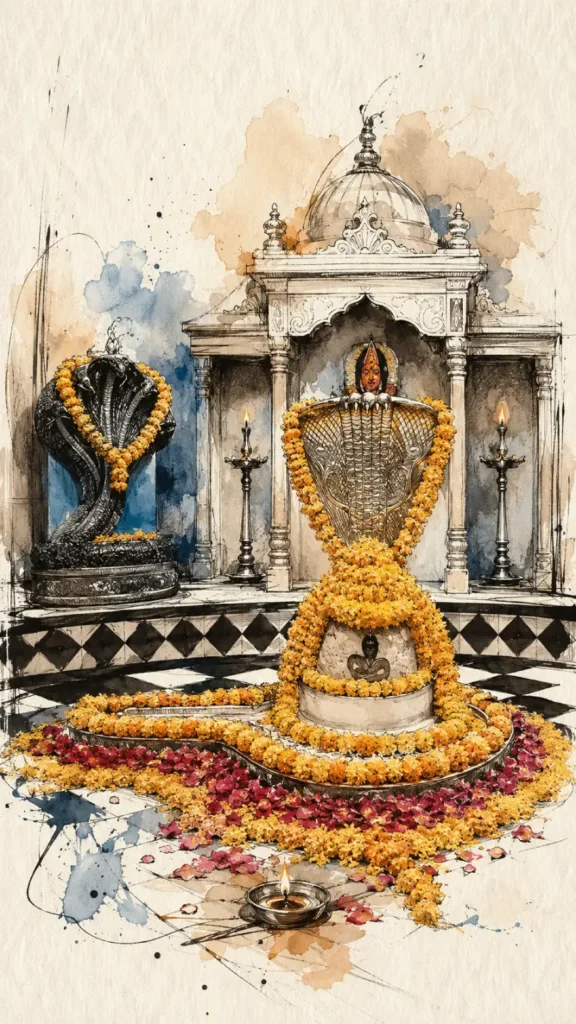
At the heart of Nageshwar worship is the Shiva Linga, rather than a conventional anthropomorphic image of Shiva.
This is important when imagining Nageshwar in sacred art.
A Shiva Linga does not simply function as a portrait. Within Hindu worship, it is a profound symbol of Shiva’s presence, transcendence, and the mysterious source of existence.
The Gujarat temple also has a prominent large seated image of Lord Shiva in meditation. The Government of Gujarat’s Devbhumi Dwarka district describes the statue as approximately 25 metres tall and notes the underground sanctum containing the Jyotirlinga.
Artists therefore have several visual directions available when portraying Nageshwar:
- Shiva in deep meditation
- the sacred Jyotirlinga within a temple setting
- Shiva accompanied by serpent symbolism
- the peaceful presence of Mahadeva against the imagery of the western coast
- a devotional composition inspired by Darukavana and the story of Supriya
These should be understood as artistic and traditional representations, not as a claim that every visual detail comes directly from scripture.
The Symbols and Attributes of Nageshwar
Serpent imagery naturally becomes important in the artistic language of Nageshwar.
The serpent around Shiva is not merely decorative. In Shaiva symbolism, Shiva’s relationship with the serpent can evoke mastery over fear, death and powerful primal forces.
The Shiva Linga expresses another dimension: the divine cannot always be reduced to a human-like form.
The meditative Shiva associated with the Nageshwar temple complex adds yet another layer. His stillness creates a striking contrast with the turmoil of the ancient legend.
For sacred artwork, this contrast is especially meaningful.
The story contains captivity, fear, and conflict.
The image can contain silence.
That transformation from turmoil to stillness is one of the most beautiful artistic possibilities within the Nageshwar tradition.
The Spiritual Meaning of Nageshwar
At its deepest level, Nageshwar speaks about steadfast devotion in the presence of fear.
Supriya’s story does not suggest that devotion means the absence of difficulty. Instead, it presents devotion as the ability to remember one’s spiritual centre even during difficulty.
Nageshwar can therefore be contemplated through several connected ideas:
Courage: Fear does not have to determine one’s actions.
Faith: Spiritual remembrance can remain alive even when circumstances appear unfavourable.
Dharma: Power without restraint can become destructive, while divine consciousness restores balance.
Inner strength: The strongest response to uncertainty is not always external force. Sometimes it is steadiness.
Divine presence: Shiva is remembered as present not only in moments of celebration, but also when a devotee feels surrounded by darkness.
This is why Nageshwar can hold such emotional significance for devotees.
It does not merely tell a story about an ancient demon.
It tells a story about what happens when devotion refuses to disappear.
Why Devotees Are Drawn to Nageshwar
Many devotees are drawn to Nageshwar because its tradition combines the immense spiritual symbolism of Shiva with a deeply human story of fear, imprisonment, and faith.
Worshippers traditionally seek Shiva’s grace, guidance, and spiritual strength.
The story particularly resonates with those who value the idea of remaining inwardly grounded during difficult circumstances.
It is important, however, not to reduce Nageshwar worship to promises of guaranteed protection, wealth, health, or removal of every difficulty. Such claims go beyond what responsible devotional writing should promise.
The real strength of the tradition lies in its spiritual message.
Remember Shiva.
Remain steady.
Walk towards dharma.
Nageshwar in Everyday Life
Modern life can look very different from the world of Darukavana, yet the emotional questions remain surprisingly familiar.
A person may be dealing with uncertainty about a career.
Another may be carrying family responsibilities.
Someone may be beginning a new chapter and wondering whether the decision is right.
Another person may simply feel mentally overwhelmed.
The Nageshwar story offers a quiet reminder: fear does not have to become the ruler of the mind.
Supriya could not immediately change his external situation. What he could change was how he responded to it.
This makes Nageshwar meaningful beyond pilgrimage.
A small moment of prayer before beginning the day, a quiet remembrance of Shiva during a difficult decision, or a sacred image placed in a meditation space can become a visual reminder of inner steadiness.
The value is not in treating an object as magical.
It is in allowing a sacred symbol to continually bring the mind back to a spiritual ideal.
Famous Temple Associated With Nageshwar
Nageshwar Jyotirlinga Temple, Dwarka, Gujarat
The principal sacred place associated with the subject of this article is Nageshwar Jyotirlinga Temple, located near Dwarka in Gujarat.
City/Town: Dwarka
State: Gujarat
Area: Daarukavanam, near the Dwarka–Bet Dwarka route
Public address: Daarukavanam, Dwarka, Gujarat 361335.
The Government of Gujarat’s Devbhumi Dwarka district identifies Nageshwar as an important Shiva temple on the route between Dwarka city and Bet Dwarka and describes the Jyotirlinga as being housed in an underground sanctum.
Government of Gujarat — Nageshwar Temple information
Official Nageshwar Jyotirlinga Temple
The temple is particularly significant because it forms part of the wider sacred landscape of Dwarka. Pilgrims visiting the Krishna tradition of Dwarka often include Nageshwar in their journey, creating a beautiful meeting point between Vaishnava and Shaiva sacred geography.
The temple complex is also visually distinctive because of its large seated Shiva statue and peaceful surroundings.
Why Nageshwar Makes Meaningful Sacred Art
Nageshwar has an unusual artistic quality.
Its story is dramatic, but its central image is deeply peaceful.
That contrast makes it especially suitable for devotional artwork.
A carefully created Nageshwar painting can bring together Shiva’s meditative presence, serpent symbolism, the sacred Linga, and the atmosphere of ancient Darukavana.
For a spacious living room or meditation area, a large Nageshwar canvas artwork can create a strong spiritual focal point without needing excessive decoration.
A detailed framed composition may be especially suited to a home temple or prayer room, where the artwork can function as a visual reminder of devotion.
For devotees living outside India, Nageshwar artwork can also carry another meaning: a connection to India’s sacred geography and the living traditions of Hindu pilgrimage.
This is where sacred art becomes more than interior decoration.
It can preserve memory.
It can express identity.
It can remind a family of stories and values that may otherwise remain distant from everyday life.
Nageshwar Art for a Contemporary Home
According to commonly followed devotional and Vastu traditions, sacred images are often given a respectful place in a home temple, prayer room, or meditation space.
For a Nageshwar artwork, a clean and peaceful setting is naturally appropriate. A dedicated prayer area allows the image to remain connected to its devotional purpose, while a living room can work when the artwork is treated with the same respect given to other sacred representations.
Rather than thinking of placement as a promise of automatic Vastu benefits, it is better to consider the artwork’s atmosphere.
Does the image create a sense of calm?
Does it remind you of devotion?
Does it encourage reflection?
Those questions often matter more than turning sacred art into a formula.
Bringing the Spirit of Nageshwar Into Sacred Art
The most compelling Nageshwar artwork does not need to be visually crowded.
A calm Shiva.
A dignified Jyotirlinga.
Subtle serpent symbolism.
A sense of ancient forest.
Perhaps the suggestion of the western sea.
These elements can create an artwork that feels both traditionally rooted and contemporary.
For ShaktiShraddha, Nageshwar offers a particularly meaningful artistic direction because the subject carries a complete emotional journey: fear, devotion, divine intervention, and finally stillness.
A premium framed artwork or carefully finished canvas can therefore become a visual expression of that journey.
It does not promise supernatural results.
Instead, it gives the viewer something more enduring: a daily reminder of the spiritual meaning behind the image.
Nageshwar — The Light That Remains Steady
The story of Nageshwar begins in darkness. Yet darkness is not where it ends. A devotee remembers Shiva. Others join him. Faith becomes stronger than fear. Shiva manifests, dharma is restored, and the sacred presence remains. That is why Nageshwar continues to speak to the modern heart. Life does not always become peaceful simply because we pray. But prayer can change the way we stand within life’s uncertainty. Nageshwar reminds us to remain anchored when circumstances become difficult, to choose courage over fear and to keep returning to the still centre within.
For ShaktiShraddha, that meaning naturally extends into sacred art. A Nageshwar artwork can bring the serene presence of Shiva into a home, prayer room, meditation space, or collection of Indian spiritual art—not as a guarantee of miracles, but as a beautiful visual reminder of faith, steadiness, and divine consciousness. And perhaps that is the greatest beauty of Nageshwar:
The world around us may change, but the light of devotion can remain steady.
FAQs
1. What is Nageshwar Jyotirlinga?
Nageshwar Jyotirlinga is a sacred manifestation of Lord Shiva traditionally counted among the twelve Jyotirlingas. The famous Nageshwar shrine near Dwarka in Gujarat is an important centre of Shiva worship.
2. What does Nageshwar mean?
Nageshwar is commonly understood as “Lord of the Nagas” or “Lord associated with serpents,” reflecting an important aspect of Shiva’s traditional symbolism.
3. What is the story of Nageshwar Jyotirlinga?
The principal legend describes the Shiva devotee Supriya being imprisoned by the demon Daruk. Supriya encouraged the prisoners to remember Shiva, after which Shiva manifested, defeated the oppressive force, and became associated with Nageshvara Jyotirlinga.
4. Which scripture is associated with Nageshwar Jyotirlinga?
The Nageshvara legend is associated particularly with the Shiva Purana, including its account of Darukavana, Daruk, and Supriya.
5. Where is Nageshwar Jyotirlinga located?
The Nageshwar Jyotirlinga temple associated with the Dwarka tradition is located in Daarukavanam near Dwarka, Gujarat, on the route towards Bet Dwarka.
6. What does Nageshwar symbolize?
Nageshwar is especially meaningful as a symbol of steadfast devotion, courage in the presence of fear, divine remembrance, and the restoration of dharma.
7. Is Nageshwar artwork suitable for a home temple?
Yes. A respectful depiction of Nageshwar can be placed in a home temple or prayer space as devotional art. The artwork should be treated as a sacred representation rather than as an object guaranteed to produce supernatural or Vastu results.
8. Why is Nageshwar meaningful as devotional art?
The combination of meditative Shiva, Jyotirlinga symbolism, serpent imagery, and the story of Supriya gives Nageshwar strong visual and spiritual depth, making it well suited to framed artwork, canvas, and other devotional art formats.
9. How can I reach Nageshwar Jyotirlinga from the airport?
Nageshwar Jyotirlinga is located near Dwarka in Gujarat. The nearest airports serving the Dwarka region are Porbandar Airport and Jamnagar Airport. From either airport, pilgrims can continue by road to Dwarka and then travel approximately 16–18 km to Nageshwar Temple. Gujarat Tourism lists Porbandar and Jamnagar as the closest airport options.
10. How can I reach Nageshwar Jyotirlinga from the railway station?
The nearest convenient railway station is Dwarka Railway Station (DWK). According to the District Devbhumi Dwarka administration, Nageshwar Temple is approximately 16 km from Dwarka Railway Station. From the station, pilgrims can reach the temple by taxi, auto-rickshaw, or other local road transport.
11. What other important temples and sacred places can I visit near Nageshwar Jyotirlinga?
Several important temples and sacred places around Dwarka can be visited along with Nageshwar Jyotirlinga:
- Dwarkadhish Temple (Jagat Mandir) — Dwarka, Devbhumi Dwarka District, Gujarat – 361335. Dedicated to Lord Krishna, this temple is one of the most important pilgrimage sites in the region.
- Rukmini Devi Temple — Rukmini Temple Road, Dwarka, Devbhumi Dwarka District, Gujarat – 361335. Dedicated to Goddess Rukmini, the temple is located approximately 2 km from Dwarka city.
- Beyt Dwarka — Beyt Dwarka, Okha, Devbhumi Dwarka District, Gujarat – 361350. This island pilgrimage destination is traditionally associated with Lord Krishna and contains several important temples.
- Gomti Ghat — Gomti Ghat, Dwarka, Devbhumi Dwarka District, Gujarat – 361335. Located near Dwarkadhish Temple, this sacred ghat is associated with the meeting of the Gomti River and the Arabian Sea.
- Gopi Talav — Gopi Talav, Dwarka–Nageshwar Road, Devbhumi, Dwarka District, Gujarat – 361335. This sacred lake is associated with traditional legends of Lord Krishna and the Gopis.
These sites make the Dwarka–Nageshwar pilgrimage circuit particularly significant, combining the worship of Lord Shiva at Nageshwar with the sacred traditions associated with Lord Krishna and Dwarka.