
Bhimashankar Jyotirlinga
● Somnath ● Mallikarjuna ● Kashi Vishwanath ● Baidyanath ● Kedarnath ● Grishneshwar ●
● Rameshwaram ● Bhimashankar ● Mahakaleshwar ● Trimbakeshwar ● Nageshwar ● Omkareshwar ●
Where Shiva Emerges from the Heart of the Sahyadris
What happens when immense power forgets humility?
The story of Bhimashankar begins with that question.
Deep among the green Sahyadri hills of Maharashtra, where forests surround an ancient Shiva shrine, Hindu tradition remembers a fierce battle between uncontrolled power and divine righteousness. At the centre of that story stands Lord Shiva — not merely as a distant destroyer, but as the Divine who appears when sincere devotion is threatened.
Today, Bhimashankar Jyotirlinga is revered as one of the twelve Jyotirlingas of Lord Shiva and one of the three traditionally recognised Jyotirlinga shrines of Maharashtra. The temple stands in the Bhimashankar region of Pune district, within the dramatic landscape of the Sahyadri hills. The surrounding area is also known for the Bhimashankar Wildlife Sanctuary and its rich biodiversity. This combination makes Bhimashankar visually exceptional. Here, sacred architecture and wild forest do not feel separate. The temple belongs to the landscape, and the landscape becomes part of the spiritual experience.
Who Is Bhimashankar Jyotirlinga?
Bhimashankar is a sacred manifestation of Lord Shiva, worshipped as one of the twelve Jyotirlingas. A Jyotirlinga is traditionally understood as a radiant manifestation of Shiva’s infinite presence. The Sanskrit word jyoti means light or radiance, while linga refers to the sacred sign or form through which Shiva is worshipped. Bhimashankar is traditionally identified with the sixth Jyotirlinga in the commonly recited sequence of the twelve sacred shrines. Maharashtra Tourism also identifies Bhimashankar as one of the twelve Jyotirlingas and places the temple in the Sahyadri region near Pune. The shrine is especially meaningful because its identity brings together three elements: Shiva, the sacred forest, and the Bhima River.
The Bhima River is traditionally associated with the sacred geography of Bhimashankar, and the surrounding forest has helped preserve a distinctive atmosphere of solitude and natural beauty. For a devotee, Bhimashankar is therefore not simply a temple to visit. It is a sacred environment in which the presence of Shiva is experienced alongside mountains, water, and living nature.
The Meaning of Bhimashankar’s Name
The name Bhimashankar is traditionally connected with Bhima and Shankara. Shankara is one of the revered names of Lord Shiva and is commonly understood as “the auspicious one” or “the one who brings well-being.” Bhima can mean formidable, mighty, or terrible. In the Bhimashankar legend, however, the name is also closely associated with the powerful demon Bhima, whose actions lead to Shiva’s manifestation at the sacred site. The name therefore carries a striking contrast. There is the destructive force of Bhima, and there is the transforming presence of Shankara. The sacred story ultimately places uncontrolled strength before divine consciousness.
The Story of Bhimashankar Jyotirlinga
The principal legend associated with Bhimashankar is preserved in the Shiva Purana tradition, particularly in the Koti-Rudra Samhita. The story begins with Bhima, who is traditionally described as the son of Kumbhakarna, the mighty brother of Ravana. After learning about his father’s death during the events of the Ramayana, Bhima became consumed by anger and revenge. He performed severe austerities to please Lord Brahma and eventually received extraordinary power. But power without self-control became the source of his downfall. Bhima began to oppress gods, kings, and ordinary beings. His strength made him arrogant, and he demanded submission rather than devotion. Among those who suffered was a righteous king traditionally known as Kamarupeshvara or Sudakshina, depending on the retelling.
The king was devoted to Lord Shiva. Even after being imprisoned, he did not abandon his worship. Inside captivity, he continued to remember Shiva and fashioned a Shiva Linga from earth. His circumstances had changed, but his devotion had not. This becomes the emotional centre of the story. Bhima could control the king’s surroundings. He could take away his freedom. But he could not take away his faith.
When Bhima discovered the king’s continued worship, he became enraged. He moved to destroy the sacred Linga. At that moment, Shiva manifested. The Divine appeared to protect the devotee and confront the force that had become intoxicated with its own power. A fierce battle followed between Shiva and Bhima. Eventually, Shiva destroyed the demon and ended his tyranny. The gods and devotees then prayed that Shiva remain present at that sacred place. Shiva accepted. He manifested there as Bhimashankar Jyotirlinga.
The story carries a timeless spiritual message: outer power becomes destructive when it is separated from dharma, while sincere devotion can remain strong even when everything else is taken away. The Bhimashankar tradition is also associated with another sacred narrative involving Tripurasura, preserved in regional devotional traditions. Rather than treating every version as identical, it is more responsible to recognise the Bhima narrative as the principal story associated with the Jyotirlinga while acknowledging the wider regional traditions surrounding the shrine.
The Divine Form of Bhimashankar
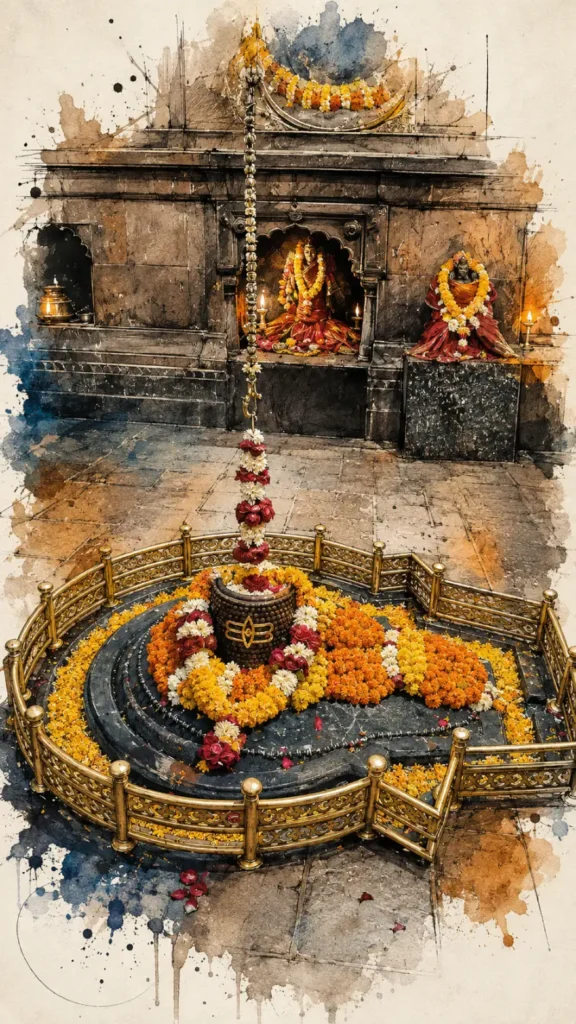
At the heart of Bhimashankar is the Shiva Linga, the sacred form through which Lord Shiva is worshipped. Unlike an anthropomorphic image of Shiva with a visible face, arms, and weapons, the Linga expresses Shiva through a symbolic and non-anthropomorphic form. This makes Bhimashankar particularly powerful as sacred art. The artist does not need to portray Shiva as a warrior. The Linga itself communicates presence. Devotional representations may place the sacred form within the ancient temple sanctum, surrounded by flowers, bilva leaves, lamps, and other traditional offerings.
Artists may also portray the temple exterior, Nandi, forested Sahyadri hills, and the flowing Bhima River. These surrounding elements are artistic and devotional interpretations rather than a fixed scriptural requirement. The beauty of Bhimashankar artwork lies precisely in this freedom. The central Shiva Linga can remain visually simple while the surrounding landscape tells the larger story.
The Symbols and Sacred Landscape of Bhimashankar
The Shiva Linga
The Linga is the central sacred symbol of Shiva. At Bhimashankar, it represents the divine presence at the heart of the Jyotirlinga tradition.
The Sahyadri Hills
The mountains and forests surrounding the shrine create an atmosphere of solitude. They can symbolise withdrawal from distraction and movement toward inner awareness.
The Bhima River
The Bhima is deeply connected with the sacred identity of the region. In devotional imagination, water flowing from the presence of Shiva represents the continuation of divine grace through the landscape.
Nandi
Nandi, Shiva’s sacred bull and devoted attendant, is traditionally placed before Shiva temples. His stillness and attentive posture naturally express devotion, patience, and surrender.
The Temple Architecture
Maharashtra Tourism describes the Bhimashankar temple as having Nagara-style architecture, with later additions and renovations contributing to the structure visible today. The temple’s stone craftsmanship forms an important part of its visual identity. Together, these elements make Bhimashankar more than a single religious symbol. It becomes a complete sacred composition.
The Spiritual Meaning of Bhimashankar
The deepest teaching of Bhimashankar is the transformation of power through devotion and dharma. Bhima had strength, but he lacked restraint. The imprisoned king had almost nothing, yet he possessed unwavering faith. The story therefore reverses the ordinary idea of power. The strongest person is not necessarily the one who can dominate others. True strength can mean remaining faithful when circumstances become difficult. This is one reason Bhimashankar continues to speak to modern devotees. People today also encounter different forms of power. Career success can become pride; ambition can become obsession.
Authority can become control. Fear can become anger. Even personal achievement can sometimes make a person forget humility. The Bhimashankar story quietly asks us to examine how we use whatever strength we have been given.
Is our strength protecting something meaningful, or merely proving that we are strong?
That question gives this Jyotirlinga an enduring spiritual relevance.
Why Devotees Are Drawn to Bhimashankar
Devotees traditionally visit Bhimashankar to seek darshan of Lord Shiva, offer prayers, and experience the sacred atmosphere of one of the Jyotirlingas. Many are drawn by the Shiva Purana tradition and the story of Bhima. Others are deeply attracted to the forest setting, the Sahyadri hills, and the association with the Bhima River. Maha Shivaratri and the month of Shravan are particularly important periods in the devotional life of the temple, bringing large numbers of worshippers. But perhaps the strongest attraction is simpler. Bhimashankar offers devotees the chance to step away from ordinary surroundings and enter a place where devotion, nature, and Shiva worship exist together.
Bhimashankar in Everyday Life
Modern life can create a strange kind of strength.
We become good at carrying responsibilities.
We learn to solve problems.
We learn to compete.
We learn to keep going.
But sometimes we forget to ask whether we are becoming peaceful while becoming successful.
Bhimashankar offers another idea of strength.
The story of Bhima reminds us that power without discipline can destroy.
The king’s devotion reminds us that faith can survive difficult circumstances.
And Shiva’s manifestation reminds us that righteousness does not have to announce itself loudly.
For someone facing career pressure, family responsibility, uncertainty, or a difficult personal decision, Bhimashankar can become a reminder to use strength with humility.
Not every battle needs anger.
Not every difficulty needs control.
Sometimes the greater strength is to remain steady.
Famous Temple Associated With Bhimashankar Jyotirlinga
Shri Bhimashankar Jyotirlinga Temple
Temple: Shri Bhimashankar Temple
Deity: Lord Shiva as Bhimashankar Jyotirlinga
Village: Bhimashankar / Bhorgiri region
Taluka: Khed
District: Pune
State: Maharashtra, India
Complete public address:
Shri Kshetra Bhimashankar, Via Dimbhe Colony, Taluka Khed, District Pune, Maharashtra – 410509, India.
The temple is famous as one of the twelve Jyotirlingas of Lord Shiva and for its location among the Sahyadri hills. The surrounding Bhimashankar Wildlife Sanctuary adds a rare ecological dimension to the pilgrimage landscape. Maharashtra Tourism notes the area’s biodiversity, including the Malabar giant squirrel, locally known as Shekru. The temple is particularly significant for devotees of Shiva, pilgrims visiting the Jyotirlingas of Maharashtra, and those who wish to experience the meeting of sacred architecture and the Western Ghats landscape. For official tourism information about the temple, heritage, surroundings, and access, visitors can consult the Government of Maharashtra’s tourism page.
Maharashtra Tourism — Bhimashankar Temple
Why Bhimashankar Makes Meaningful Sacred Art
Some sacred places are visually beautiful. Bhimashankar is visually story-rich. An artwork can show the Shiva Linga at the centre, the stone temple rising behind it, Nandi in quiet devotion, and the Sahyadri forests surrounding the shrine. The composition can become even more powerful when the atmosphere is allowed to remain natural — deep greens, stone textures, mist, flowing water, and the quiet presence of Shiva. This makes Bhimashankar wall art especially suitable for devotees who want something more than a conventional portrait of Shiva.
A premium Bhimashankar canvas can bring the sacred landscape into a larger living space.
A refined framed artwork can work beautifully in a home temple, meditation corner, or prayer room.
For Indian families living abroad, a Bhimashankar painting can also become a visual connection with Maharashtra, the Jyotirlinga tradition, and the sacred geography of the Sahyadri hills.
The artwork need not promise miracles. Its purpose can be much more meaningful. It can remind someone of devotion when life becomes demanding. It can represent dharma’s victory over uncontrolled power. It can bring the visual atmosphere of a sacred pilgrimage into a contemporary home, and it can preserve a connection with India’s spiritual and artistic heritage.
Bhimashankar Art for the Home
According to commonly followed Vastu traditions, devotional artwork is naturally suited to spaces dedicated to prayer, meditation, or spiritual reflection.
A Bhimashankar artwork can therefore find a natural place in a home temple, puja room, or meditation space.
It may also be displayed in a calm section of a living room or personal reading area, particularly when the artwork is treated as sacred-inspired art rather than merely decorative imagery.
There is no need to claim that a particular direction guarantees prosperity, health, or protection.
The more enduring principle is respectful placement and devotional intention.
A sacred image becomes meaningful when it reminds us to live the values represented by the Divine.
The ShaktiShraddha Vision of Bhimashankar
Bhimashankar has a visual language unlike many other Jyotirlingas.
It does not depend only on the grandeur of a monumental temple.
Its strength comes from contrast.
A small sacred shrine within an immense forest.
A still Shiva Linga beside flowing water.
The quiet Sahyadris surrounding a story of tremendous divine power.
The humility of a devotee standing against the arrogance of a demon.
These contrasts offer extraordinary possibilities for sacred art.
A ShaktiShraddha interpretation of Bhimashankar Jyotirlinga can therefore go beyond simply reproducing a temple photograph.
It can tell the story through atmosphere.
The stone temple can represent permanence.
The forest can represent mystery.
The river can represent movement.
Nandi can represent devotion.
And Shiva at the centre can represent the stillness that remains when uncontrolled desire and fear have been overcome.
This is why a carefully created Bhimashankar canvas or framed devotional artwork can become more than an attractive piece of Indian spiritual decor.
It can become a visual reminder of a principle worth carrying into everyday life:
Strength becomes sacred when it is guided by dharma.
Bhimashankar teaches that power is not the ability to control everything around us.
Sometimes, true power is the ability to remain devoted, humble, and steady.
That is the feeling ShaktiShraddha sacred art can bring into a home — not a promise of supernatural results, but a beautiful and enduring reminder of Shiva, devotion, and the inner strength to walk one’s path with grace.
FAQs
1. What is Bhimashankar Jyotirlinga?
Bhimashankar Jyotirlinga is one of the twelve revered Jyotirlingas of Lord Shiva. It is located in the Sahyadri hills of Pune district, Maharashtra.
2. What does Bhimashankar mean?
Bhimashankar combines the name Bhima, associated with the principal legend of the shrine, with Shankara, a revered name of Lord Shiva.
3. What is the story of Bhimashankar Jyotirlinga?
The Shiva Purana tradition tells of the powerful demon Bhima, who oppressed a devotee of Shiva. When Bhima attempted to destroy the devotee’s Shiva Linga, Lord Shiva manifested and defeated him. Shiva then remained at the sacred place as Bhimashankar.
4. Which scripture is associated with the Bhimashankar story?
The principal Bhimashankar legend is associated with the Shiva Purana, particularly the Koti-Rudra Samhita tradition. Regional traditions also preserve additional stories connected with the shrine.
5. Where is Bhimashankar Temple located?
Bhimashankar Temple is in Khed taluka of Pune district, Maharashtra, in the Sahyadri hills. Its public address is Shri Kshetra Bhimashankar, Via Dimbhe Colony, Taluka Khed, District Pune, Maharashtra – 410509.
6. What river is associated with Bhimashankar?
The Bhima River is traditionally associated with Bhimashankar and its sacred geography. The river eventually joins the Krishna River system.
7. Is Bhimashankar suitable for a home temple?
Yes. A respectful Bhimashankar devotional artwork can be naturally placed in a home temple, puja room, or meditation space. It can serve as a visual reminder of Shiva and the values associated with the Jyotirlinga tradition.
8. What does Bhimashankar represent in devotional art?
Bhimashankar can represent Shiva’s divine strength, protection of sincere devotion, humility, dharma, and the transformation of uncontrolled power into spiritual awareness.
9. How can I reach Bhimashankar Temple from the airport?
The nearest major airport is Pune International Airport, approximately 120–125 km from Bhimashankar Temple. From the airport, pilgrims can hire a taxi, bus, or private vehicle towards Bhimashankar. The road journey passes through the scenic Sahyadri region.
10. How can I reach Bhimashankar Temple from the railway station?
Pune Railway Station is the most convenient major railway station for pilgrims travelling to Bhimashankar, approximately 120–125 km from the temple. From Pune, visitors can continue by state transport bus, taxi, or private vehicle to Bhimashankar. Maharashtra Tourism also lists Karjat as a railway option, although Pune is the more useful major railhead for long-distance travellers.
11. What other important temples and sacred places can I visit near Bhimashankar?
Several important temples and sacred places can be visited along with Bhimashankar Jyotirlinga:
- Gupt Bhimashankar — Bhimashankar, Khed Taluka, Pune District, Maharashtra – 410509. Located in the forested area near the main temple, Gupt Bhimashankar is traditionally associated with a sacred manifestation of Lord Shiva. Maharashtra Tourism places it approximately 1.5 km from the main temple.
- Bhimashankar Temple — Bhimashankar, Bhorgiri, Khed Taluka, Pune District, Maharashtra – 410509. The principal shrine houses the Bhimashankar Jyotirlinga and is situated in the Sahyadri hills.
- Hanuman Lake — Bhimashankar, Khed Taluka, Pune District, Maharashtra – 410509. A peaceful natural destination surrounded by the forested landscape of the Bhimashankar region.
- Nagphani Point (Snake’s Hood) — Bhimashankar, Khed Taluka, Pune District, Maharashtra – 410509. A popular viewpoint in the Sahyadri hills, offering panoramic views of the surrounding landscape.
- Bhorgiri Fort — Bhorgiri, Khed Taluka, Pune District, Maharashtra – 410509. An ancient hill fort located near Bhimashankar and an interesting destination for visitors exploring the area’s historical heritage.
- Bhimashankar Wildlife Sanctuary — Bhimashankar, Khed Taluka, Pune District, Maharashtra – 410509. The sanctuary surrounds the temple region and is known for its rich biodiversity, forests, and the Indian Giant Squirrel (Shekru).
These places make a visit to Bhimashankar more than a temple pilgrimage, combining the spiritual significance of the Jyotirlinga with the forests, hills, wildlife, and natural beauty of the Sahyadri region.