
Mahakaleshwar Jyotirlinga
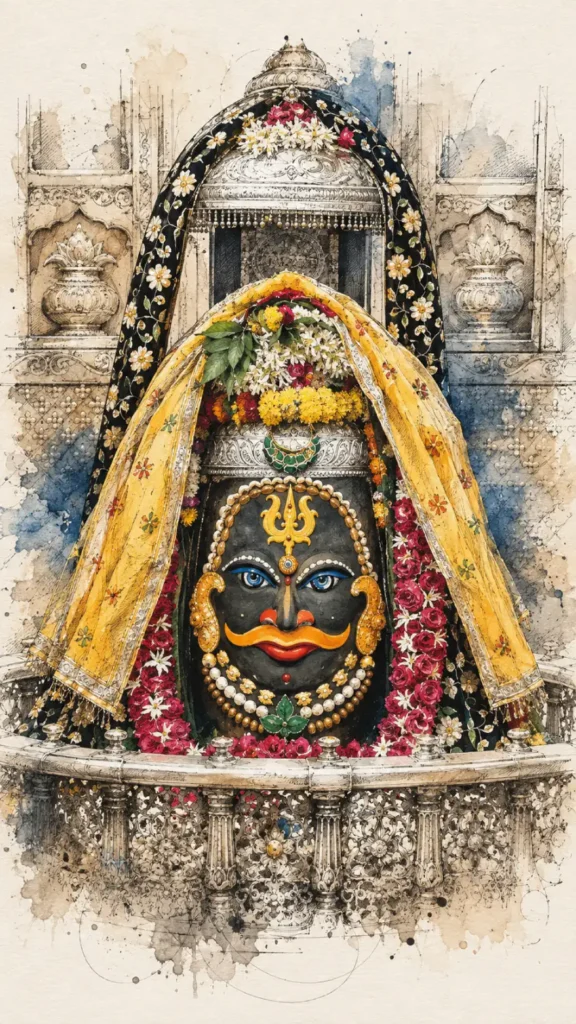
● Somnath ● Mallikarjuna ● Kashi Vishwanath ● Baidyanath ● Kedarnath ● Grishneshwar ●
● Rameshwaram ● Bhimashankar ● Mahakaleshwar ● Trimbakeshwar ● Nageshwar ● Omkareshwar ●
Shiva Beyond the Fear of Time
Kings rise and disappear. Cities grow, transform, and become memories. Youth becomes age, seasons pass, and every moment moves quietly toward another. Yet in the ancient city of Ujjain, devotees have worshipped a form of Shiva whose very name speaks of something beyond the ordinary flow of time.
Mahakaleshwar — Mahakal, the Great Lord of Time.
Here, Shiva is worshipped as one of the twelve Jyotirlingas of India. The sacred shrine stands in Ujjain, a city traditionally known as Ujjayini and Avanti, and long associated with pilgrimage, learning, astronomy, and spiritual culture.
But Mahakaleshwar is not simply a famous temple or an important Jyotirlinga. Its traditional story presents Shiva as a divine presence who appears when devotees are threatened, destroys destructive forces, and then remains among the people.
That is the heart of Mahakal.
When fear becomes overwhelming, the devotee remembers what lies beyond fear itself.
Who Is Mahakaleshwar Jyotirlinga?
Mahakaleshwar is the sacred form of Lord Shiva worshipped at Ujjain in Madhya Pradesh.
The Shiva Purana includes Mahakala of Ujjayini among the twelve Jyotirlinga manifestations of Shiva. In its traditional account, Shiva manifests at Ujjain to protect his devotees from the demon Dushana. (Wisdom Library)
The word Jyotirlinga combines jyoti, meaning light or radiance, with linga, the sacred symbol through which Shiva is worshipped. Devotional tradition therefore understands a Jyotirlinga as a manifestation of Shiva associated with divine radiance and transcendence.
Mahakaleshwar has a distinctive place among the Jyotirlingas because the sacred Linga is traditionally described as Dakshinamukhi, or south-facing. The Ujjain district administration also identifies it as the only south-facing Jyotirlinga. (Ujjain)
The temple’s official tradition further describes the Mahakal Jyotirlinga as swayambhu, meaning self-manifested, rather than an image established through ordinary consecration. (Shrimahakaleshwar)
The Meaning of the Name Mahakaleshwar
The name Mahakaleshwar can be understood through three Sanskrit elements:
- Maha — great
- Kala — time, and in a deeper religious sense, mortality or death
- Ishwara — Lord or Supreme Lord
Thus, Mahakaleshwar can be understood as the Great Lord of Time.
The name has profound spiritual depth.
Time is something human beings cannot stop. It moves through every achievement, relationship and experience. Even the most powerful person eventually encounters change.
Mahakal represents Shiva in relation to this ultimate reality.
He is not simply portrayed as another force operating within time. Devotional thought approaches Mahakal as the Divine who transcends the limitations that time imposes upon embodied life.
This is why the name can inspire both awe and comfort.
Mahakal reminds the devotee that while life is temporary, spiritual truth is not measured by the changing circumstances of a single moment.
The Story of Mahakaleshwar
The central traditional story of Mahakaleshwar is preserved in the Shiva Purana, in its account of the greatness and origin of the Mahakala Jyotirlinga. (Wisdom Library)
The story takes place in the ancient city of Avanti, identified with Ujjayini, present-day Ujjain.
A powerful demon named Dushana had become an enemy of righteous conduct and Vedic religious practices. Empowered by a boon from Brahma, he became arrogant and oppressive. He disturbed sacred rites and threatened those devoted to dharma.
Eventually, Dushana turned toward Ujjayini.
Among the people of the city were devoted Brahmins, described in the Purana as the sons of Vedapriya. When danger approached, they did not attempt to answer the demon’s power with greater violence.
Instead, they turned toward Shiva.
They worshipped Shiva and meditated upon Him with unwavering faith.
Dushana ordered them to stop.
They continued their worship.
As the threat reached its peak, the earth near the sacred image of Shiva opened with a tremendous sound. From that opening, Shiva manifested in a terrifying and magnificent form.
He declared Himself Mahakala.
The demon and his forces were destroyed by Shiva’s power. The traditional account describes the destructive force of Mahakala as arising not from ordinary anger, but as divine intervention against oppression.
Afterward, the gods and devotees praised Shiva and requested Him to remain at Ujjayini.
Shiva accepted.
He remained there as the Jyotirlinga known as Mahakaleshwar.
The full traditional account can be explored in the translated Shiva Purana’s chapter on the origin and greatness of Mahakaleshwar. Shiva Purana — Mahakaleshwar tradition
The spiritual lesson is powerful: devotion does not always mean escaping difficulty; it can mean finding courage and steadiness in the presence of difficulty.
The Divine Form of Mahakaleshwar
The principal sacred form of Mahakaleshwar is the Shiva Linga.
Unlike an elaborate anthropomorphic depiction of Shiva, the Linga expresses a more concentrated and contemplative dimension of the deity.
At Mahakaleshwar, the sacred Linga is traditionally associated with a south-facing orientation, known as Dakshinamukhi. This gives the shrine a distinctive place within the Jyotirlinga tradition. The Ujjain district administration specifically notes this unusual orientation and its association with tantric tradition. (Ujjain)
The temple complex also contains other sacred forms. According to the temple’s official description, the Mahakal shrine occupies the lowest level, with Omkareshwar Shiva above it and Nagchandreshwar on the top level. (Shrimahakaleshwar)
In devotional art, however, artists may portray Mahakaleshwar in several ways.
Some compositions focus on the sacred Linga.
Others depict Shiva in a powerful Mahakal form, surrounded by sacred ash, flames, tridents, serpents, Nandi, temple lamps, or the night atmosphere of Ujjain.
These should be understood as devotional artistic interpretations, rather than assuming every visual element belongs to a specific ancient scriptural description.
The Symbols and Sacred Attributes of Mahakal
The Shiva Linga is the central sacred symbol of Mahakaleshwar. It invites contemplation of Shiva beyond ordinary physical form.
The south-facing orientation is one of the shrine’s most distinctive features.
Bhasma, or sacred ash, carries another powerful association. Ash can remind devotees of impermanence, detachment, and the temporary nature of physical existence.
This symbolism becomes especially visible during the famous Bhasma Aarti, a pre-dawn ritual for which Mahakaleshwar is particularly renowned. The temple’s official website describes the daily Bhasma Aarti as a distinctive feature of the shrine. (Shrimahakaleshwar)
Nandi, Shiva’s sacred bull, traditionally faces the sanctum. Nandi’s stillness can be read devotionally as an image of patience, attention and unwavering focus.
The trident, often associated with Shiva in devotional art, may represent different triads within Shaiva symbolism. When included in a Mahakal painting, it can visually strengthen the sense of divine authority and spiritual power.
The combination of darkness, lamp-light, ash, stone, and the sacred Linga gives Mahakaleshwar an especially striking visual language.
The Spiritual Meaning of Mahakaleshwar
Mahakaleshwar carries a spiritual message that is both profound and intimate:
Do not mistake the changing world for the whole of reality.
Human life is filled with uncertainty. Plans change. Careers change. Relationships change. Bodies change. Circumstances change.
Mahakal places all of this within a larger spiritual perspective.
The traditional story also presents Shiva as the protector of those who remain devoted during a moment of danger. This does not mean that worship guarantees a particular worldly outcome. Rather, the story invites the devotee to cultivate faith, courage, surrender, and inner steadiness.
Mahakal can therefore be meaningful to someone facing a difficult transition.
The form reminds us that fear of change can itself become a burden.
And the image of Shiva beyond time can encourage a quieter question:
What remains when everything temporary changes?
Why Devotees Are Drawn to Mahakaleshwar
For centuries, Ujjain has been deeply associated with Mahakal. The district administration describes Mahakaleshwar as one of India’s twelve celebrated Jyotirlingas and notes that Mahakal has long occupied a central place in the spiritual life of Ujjain. (Ujjain)
Devotees traditionally come for darshan, worship, prayer, and participation in the temple’s living traditions.
Many are especially drawn to the atmosphere surrounding the Bhasma Aarti.
Others come because Ujjain itself is sacred to them.
Some arrive during festivals such as Mahashivaratri or the month of Shravan, when the city becomes especially vibrant with devotional activity. The traditional Mahakal processions during Shravan are an important part of Ujjain’s religious culture. (Ujjain)
For a devotee, visiting Mahakaleshwar can therefore mean more than seeing an ancient shrine.
It can mean standing before a sacred tradition that has continued through generations.
Mahakaleshwar in Everyday Life
The message of Mahakal becomes surprisingly relevant to modern life.
A professional may worry about an uncertain career.
A family may face a difficult transition.
Someone may be starting again after a disappointment.
Another person may feel overwhelmed by the speed of modern life.
In each case, the idea of Mahakal offers a different perspective.
Everything changes.
Therefore, not every change needs to be feared.
Mahakal can become a reminder to distinguish between what is temporary and what deserves our deepest attention.
The symbolism of sacred ash is particularly powerful here. It does not ask us to reject life. It asks us to remember that possessions, status, and physical circumstances are not permanent.
That remembrance can encourage humility.
It can also make ordinary moments more meaningful.
Famous Temple Associated With Mahakaleshwar
The principal shrine is Shri Mahakaleshwar Jyotirlinga Temple, located in Ujjain, Madhya Pradesh.
City: Ujjain
State: Madhya Pradesh, India
Public location: Mahakal Temple area, Ujjain, Madhya Pradesh — PIN 456001
The temple is one of the twelve Jyotirlinga shrines and is the principal sacred centre associated with Mahakaleshwar. The Ujjain district administration describes the temple as standing near the Kshipra River and highlights its south-facing Jyotirlinga and daily Bhasma Aarti. (Ujjain)
The temple’s official administration is the Shri Mahakaleshwar Temple Management Committee. Its current official contact information lists the temple office at the Shri Mahakaleshwar Jyotirlinga Karyalay, Prashasnik Bhawan, Ujjain, Madhya Pradesh. (Shrimahakaleshwar)
For current temple information, services, and official pilgrimage-related updates, devotees can refer to the official Shri Mahakaleshwar Jyotirlinga website.
For broader historical and tourism information about the shrine and Ujjain, the Ujjain District Government tourism information is a useful official reference.
Why Mahakaleshwar Makes Meaningful Sacred Art
Mahakaleshwar has exceptional potential as sacred art because its symbolism is visually powerful without needing excessive ornament.
A devotional painting can focus on the serene Shiva Linga, surrounded by flowers and traditional lamps.
A more dramatic composition can portray Mahakal against a deep midnight atmosphere, with sacred ash, temple architecture, and the glow of oil lamps.
Another interpretation may place Mahakaleshwar within the visual landscape of Ujjain, connecting the deity with the ancient city and its sacred traditions.
For ShaktiShraddha, this makes Mahakaleshwar particularly suited to premium framed artwork, canvas wall art, and devotional pieces for a home temple or meditation space.
A carefully composed Mahakaleshwar artwork can become a visual reminder of strength, surrender, and the impermanence of worldly circumstances.
It can also serve as meaningful Indian spiritual art for families living outside India who wish to preserve a connection with India’s sacred traditions.
The purpose of such artwork is not to promise supernatural results.
Its beauty lies in what it reminds us to remember.
Mahakaleshwar, Sacred Space and Home Placement
There is no single universally binding Vastu rule specifically prescribed for Mahakaleshwar artwork.
According to commonly followed Vastu traditions, devotional images are generally best placed in a clean, peaceful, and respectfully maintained prayer or meditation space.
A home temple is therefore a natural setting for a Mahakaleshwar artwork.
A framed piece may also work beautifully in a quiet meditation corner or another dedicated spiritual area.
If displayed in a living room or workspace, the artwork can function as a visual reminder of stillness, discipline, and perspective.
The emphasis should remain on reverence rather than making unsupported claims about material benefits or guaranteed Vastu effects.
The Emotional Power of Mahakal Sacred Art
Sacred art often becomes meaningful because of the memories and values attached to it.
A Mahakaleshwar artwork might remind someone of a pilgrimage to Ujjain.
For another person, it may represent a family’s devotion to Shiva.
For someone living far from India, it can become a visual connection with an ancient sacred city.
And for a new devotee, it may simply be the image that first creates curiosity about Mahakal.
This is where sacred art becomes more than interior decoration.
A beautifully rendered Mahakaleshwar can become a visual pause within a busy home.
The eye rests on the image.
The mind remembers the story.
And for a moment, the constant movement of everyday life becomes quieter.
The Eternal Presence of Mahakaleshwar
Mahakaleshwar is a powerful expression of Shiva because it does not ask us to pretend that time, change, and mortality do not exist.
It faces them directly.
The traditional story tells of a city threatened by destructive power, devotees who remain steadfast, and Shiva appearing as Mahakala to restore protection and order. The sacred Linga then remains at Ujjain as a continuing focus of devotion. (Wisdom Library)
That message remains deeply relevant.
We cannot command time.
We cannot hold every moment.
We cannot prevent every change.
But we can choose how we meet change.
With fear or with faith.
With attachment or with wisdom.
With agitation or with inner stillness.
Mahakaleshwar stands in the imagination of Hindu devotion as Shiva beyond the fear of time.
And when that sacred form is brought into a home through ShaktiShraddha’s devotional art, it can become a quiet visual expression of the same timeless idea — that beyond everything that changes, there is something worthy of remembrance, reverence, and inner stillness.
FAQs
1. Where is Mahakaleshwar Jyotirlinga located?
Mahakaleshwar Jyotirlinga is located in Ujjain, Madhya Pradesh, India, near the sacred Kshipra River. It is one of the twelve Jyotirlingas dedicated to Lord Shiva and is one of the most important pilgrimage sites in Ujjain. The temple is situated in the Mahakal Temple area of the city, approximately 2 km from Ujjain Railway Station. Ujjain itself is an ancient sacred city associated with Mahakal, pilgrimage, religious learning and the Kumbh Mela tradition.
2. How can I reach Mahakaleshwar from Indore Airport?
The nearest major airport to Mahakaleshwar is Devi Ahilyabai Holkar Airport in Indore (IDR). The airport is approximately 53 km from Ujjain. After arriving at Indore Airport, the most convenient option for most pilgrims is to travel directly to Ujjain by private taxi or cab. Bus services between Indore and Ujjain are also available. If you are travelling specifically for the early-morning Bhasma Aarti, reaching Ujjain the previous evening can be more convenient than travelling from Indore during the night.
3. How can I reach Mahakaleshwar from Ujjain Railway Station?
Ujjain Railway Station is one of the most convenient gateways for pilgrims travelling to Mahakaleshwar by train. The station is approximately 2 km from the temple. From the railway station, visitors can use local auto-rickshaws, taxis or other city transport to reach the Mahakal Temple area. Because Ujjain is an important pilgrimage destination, railway services connect the city with several major cities across India. Visitors arriving by train can therefore plan their onward journey to Mahakaleshwar relatively easily.
4. What are the Mahakaleshwar Temple darshan timings?
Mahakaleshwar Temple follows a daily schedule of darshan, aarti and other religious rituals. The current official schedule includes Bhasma Aarti from 4:00 AM to 6:00 AM, followed by other morning, afternoon and evening worship services. Dadyodak Aarti, Bhog Aarti, Sandhya Aarti and Shayan Aarti are also performed at scheduled times. Temple timings may vary according to the season, festivals and special religious occasions. Devotees should therefore check the official Shri Mahakaleshwar Temple website for the latest schedule before planning their visit.
5. What time is Bhasma Aarti at Mahakaleshwar?
The famous Bhasma Aarti is performed in the early morning from approximately 4:00 AM to 6:00 AM, according to the current official temple schedule. It is one of the most distinctive rituals associated with Mahakaleshwar and attracts devotees from different parts of India and around the world. Because the ritual takes place before sunrise and has specific arrangements for devotees, visitors wishing to attend should check the latest entry and booking requirements in advance.
6. How can I book Bhasma Aarti at Mahakaleshwar?
Devotees can use the official Shri Mahakaleshwar Temple online services to check availability and apply for Bhasma Aarti and other temple services. The booking process and requirements may include specific details regarding the devotee, identification and permitted entry arrangements. These rules can change, particularly during major festivals and periods of heavy pilgrimage. For this reason, it is best to use the official temple administration’s website rather than relying on unofficial agents or outdated information.
7. What puja and Abhishek services are available at Mahakaleshwar?
Mahakaleshwar Temple provides arrangements for various religious services, including different forms of Puja and Abhishek, in addition to regular darshan and aarti. The official temple portal provides information and online services for available Pujan/Abhishek and other religious ceremonies. The exact services, timings, availability and booking conditions can change. Devotees planning a special puja should therefore check the current information provided by the Shri Mahakaleshwar Temple Management Committee before visiting.
8. What is the best time to visit Mahakaleshwar?
The best time to visit Mahakaleshwar depends on the kind of pilgrimage experience you are seeking. For a more comfortable visit, many travellers prefer the cooler months from October to March. Ujjain also becomes especially vibrant during major Hindu festivals, including Mahashivaratri, Shravan and other important occasions associated with Mahakal. However, festival periods can bring very large crowds and special arrangements. If your primary purpose is to attend Bhasma Aarti or perform a particular puja, it is more important to plan around the temple’s ritual schedule and booking requirements than simply choosing a particular season.
9. What other important temples can I visit in Ujjain?
Ujjain has many important sacred places that can be included in a pilgrimage alongside Mahakaleshwar. Among the well-known sites are Kaal Bhairav Temple, Harsiddhi Temple, Mangalnath Temple, Sandipani Ashram and Gadkalika Temple. The sacred Kshipra River and Ram Ghat are also important parts of Ujjain’s religious landscape. Many devotees therefore spend more than a few hours in Ujjain so they can experience several of the city’s important temples and sacred traditions rather than visiting Mahakaleshwar alone.
10. What should I know before visiting Mahakaleshwar Temple?
Mahakaleshwar is a living place of worship, not simply a historical monument or tourist attraction. Visitors should respect the temple’s religious environment, follow the applicable dress and entry guidelines, and allow sufficient time for security checks and queues. If you wish to attend Bhasma Aarti, a special Puja or Abhishek, check the latest official booking requirements before travelling. Temple arrangements can change during festivals and other major religious occasions. It is also advisable to rely on the official Shri Mahakaleshwar Temple administration for current timings, bookings and visitor information.
A pilgrimage to Mahakaleshwar can be more than a visit to one of India’s twelve Jyotirlingas. It can be an opportunity to experience the living spiritual traditions of Ujjain and to encounter Mahakal—the form of Shiva traditionally associated with time, mortality, devotion and the eternal.