
Mallikarjuna Jyotirlinga
● Somnath ● Mallikarjuna ● Kashi Vishwanath ● Baidyanath ● Kedarnath ● Grishneshwar ●
● Rameshwaram ● Bhimashankar ● Mahakaleshwar ● Trimbakeshwar ● Nageshwar ● Omkareshwar ●
Where Shiva Came Near to His Son
There are sacred places where people go to seek God. And then there are places whose stories remind us that the Divine also comes closer to those who need Him. High among the Nallamala Hills of Andhra Pradesh stands Srisailam, one of the most revered Shaiva pilgrimage centres of India. Here, Lord Shiva is worshipped as Mallikarjuna Jyotirlinga, one of the twelve Jyotirlingas traditionally revered across India.
But the story of Mallikarjuna is not only a story of cosmic power. It is also a story of family, love, disappointment, compassion, and divine presence. According to the traditional account, Shiva and Parvati followed their son Kartikeya when he withdrew to the southern mountains. Shiva remained at Srisailam as Mallikarjuna, making the sacred hill a place where divine love became inseparable from sacred geography. Today, the Mallikarjuna shrine continues to draw devotees into an atmosphere where Shiva, Shakti, mountain, forest, river, and centuries of worship come together.
Who Is Mallikarjuna Jyotirlinga?
Mallikarjuna is the form of Lord Shiva worshipped at Srisailam, in the present-day Nandyal district of Andhra Pradesh. The shrine is traditionally counted as the second of the twelve Jyotirlingas. A Jyotirlinga is understood in Shaiva tradition as a sacred manifestation of Shiva associated with divine light and the limitless nature of the Supreme.
Srisailam is especially distinctive because the temple complex is also associated with Goddess Bhramaramba, making it an important centre of both Shaiva and Shakta devotion. The official Srisailam Devasthanam describes Mallikarjuna and Bhramaramba as the sacred forms of Shiva and Shakti worshipped together at Srisailam. (Srisailam Devasthanam). The sacred landscape itself is part of the experience. Srisailam lies amid the Nallamala Hills and near the Krishna River, creating a powerful union of temple, mountain, and nature.
The Meaning of the Name Mallikarjuna
The name Mallikarjuna carries several traditional interpretations. The word Mallika is associated with the jasmine flower, while Arjuna is connected in Srisailam’s traditional explanations with the Arjuna tree and with Shiva’s radiant or fair appearance. The Srisaila Devasthanam preserves a tradition in which Shiva is associated with an Arjuna tree entwined with jasmine. Another traditional explanation connects the name with Shiva accepting a garland of mallika flowers offered by the devotee Chandravati. (Srisailam Devasthanam)
The image created by the name is beautiful: Shiva surrounded by the purity and fragrance of jasmine, established upon the sacred mountain of Srisailam. For devotional art, this association is particularly meaningful because jasmine can become more than decoration. It can visually suggest purity, tenderness and loving offering.
The Story of Mallikarjuna Jyotirlinga
The best-known traditional story begins with Shiva and Parvati’s two sons, Ganesha and Kartikeya.A question arose about which son should marry first. Shiva and Parvati proposed a challenge: the son who completed the prescribed journey around the world first would receive the honour.
Kartikeya immediately set out on his peacock. His determination was direct and heroic. Ganesha, however, understood the deeper meaning of the challenge. He circumambulated Shiva and Parvati, regarding his parents as the embodiment of the entire universe.Pleased with Ganesha’s wisdom and devotion, Shiva and Parvati accepted his understanding, and Ganesha’s marriage took place before Kartikeya returned. When Kartikeya came back and learned what had happened, he was deeply hurt. Rather than remain in a situation that caused him pain, he withdrew from his parents and went towards the southern mountain associated with the tradition of Srisailam.
Shiva and Parvati were saddened by their son’s departure. They did not simply remain at Kailasa. They followed him. Traditional accounts connected with Srisailam describe Shiva and Parvati coming to the mountain out of affection for Kartikeya. Even when Kartikeya did not return to them, Shiva remained there as a Jyotirlinga.
That manifestation became known as Mallikarjuna.
The story gives the shrine a remarkably human emotional dimension. Shiva is not portrayed only as the distant cosmic Lord. He appears as a father who follows his son. The sacredness of Srisailam therefore carries a message of compassionate presence: when someone withdraws in pain, love does not necessarily abandon them. Different regional traditions add other stories to the sacred history of Srisailam, including the devotion of Chandravati and the association of Shiva with the jasmine garland. These traditions enrich the temple’s sacred identity without needing to be treated as identical versions of one single narrative. (Srisailam Devasthanam)
The Divine Form of Mallikarjuna
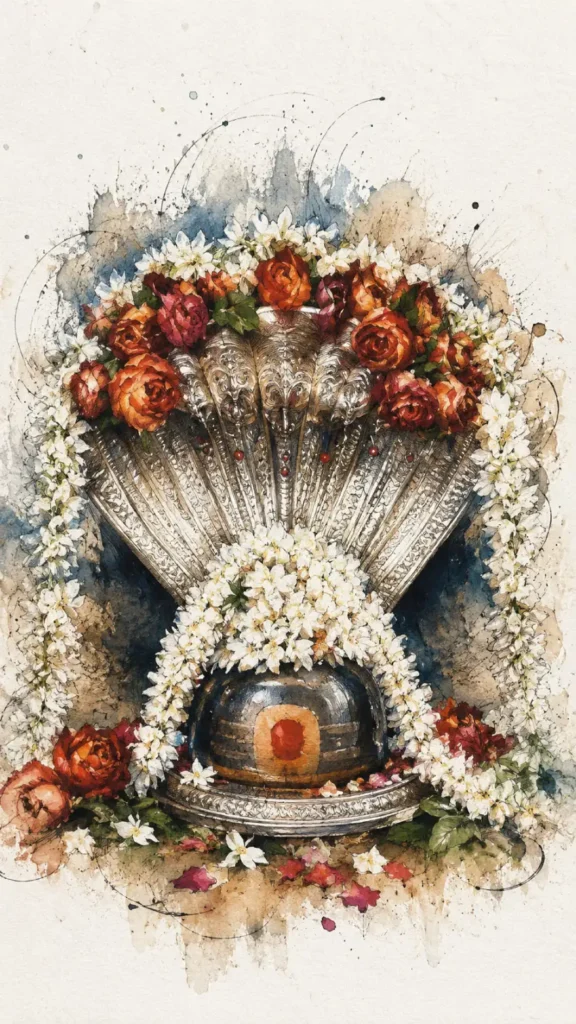
Unlike an anthropomorphic painting of Shiva, the central sacred form of Mallikarjuna at Srisailam is a Shiva Linga. The Linga is not merely an object representing Shiva. Within Shaiva worship, it is a profound symbol of Shiva’s transcendent and formless nature becoming accessible through a sacred form. The visual simplicity is part of its power. There is no need for a dramatic warrior pose or elaborate mythological scene. The sacred Linga, flowers, ritual offerings, lamps, and the sanctum create an atmosphere of stillness.
Traditional Srisailam descriptions also connect Mallikarjuna with the Arjuna tree and jasmine. The temple’s own account preserves these associations as part of the identity of the deity. (Srisailam Devasthanam). In artistic interpretation, an image of Mallikarjuna may therefore focus on the Linga itself, jasmine garlands, sacred lamps, Nandi, temple architecture or the mountainous landscape of Srisailam. If an artist portrays Shiva in a human-like form beside these elements, that should be understood as devotional artistic interpretation, rather than as the literal iconographic form of the Jyotirlinga.
The Symbols and Sacred Attributes of Mallikarjuna
The most important visual symbol is the Shiva Linga.
It represents a form through which devotees approach the limitless reality of Shiva.
Jasmine carries a special connection with the name Mallikarjuna. Its delicate white flowers can represent purity, devotion, and loving offering.
Nandi, the sacred bull associated with Shiva, is traditionally placed facing the sanctum in Shiva temples. Nandi can be understood devotionally as an image of steadfastness, patience, and focused attention.
The mountain is equally important at Srisailam. The temple is not separated from its landscape. The Nallamala Hills form part of the sacred identity of the pilgrimage.
And beside Mallikarjuna stands the tradition of Bhramaramba Devi, bringing the symbolism of Shiva and Shakti together in the same sacred environment.
The Spiritual Meaning of Mallikarjuna
Perhaps the deepest message of Mallikarjuna is divine compassion expressed through presence.
The story of Kartikeya reminds us that even divine families can be represented through moments of disagreement, hurt, and separation. What transforms the story is what Shiva and Parvati do afterward. They go closer. This makes Mallikarjuna especially meaningful for anyone experiencing uncertainty, disappointment, or emotional distance. The Jyotirlinga also represents a different dimension of the same teaching. The Linga points beyond limited form toward Shiva as an infinite reality. Together, these ideas create a beautiful spiritual movement:
The Infinite becomes intimate. The cosmic Lord is worshipped in a simple sacred form. The transcendent becomes approachable. The mountain becomes a place of prayer. And the story of a divine family becomes a reminder that love can remain present even when circumstances are difficult.
Why Devotees Are Drawn to Mallikarjuna
Devotees traditionally visit Srisailam to worship Mallikarjuna with reverence, prayer, and surrender.
The temple’s religious traditions regard Srisailam as an exceptionally sacred Shaiva kshetra, and the Puranic traditions associated with the site celebrate its spiritual importance. The official temple tradition also identifies Mallikarjuna as the second Jyotirlinga and Srisailam as a major sacred centre. (Srisailam Devasthanam)
For many worshippers, however, pilgrimage is not simply about asking for a particular result.
It can be an opportunity to pause.
To remember.
To surrender anxiety.
To reconnect with faith.
To stand before a sacred form that has been worshipped across generations.
The official temple also provides free Sarva Darshan for pilgrims and maintains facilities connected with worship and prasadam, reflecting Srisailam’s continuing role as a living pilgrimage centre. (Srisailam Devasthanam)
Mallikarjuna in Everyday Life
The story of Mallikarjuna can speak quietly to modern life.
A person may be successful professionally and still feel emotionally unsettled. A family may love one another deeply and yet experience disagreement. Someone may make a decision that takes them away from familiar surroundings. Another may simply need a place where the noise of everyday life becomes quieter.
Mallikarjuna offers a powerful thought:
Being distant does not always mean being abandoned.
The story of Shiva following Kartikeya can become a reminder to approach relationships with patience and compassion.
The Jyotirlinga can also become a reminder to create moments of stillness. In a world filled with notifications, deadlines, and constant movement, a simple devotional image can invite the mind to pause.
Prayer does not have to be dramatic.
Sometimes it begins with simply sitting quietly before a sacred form.
Famous Temple Associated With Mallikarjuna Jyotirlinga
The principal sacred site is the Sri Bhramaramba Mallikarjuna Swamy Varla Devasthanam, popularly known as the Srisailam Temple.
City/Town: Srisailam
District: Nandyal
State: Andhra Pradesh, India
Public Address: Srisaila Devasthanam, Srisailam – 518101, Nandyal District, Andhra Pradesh, India
The temple is one of India’s twelve Jyotirlinga shrines and is also associated with the Bhramaramba Shakti tradition. Its architecture contains carved stone work and reflects the patronage of several historical dynasties and rulers. The Nandyal district’s official tourism information describes Srisailam as an ancient sacred centre, with the Mallikarjuna shrine traditionally counted among the twelve Jyotirlingas. (Nandyal District)
For the most current temple information, devotees can refer to the official Srisailam Devasthanam website.
For broader pilgrimage and heritage information, Incredible India’s Srisailam Temple guide is another useful reference.
The sacred landscape of Srisailam, including the Nallamala Hills and Krishna River, is an important part of the pilgrimage experience. (Incredible India)
Why Mallikarjuna Makes Meaningful Sacred Art
Mallikarjuna has a rare visual quality. It can be represented through quietness rather than spectacle. A carefully composed artwork may place the Shiva Linga at the centre, surrounded by white jasmine flowers, subtle temple architecture, and the warm glow of traditional lamps. Another artistic interpretation may bring in Nandi, the stone corridors of Srisailam, or the surrounding Nallamala landscape.
This makes Mallikarjuna especially suited to framed devotional artwork and premium wall art. For a home temple, a restrained composition can create a peaceful devotional focal point. For a living room or meditation space, a more atmospheric interpretation can connect spiritual meaning with Indian artistic heritage. For collectors outside India, Mallikarjuna artwork can also carry another layer of meaning: it can become a visual connection to one of India’s great pilgrimage traditions.
The artwork does not need to promise supernatural benefits. Its value can be simpler and deeper. It can remind someone of Shiva’s presence, the story of compassion behind Srisailam, and the quiet discipline of turning inward.
Mallikarjuna, Sacred Space and the Home
There is no single universally applicable Vastu rule that belongs specifically to Mallikarjuna Jyotirlinga artwork.
According to commonly followed Vastu traditions, devotional images are generally considered most appropriate in a clean, peaceful prayer or meditation area, with respectful placement and regular care.
A dedicated home temple or prayer room is therefore a natural setting for Mallikarjuna artwork.
In a living room or workspace, a tasteful framed representation can also serve as a visual reminder of stillness, devotion, and inner balance.
The emphasis should remain on reverence rather than superstition.
Bringing the Spirit of Srisailam Into Art
A sacred artwork cannot replace pilgrimage.
It cannot reproduce the sound of temple bells, the atmosphere of the sanctum, the fragrance of flowers, or the experience of standing upon the sacred hills of Srisailam.
But art can preserve a memory.
It can bring a meaningful symbol into the everyday rhythm of a home.
A Mallikarjuna artwork from ShaktiShraddha can therefore be approached as more than decorative imagery. A carefully created piece can become a visual reminder of Shiva’s compassion, the sacred story of Srisailam and the enduring relationship between devotion and beauty.
For those who love Indian spiritual art, a refined Mallikarjuna composition can work beautifully as framed art, premium wall decor, or a devotional centrepiece for a home temple.
The Eternal Presence of Mallikarjuna
The story of Mallikarjuna begins with separation, but it does not end there.
A son goes away.
Parents follow.
A mountain becomes sacred.
And Shiva remains.
That may be why the Mallikarjuna Jyotirlinga continues to speak so powerfully across generations. Its story combines the vastness of Shiva with the tenderness of family love. Its Linga expresses the infinite, while its sacred legends make that infinity feel remarkably close.
At Srisailam, devotion is inseparable from landscape, memory, and living tradition.
And when the image of Mallikarjuna enters a home through sacred art, it can serve as a quiet reminder of that timeless message: the Divine may be infinite, yet compassion can make that presence feel close.
This is the spirit ShaktiShraddha seeks to preserve through sacred art — transforming stories of India’s spiritual heritage into beautiful visual expressions that can be contemplated, cherished, and passed from one generation to another.
FAQs
1. Where is Mallikarjuna Jyotirlinga located?
Mallikarjuna Jyotirlinga is located at Srisailam in Nandyal district of Andhra Pradesh, India. The sacred temple stands among the Nallamala Hills and is dedicated to Lord Mallikarjuna Swamy, a form of Lord Shiva.Srisailam has an especially important place in Hindu pilgrimage because the temple complex is associated with both Mallikarjuna Jyotirlinga and Goddess Bhramaramba, one of the traditionally recognized Shakti Peethas. The presence of Shiva and Shakti together makes Srisailam particularly significant among India’s sacred pilgrimage centres.
2. How can I reach Mallikarjuna Jyotirlinga from the airport?
Srisailam is a hill pilgrimage destination, so the final part of the journey is generally by road. The Ministry of Tourism’s Srisailam information lists Kurnool Airport at approximately 180 km from Srisailam. Another major option for air travellers is Rajiv Gandhi International Airport in Hyderabad, from where Srisailam can be reached by road. Devotees can continue from the airport by private taxi, cab or available bus services. Because airport connectivity and road travel options can change, it is advisable to check the latest transportation availability before planning the journey.
3. How can I reach Mallikarjuna Jyotirlinga from the railway station?
The nearest convenient railway station is Markapur, approximately 85 km from Srisailam, according to the Ministry of Tourism’s Srisailam information. From Markapur, pilgrims can continue their journey by road to Srisailam. Another option is to travel by rail to larger railway stations such as Kurnool or other suitable railheads and continue to Srisailam by road, depending on the traveller’s route and available train services. Since Srisailam is situated in the Nallamala Hills, the final part of the pilgrimage journey is generally a road journey through the surrounding hill region.
4. What are the Mallikarjuna Temple darshan timings?
According to the current official Srisaila Devasthanam information, Darshanam starts from 6:00 AM onwards. The temple conducts different forms of worship and Seva throughout the day. Darshan arrangements can vary during festivals, special occasions and other temple events. Devotees should check the official Srisaila Devasthanam website for the latest darshan schedule before travelling.
5. Can devotees book Darshan at Mallikarjuna Temple online?
Yes. The Srisaila Devasthanam provides online booking for Darshanam tickets as well as different Seva services. The official temple website currently provides options for Darshanam, Pratyaksha Seva and Paroksha Seva. Devotees can also obtain Darshan tickets through the temple’s designated offline ticket facilities. The availability and rules for individual services can change, particularly during major festivals. It is therefore advisable to use the official temple portal when making advance arrangements.
6. What Puja and Abhishek services are available at Mallikarjuna Temple?
Srisaila Devasthanam offers several religious Sevas associated with Lord Mallikarjuna Swamy and Goddess Bhramaramba. The official temple services include offerings such as Rudra Abhishekam, Rudra Homam, Chandi Homam, Kumkumarchana and other Sevas. Both in-person Pratyaksha Seva and certain virtual Paroksha Seva options are available through the temple’s official booking system. The exact availability, timing and booking requirements may vary, so devotees planning a particular Puja or Abhishek should check the current official schedule.
7. What is the best time to visit Mallikarjuna Jyotirlinga?
The cooler months are generally more comfortable for exploring Srisailam and its surrounding pilgrimage sites. October to March is often a convenient period for visitors who wish to combine temple darshan with sightseeing around the Nallamala Hills. Srisailam becomes particularly active during major occasions such as Maha Shivaratri, Navaratri and other important temple festivals. These periods can provide a deeply devotional atmosphere but may also bring larger crowds. If you prefer a relatively relaxed pilgrimage, consider travelling outside the busiest festival periods.
8. What other important temples can I visit in Srisailam?
Srisailam has numerous sacred places in addition to the main Mallikarjuna-Bhramaramba temple. Important places include Sakshi Ganapathi Temple, Sikhareswaram, Hatakeswaram, Pathaleswara Swamy Temple, Istakameshwari Temple and several ancient temples and sacred sites in the surrounding region. The Srisaila Devasthanam also lists places such as Akkamahadevi Caves, Mallela Theertham and Srisailam Dam among the area’s notable attractions. Sakshi Ganapathi, located about 2 km from the main temple, has a particularly interesting traditional association with pilgrims visiting Srisailam.
9. Is there a dress code and are there restrictions inside Mallikarjuna Temple?
Yes. The Srisaila Devasthanam states that devotees participating in Seva must wear traditional Hindu attire and that modern or sleeveless clothing is not permitted for such participation. Photography is also prohibited inside the temple according to the official Devasthanam information. Devotees should therefore follow the current temple regulations regarding clothing, photography, mobile phones and other personal belongings. The temple provides a cloakroom facility for items such as bags, mobile phones and cameras that cannot be taken inside.
10. What should I know before visiting Mallikarjuna Jyotirlinga?
Mallikarjuna Jyotirlinga is part of a larger sacred landscape rather than being simply a single temple building. Srisailam combines the worship of Lord Mallikarjuna and Goddess Bhramaramba, surrounded by the Nallamala Hills and numerous temples, sacred water bodies and pilgrimage sites. If you are planning a special Darshan, Puja or Abhishek, check the official Devasthanam website before travelling and make advance bookings where required. It is also worth allowing sufficient time to explore Srisailam beyond the main shrine. Visiting the surrounding sacred sites can turn a temple visit into a more complete pilgrimage experience.
For devotees, the journey to Mallikarjuna is therefore not simply a visit to one of India’s twelve Jyotirlingas. It is an opportunity to experience a sacred landscape where Shiva and Shakti, temple tradition, mythology and the natural beauty of the Nallamala Hills come together.