
Vikata Ganapati
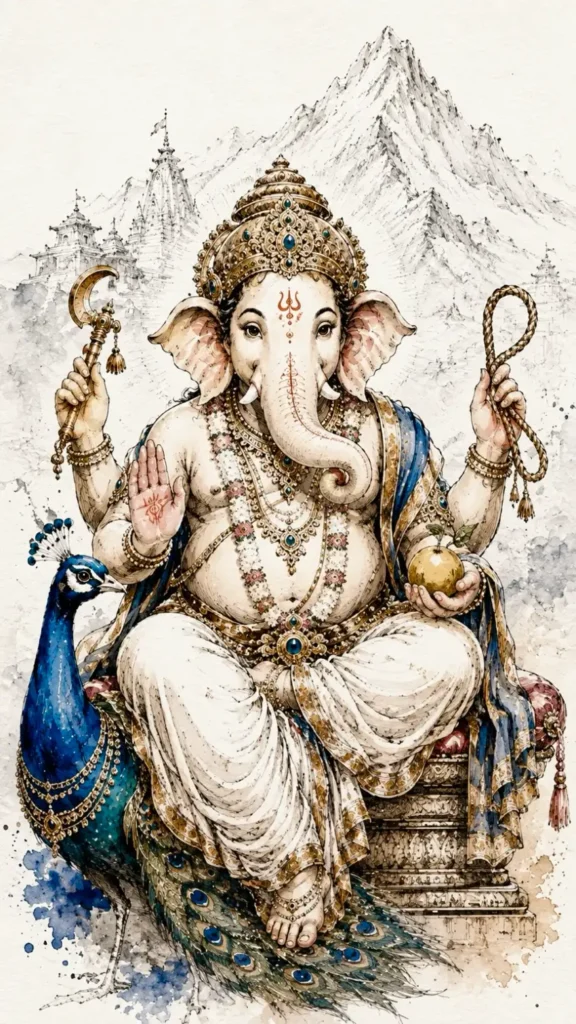
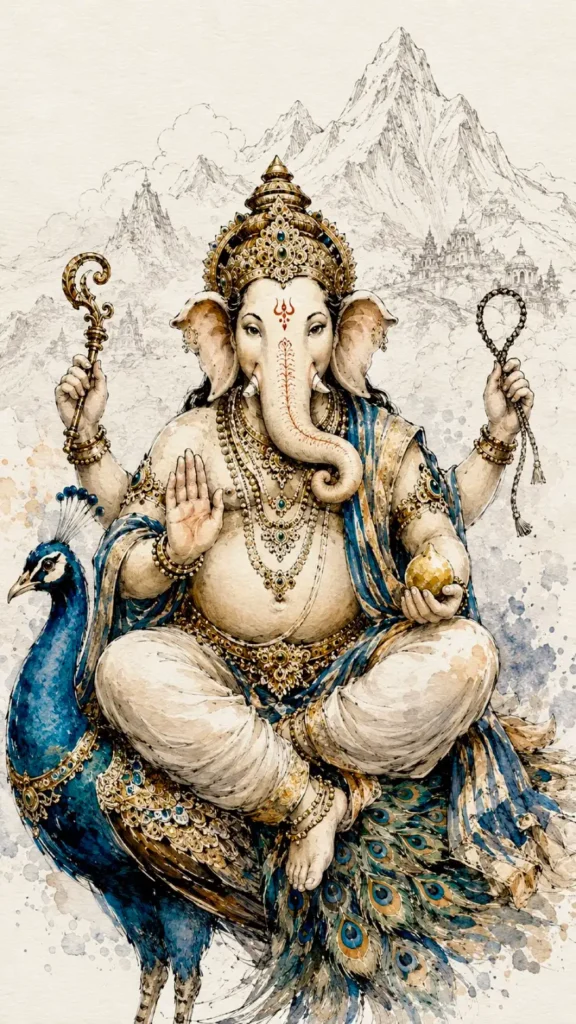
The Divine Form That Conquers Desire
Sometimes the greatest obstacle in life is not outside us. It is the desire within us that quietly grows until it begins to control our thoughts, choices, and actions.
Hindu tradition presents a powerful answer to this inner struggle through Vikata Ganapati, one of the eight principal incarnations of Lord Ganesha described in the Mudgala Purana. In this form, Ganesha appears as a formidable divine presence associated with the defeat of Kamasura, the demon who represents uncontrolled desire.
Vikata is especially distinctive because his vehicle is not the familiar mouse. He is traditionally associated with the peacock, giving this form a majestic and visually striking character.
But the story of Vikata is more than a battle between a god and a demon. It is a story about desire, discipline, surrender, and the discovery that true freedom begins when the mind is no longer ruled by what it wants.
Who Is Vikata Ganapati?
Vikata Ganapati is the sixth major incarnation of Lord Ganesha in the Mudgala Purana. The text presents eight important manifestations of Ganesha, each associated with overcoming a particular negative force represented by an asura.
Vikata is associated with Kamasura, whose name comes from kama, a Sanskrit word that can refer to desire, longing, or sensual desire. In the story, Kamasura allows desire and ambition to become destructive forces.
Ganesha therefore manifests as Vikata to restore balance.
The Mudgala Purana devotes its sixth section, known as Vikatacharitam, to the Vikata incarnation and the conflict with Kamasura. The narrative also connects this tradition strongly with Mayura Kshetra, traditionally identified with present-day Morgaon in Maharashtra.
Vikata is therefore not simply another name for Ganesha. He represents a particular divine response to a particular inner and cosmic problem.
The Meaning of Vikata Ganapati’s Name
The Sanskrit word Vikaṭa has several shades of meaning. Sanskrit dictionaries give meanings including unusual in appearance, formidable, difficult, dreadful, or imposing.
For Vikata Ganapati, the idea of being formidable is especially meaningful.
Ganesha does not appear in this form because the divine is angry or destructive by nature. Rather, the formidable appearance expresses the immense strength required to confront forces that have become difficult to control.
Desire itself is not always considered negative in Hindu thought. Human beings naturally have aspirations, affection, ambitions, and legitimate worldly responsibilities.
The deeper warning in the Vikata story concerns desire that becomes the master instead of remaining the servant.
That is why Vikata’s name can be understood spiritually as pointing toward a divine power strong enough to confront overwhelming tendencies.
The Story of Vikata Ganapati
The story unfolds around Kamasura, who becomes immensely powerful after undertaking severe austerities and receiving divine favour. Empowered by his strength, he begins to disturb the established order and trouble the gods and sages.
The problem is no longer simply that Kamasura desires something.
His desires have become so powerful that they control his conduct.
The gods seek a way to restore dharma. Their prayers eventually lead them toward Ganesha and the sacred Mayura Kshetra. There, through devotion and worship, they seek divine assistance.
According to the traditional narrative, Ganesha appears in the formidable form of Vikata, associated with the peacock. The gods receive courage, and the conflict with Kamasura begins.
The battle is not presented as a simple display of physical strength.
Kamasura’s forces fight fiercely. His sons also enter the conflict, and the struggle becomes increasingly intense. Vikata protects the gods and ultimately confronts Kamasura himself.
At this point, something important happens.
Instead of simply destroying the demon, Vikata reveals his deeper nature. Kamasura begins to understand that the power before him is not merely another warrior’s strength. He realizes that he has misunderstood the nature of divine power.
His pride begins to disappear.
Kamasura finally surrenders and asks for devotion to Ganesha. Vikata accepts his surrender and grants him a boon. The conflict therefore ends not merely through destruction, but through recognition and transformation.
This ending gives the story an important spiritual dimension.
The ultimate victory is not simply the defeat of an enemy. It is the moment when uncontrolled desire recognizes a higher truth.
The Divine Form of Vikata Ganapati
Vikata Ganapati is traditionally distinguished by his peacock vehicle. Among the eight incarnations described in the Mudgala Purana, Vikata is the one associated with the peacock.
This makes his visual identity immediately recognizable.
As Ganesha, Vikata retains the familiar elephant-headed form of the deity. Artists commonly portray him with a large rounded belly, divine ornaments, a crown, sacred markings, and multiple arms.
However, the precise arrangement of weapons, objects, complexion, posture, and ornaments can vary between artistic and regional traditions.
The important traditional feature is the peacock.
The peacock gives Vikata an unusual majesty. Its brilliant feathers, proud posture, and association with beauty create an interesting contrast with the teaching of the story.
The lesson is not to reject beauty or worldly life.
It is to avoid becoming enslaved by attraction.
This distinction is important when creating or interpreting Vikata Ganapati artwork. A modern devotional painting may include a specific fruit, weapon, garment, background, temple, mountain, or decorative arrangement without all of those details being prescribed by the Mudgala Purana.
The central traditional identity should remain clear: Ganesha in the Vikata manifestation, associated with the peacock and the overcoming of Kamasura.
The Symbols and Attributes of Vikata Ganapati
The Peacock
The peacock is the most distinctive symbol of Vikata.
It represents beauty, splendour, and outward attraction. In the context of the story, this creates a meaningful contrast with the need for inner mastery.
The peacock also gives the form an elevated and royal visual quality.
The Elephant Head
Ganesha’s elephant head remains a reminder of wisdom, awareness, strength, and the ability to move beyond narrow thinking.
Vikata teaches that desire cannot always be defeated through suppression alone. It must be understood with intelligence.
The Divine Weapons
Traditional descriptions of Ganesha commonly include weapons such as the pasha or noose and ankusha or goad. In the Vikata narrative, these weapons are associated with his divine power during the conflict.
Symbolically, a noose can be understood as representing restraint, while a goad suggests direction and control.
Together they offer a beautiful spiritual idea: the mind sometimes needs both restraint and guidance.
The Formidable Presence
Vikata’s very presence communicates that certain inner tendencies cannot be treated casually.
When desire becomes destructive, spiritual life requires firmness.
The Spiritual Meaning of Vikata Ganapati
The deepest teaching of Vikata Ganapati is mastery over uncontrolled desire.
Modern life makes this teaching particularly relevant.
We are constantly encouraged to want more.
A bigger home.
A better position.
More recognition.
More money.
More attention.
More possessions.
More experiences.
Ambition can be valuable. Desire can motivate creativity and progress. But when wanting becomes endless, peace becomes difficult. The story of Kamasura gives this problem a mythological form. Kamasura represents the point at which desire stops being something we experience and becomes something that controls us. Vikata represents the higher intelligence that says:
You can have desires without allowing desires to possess you.
This does not mean abandoning family, career, relationships, or legitimate goals. It means learning the difference between purposeful aspiration and compulsive craving. That is why Vikata Ganapati can be understood as a form of inner discipline.
Why Devotees Are Drawn to Vikata Ganapati
Devotees may find Vikata especially meaningful when reflecting on self-control, attachment, ambition, temptation, or the struggle to maintain balance.
Many worshippers traditionally approach Ganesha for wisdom and the removal of obstacles. In the Vikata form, the obstacle can be understood as an uncontrolled tendency within oneself.
This makes the form particularly meaningful during periods of transition.
Someone beginning a new career may have ambition but also fear of failure.
Someone building a business may want success but struggle with endless comparison.
Someone experiencing emotional attachment may find it difficult to distinguish love from possession.
Vikata offers a spiritual reminder that freedom is not the ability to obtain everything we want. Freedom is the ability to remain steady even when everything we want is not obtained.
Vikata Ganapati in Everyday Life
The story of Vikata does not need to remain inside a temple or scripture.
It can become a quiet reflection for daily life.
Before making an important decision, we can ask:
“Am I choosing this because it is truly meaningful, or simply because I cannot stop wanting it?”
That question can change the way we approach work, money, relationships, social recognition, and even technology.
A person may spend hours comparing their life with others online. Another may keep chasing professional success even after reaching a comfortable position.
The problem is not necessarily success.
The problem is when the mind says, “Just one more thing, and then I will finally be satisfied.”
Vikata reminds us to pause.
To observe.
To choose consciously.
And to place desire under the guidance of wisdom.
Famous Temple Associated With Vikata Ganapati
Shri Mayureshwar Temple, Morgaon, Maharashtra
For Vikata Ganapati, the most meaningful temple association is Shri Mayureshwar Temple at Morgaon, one of Maharashtra’s most important Ganesha pilgrimage centres. The connection requires an important clarification.
The principal deity of the temple is Mayureshwar/Moreshwar, not a separate principal shrine dedicated exclusively to Vikata. However, the temple complex traditionally houses representations of the eight Ganesha forms described in the Mudgala Purana, including Vikata. The temple’s own trust confirms the presence of these eight forms. Morgaon is also deeply connected with the peacock symbolism of Ganesha worship. Maharashtra Tourism identifies Shri Mayureshwar Temple as the first and last stop of the traditional Ashtavinayak pilgrimage.
Temple/Sacred Place: Shri Mayureshwar Temple
City/Town: Morgaon
Taluka: Baramati
District: Pune
State: Maharashtra, India
Public Address: Chinchwad Deosthan Trust Office, At Post Morgaon, Tal. Baramati, Dist. Pune, Maharashtra – 412304.
The temple’s official trust specifically states that the eight Mudgala Purana forms are installed at Morgaon, including Vikata.
For anyone researching Vikata Ganapati temple traditions, Morgaon is therefore an especially valuable pilgrimage connection.
According to Vastu Traditions: Where Can Vikata Ganapati Art Be Placed?
Devotional artwork can be placed in a home temple, prayer room, meditation area, or another clean and respectful space.
According to commonly followed Vastu traditions, many households prefer to keep images of deities in dedicated prayer spaces rather than treating them merely as decorative objects.
For Vikata Ganapati artwork, a peaceful prayer or meditation area can be especially appropriate because the form encourages reflection on discipline and mastery of desire.
Vastu practices vary between traditions and regions, so placement directions should not be presented as universal Hindu scripture.
Most importantly, the artwork should be kept clean, respectfully displayed, and placed where it can serve as a visual reminder of devotion.
Why Vikata Ganapati Makes Meaningful Sacred Art
Vikata Ganapati has exceptional visual appeal because the familiar elephant-headed form of Ganesha is combined with the majestic presence of the peacock.
This creates a composition filled with movement, colour, symbolism, and spiritual depth.
A detailed Vikata Ganapati artwork can become more than an attractive image. It can serve as a visual reminder of self-control.
A painting in a meditation space can encourage quiet reflection.
A framed artwork in a home temple can become part of a devotional environment.
A carefully designed canvas can bring together traditional Indian visual language with contemporary interior aesthetics.
For families living outside India, such artwork can also create a meaningful cultural connection for children and younger generations.
The value of sacred art is therefore not based on claiming supernatural power in the artwork itself. Its value can come from what it helps us remember.
Bringing the Meaning of Vikata Ganapati Into Your Home
A beautifully rendered Vikata Ganapati can hold several layers of meaning at once.
The elephant head speaks of wisdom.
The peacock suggests splendour and attraction.
The formidable form represents strength.
The story of Kamasura reminds us about uncontrolled desire.
And Ganesha’s presence brings the larger idea of intelligent action and inner balance.
For a sacred-art collection such as ShaktiShraddha, Vikata Ganapati offers an especially rich subject. A carefully created digital artwork can preserve intricate details, while framed or canvas art can turn the image into a strong visual focal point for a home temple, meditation corner, or culturally inspired living space.
The purpose is not to promise that a painting itself creates miracles.
It is to allow the story of the divine form to remain present in everyday surroundings.
Conclusion
Vikata Ganapati teaches a lesson that feels surprisingly modern.
The world constantly tells us to want more. Hindu tradition reminds us to ask a deeper question: Who is controlling the desire—the mind, or the desire controlling the mind?
In the story of Kamasura, uncontrolled desire grows into a destructive force. In the appearance of Vikata, divine wisdom takes a formidable form to restore balance.
His peacock makes the image magnificent. His story makes the form profound.
Vikata Ganapati therefore stands not simply as a warrior against a demon, but as a symbol of inner mastery. He reminds us that beauty does not need to become attachment, ambition does not need to become greed, and desire does not need to become bondage.
That is what makes Vikata Ganapati such a meaningful subject for sacred art. A thoughtfully created image can become a quiet reminder of these values each time we see it.
Through ShaktiShraddha’s devotional-art approach, the visual presence of Vikata Ganapati can become part of a home, prayer space, meditation corner, or meaningful cultural collection—bringing together devotion, beauty, mythology, and the timeless search for inner balance.
7. FAQ
Who is Vikata Ganapati?
Vikata Ganapati is the sixth of the eight principal Ganesha incarnations described in the Mudgala Purana. He is associated with defeating Kamasura, the demon representing uncontrolled desire.
What does Vikata Ganapati mean?
The Sanskrit word Vikaṭa can mean formidable, unusual, difficult, or imposing. In the context of Ganesha’s incarnation, it reflects the powerful form required to overcome destructive desire.
What is the story of Vikata Ganapati?
Vikata appears to confront Kamasura, whose uncontrolled desire and misuse of power disturb the gods and sages. After a fierce conflict, Kamasura recognizes Vikata’s divine nature and surrenders.
Which scripture mentions Vikata Ganapati?
Vikata is prominently described in the Mudgala Purana, particularly in its sixth section, Vikatacharitam.
What is the vehicle of Vikata Ganapati?
Vikata Ganapati is traditionally associated with the peacock. This is one of the distinctive features separating this incarnation from the familiar mouse-mounted forms of Ganesha.
Which temple is associated with Vikata Ganapati?
The Shri Mayureshwar Temple at Morgaon, Maharashtra, is particularly relevant because its temple complex traditionally contains representations of the eight Ganesha forms described in the Mudgala Purana, including Vikata.
What does Vikata Ganapati symbolize?
Vikata Ganapati symbolizes the need to bring uncontrolled desire under the guidance of wisdom, discipline, and spiritual awareness.
Is Vikata Ganapati suitable for a home temple?
A respectful depiction of Vikata Ganapati can be placed in a home temple or prayer space. Its story can serve as a reminder of self-control, clarity, and devotion.