
Vakratunda Ganapati
Vakratunda Ganapati
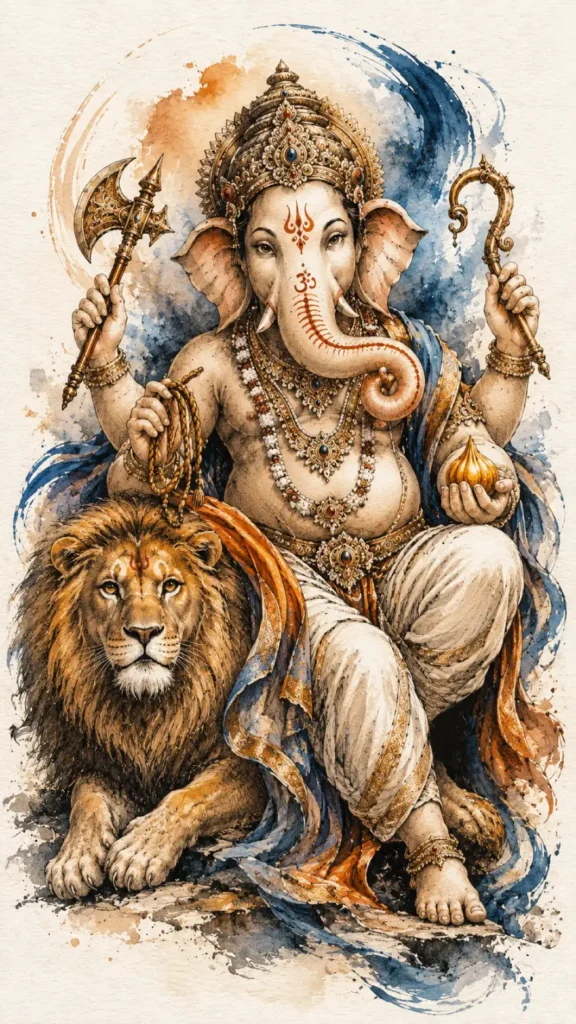
The Divine Form That Conquers Jealousy
वक्रतुण्ड महाकाय सूर्यकोटि समप्रभ।
निर्विघ्नं कुरु मे देव सर्वकार्येषु सर्वदा॥
Introduction
Among the many sacred forms of Lord Ganesha, Vakratunda Ganapati holds a special place. He is described in the Mudgala Purana as the first of Ganesha’s eight principal incarnations. The name Vakratunda is generally understood as “the One with the curved trunk.” In this form, Ganesha appears as a powerful divine presence riding a lion and confronting a force that can quietly disturb both individuals and society: Matsara, the spirit of jealousy and envy. (Wikipedia)
The story of Vakratunda is more than a tale of a god defeating a demon. It is also a story about the struggle within the human mind. Jealousy can begin with a small comparison. It can then grow into resentment, anger and a desire to see another person fail. The story of Vakratunda reminds us that such feelings must be recognised and controlled before they become destructive.
For devotees, Vakratunda represents divine strength, wisdom and the courage to overcome these inner obstacles. His image can therefore be understood not only as a sacred representation of Lord Ganesha, but also as a reminder to live with greater self-control, gratitude and inner strength.
Who Is Vakratunda Ganapati?
Vakratunda is the first major incarnation in the sequence of eight principal forms of Ganesha described in the Mudgala Purana. These eight forms are presented as manifestations of Ganesha that overcome different negative forces. Vakratunda’s opponent is Matsaryasura, also called Matsara in some accounts. He represents envy, jealousy and rivalry. (Wikipedia)
The importance of this form becomes clearer when we understand what Matsara represents.
A person may become unhappy when another person succeeds. Someone may compare their home, career, wealth, beauty or achievements with those of others. Instead of appreciating another person’s happiness, they may begin to feel resentment. This is the emotional world represented by Matsara.
Vakratunda appears as the divine power that confronts this destructive tendency.
His vehicle is not the familiar mouse seen with many other forms of Ganesha. In the Mudgala Purana tradition, Vakratunda rides a lion. The lion gives this form a particularly majestic and powerful character. (Wikipedia)
The Meaning of the Name Vakratunda
The Sanskrit name Vakratunda is associated with the idea of a curved or bent trunk. Ganesha’s trunk is one of his most recognisable features, and the name immediately draws attention to it.
The curved trunk can also inspire a deeper devotional reflection.
Life rarely moves in a completely straight line. Plans change. Difficulties appear. Unexpected situations arise. Sometimes the path that we expected to follow is no longer possible. Wisdom teaches us to adapt without losing our purpose.
The image of the curved trunk can therefore remind devotees that strength does not always mean moving in a straight line. Sometimes strength means knowing when to change direction.
This is particularly meaningful in the story of Matsara. Jealousy often makes the mind rigid. It causes a person to focus on what someone else has rather than seeing the blessings already present in their own life.
Vakratunda represents the wisdom to overcome that narrow vision.
The Story of Vakratunda and Matsara
The story of Vakratunda is traditionally connected with Matsaryasura, the demon representing jealousy and envy. According to traditional accounts, Matsaryasura became extraordinarily powerful after undertaking severe penance and receiving a powerful boon from Lord Shiva. With this strength, his ambition grew. He began to challenge the established order and eventually created suffering for the gods and other beings. (The Hindu Blog). The deeper meaning of the story lies in the nature of Matsara. Jealousy may begin quietly. A person sees someone else’s success and feels uncomfortable. Instead of asking, “How can I improve myself?”, the mind asks, “Why does that person have more than me?” When this feeling becomes stronger, it can turn into rivalry.
Rivalry can become hatred. Hatred can lead to destructive action. Matsara therefore represents more than ordinary jealousy. He represents jealousy that has become powerful enough to disturb harmony.The gods and other divine beings sought a way to overcome this growing force. In one traditional account, Sage Dattatreya advised them to worship Ganesha and invoke him through the sacred syllable “Gam.” Through their devotion, Ganesha manifested as Vakratunda. (The Hindu Blog)
Vakratunda appeared riding a magnificent lion. His arrival changed the situation completely.
Matsara, who had become confident because of his power, was confronted by a divine force far greater than his own strength. When Matsara saw Vakratunda, his pride and confidence disappeared. Instead of continuing the battle, he surrendered before Ganesha and sought refuge.
Vakratunda accepted his surrender. The victory was therefore not simply about destroying an enemy. It was about bringing a destructive force under control. This is one of the most beautiful lessons in the story. Divine strength does not always have to end in destruction. When a negative force recognises truth and surrenders, transformation becomes possible.
The Divine Form of Vakratunda Ganapati
Vakratunda is traditionally imagined as a majestic and powerful form of Lord Ganesha.
He retains the familiar elephant head, large ears and sacred curved trunk of Ganesha. Yet his overall appearance has a more commanding and warrior-like character.
The most important visual distinction is his lion vehicle.
The lion represents strength and majesty in the traditional imagery of this incarnation. Ganesha seated upon such a powerful creature creates a striking visual contrast. Ganesha’s elephant form represents wisdom and intelligence, while the lion adds courage and royal power.
Together, the image suggests that wisdom does not mean weakness.
True wisdom can be courageous.
Depending on the artistic and traditional representation, Vakratunda may be shown with multiple arms carrying divine attributes and weapons. However, artistic depictions can differ, and not every modern image follows one identical iconographic pattern.
For ShaktiShraddha artwork, the most important point is that the representation should preserve the dignity and spiritual character of Vakratunda rather than turning him into merely a decorative warrior figure.
The face should communicate divine authority, not anger.
The posture should communicate strength, not aggression.
The lion should appear majestic and controlled.
The entire composition should remind the viewer that this is Ganesha in a powerful form of divine protection and spiritual victory.
The Lion of Vakratunda
The lion is one of the most distinctive features of Vakratunda Ganapati.
Most people immediately associate Ganesha with the mouse as his vehicle. The Mudgala Purana, however, specifically associates the Vakratunda incarnation with a lion. (Wikipedia)
The lion creates a powerful symbolic image.
It suggests courage.
It suggests confidence.
It suggests the ability to face a powerful opponent without fear.
In devotional interpretation, the lion can also remind us that spiritual strength is not the same as physical aggression. Courage means standing firmly before what is wrong while remaining guided by wisdom.
This makes Vakratunda especially meaningful for anyone facing difficult circumstances, competition, insecurity or emotional conflict.
What Does Matsara Teach Us?
The demon Matsara can be understood as a mirror.
It asks us to look honestly at our own minds.
Have we ever felt unhappy because someone else succeeded?
Have we ever compared our life with another person’s life?
Have we ever felt that another person’s happiness somehow reduces our own?
These feelings are deeply human. But allowing them to grow can damage our peace.
Modern life has created many new ways for comparison to enter our minds. Social media can make other people’s achievements visible every day. We see successful careers, beautiful homes, expensive possessions and exciting journeys.
What we often do not see are the struggles behind those images.
Vakratunda teaches us to step away from unhealthy comparison.
Another person’s success does not make our own life smaller.
Another person’s happiness does not take away our opportunity to be happy.
Another person’s achievement can become inspiration rather than a reason for jealousy.
This is the spiritual victory over Matsara.
The Devotional Significance of Vakratunda
Devotees may turn to Vakratunda as a reminder of courage, wisdom and inner discipline.
The form is particularly meaningful when a person is struggling with comparison, jealousy, resentment or insecurity.
Rather than asking only for external success, devotion to Vakratunda can become an opportunity for inner transformation.
A devotee may pray for the wisdom to recognise jealousy before it grows.
They may pray for the strength to appreciate another person’s success.
They may pray for freedom from unnecessary comparison.
They may also remember that Ganesha is traditionally invoked before important beginnings and undertakings.
The well-known prayer beginning “Vakratunda Mahakaya” is widely recited in Hindu devotional practice and asks Ganesha to remove obstacles from one’s actions. (Guru Kripa)
The spiritual value of such prayer lies not only in asking for obstacles to disappear, but also in preparing the mind to face life’s challenges with faith and wisdom.
Why Devotees Feel Drawn to Vakratunda
Vakratunda has a distinctive appeal because his story deals with an emotion that many people understand.
Jealousy is not always visible.
A person may smile while secretly feeling unhappy about another person’s success. Another person may appear confident while constantly comparing themselves with others.
Vakratunda offers a spiritual way to think about these feelings.
He does not teach us to hate the negative emotion. He teaches us to overcome it.
This makes the form especially relevant for modern life.
For some devotees, Vakratunda represents courage during difficult times.
For others, he represents freedom from jealousy.
For others, he is a reminder to remain humble even after achieving success.
His divine image can therefore become a quiet reminder:
Do not compare your journey with someone else’s. Walk your own path with faith.
A Sacred Place of Worship
Unlike famous Ganesha pilgrimage centres such as Siddhivinayak in Mumbai or Dagdusheth Halwai Ganapati in Pune, Vakratunda is primarily known as a scriptural incarnation of Ganesha, rather than as the universally recognised presiding deity of one major standalone pilgrimage temple. The Mudgala Purana tradition is the strongest basis for understanding this particular form. (Wikipedia)
This distinction is important.
Many Ganesha temples worship Ganesha under different names and forms. However, it would be misleading to assign a famous temple to Vakratunda without a reliable traditional or historical connection.
For devotees wishing to experience Ganesha worship connected with the wider tradition, India’s major Ganesha temples remain important pilgrimage destinations. Siddhivinayak in Mumbai, Dagdusheth Halwai Ganapati in Pune, Moti Dungri Ganesh Temple in Jaipur and other renowned shrines attract large numbers of devotees. (Panchangya)
Vakratunda’s importance, however, comes primarily from the sacred narrative and theology of the Mudgala Purana, rather than from association with one single famous temple.
Vakratunda in Modern Life
The story of Matsara is surprisingly relevant today.
A student may feel jealous of a classmate’s marks.
A professional may feel uncomfortable when a colleague receives a promotion.
A business owner may become unhappy when a competitor succeeds.
Someone may compare their home with a friend’s home.
Someone may compare their appearance, lifestyle or achievements with images seen online.
These comparisons can quietly steal happiness.
Vakratunda offers another way.
Instead of asking, “Why does that person have more than me?” we can ask, “What can I learn from that person’s journey?”
Instead of resenting another person’s success, we can celebrate it.
Instead of constantly comparing our lives, we can work sincerely toward our own goals.
That is how the story of Vakratunda becomes a living spiritual lesson.
Vakratunda Ganapati as Devotional Art
A sacred image is often more than decoration.
A carefully created image of Vakratunda can become a visual reminder of courage, wisdom and freedom from jealousy.
The curved trunk immediately identifies the divine form.
The lion gives the composition a sense of strength.
The elephant face preserves Ganesha’s familiar identity.
Divine weapons, ornaments and sacred details can add depth to the artwork when represented according to the chosen artistic tradition.
Such artwork can find a natural place in a prayer room, meditation space, home temple or a carefully designed devotional corner.
For people living in large Indian cities, premium devotional artwork can also bring a sense of traditional culture into contemporary homes.
For Indian families living abroad, a Vakratunda image can serve as both a spiritual representation and a connection with India’s religious and artistic heritage.
Choosing Vakratunda Artwork for the Home
Vakratunda artwork can be presented in several formats according to the space and purpose.
A digital download can be useful for devotees who want a high-resolution sacred image for personal printing or digital display.
A framed artwork can create a more traditional devotional presentation.
A canvas print can give the image a strong presence on a larger wall.
Smaller formats can work beautifully in a home temple or prayer area.
For those interested in traditional Indian décor, the image can also become part of a larger spiritual wall arrangement.
Embroidery framing offers another distinctive possibility. A carefully embroidered representation of Vakratunda can combine devotional symbolism with traditional Indian craftsmanship.
When people consider Vastu while arranging devotional artwork, the placement should be described responsibly as a matter of traditional preference rather than a guaranteed spiritual or material result.
The purpose of the artwork remains devotion.
Its beauty is an expression of that devotion.
A Sacred Image With a Deeper Meaning
Vakratunda Ganapati is a powerful reminder that some of life’s greatest obstacles begin within us.
The story of Matsara shows how jealousy can grow into something destructive.
Vakratunda shows the strength required to overcome it.
His curved trunk reminds us that life does not always follow a straight path.
His lion represents courage and majesty.
His elephant head represents the familiar wisdom and divine presence of Ganesha.
Together, these elements create a form that is both powerful and deeply reflective.
A Vakratunda image placed in a home can therefore carry a simple message every day:
Be strong without becoming arrogant. Be successful without becoming jealous. Celebrate others without forgetting your own journey. And when the path becomes difficult, move forward with wisdom.
Frequently Asked Questions
1. Who is Vakratunda Ganapati?
Vakratunda Ganapati is the first of the eight principal incarnations of Ganesha described in the Mudgala Purana. He is associated with overcoming Matsara, the destructive force of jealousy and envy. (Wikipedia)
2. What does Vakratunda mean?
Vakratunda refers to the curved or bent trunk of Lord Ganesha. It is one of the traditional names associated with Ganesha.
3. Which demon did Vakratunda defeat?
Vakratunda is associated with the defeat of Matsaryasura, or Matsara, who represents jealousy, envy and rivalry. (The Hindu Blog)
4. What is the vehicle of Vakratunda Ganapati?
The Mudgala Purana tradition associates Vakratunda with a lion, unlike the mouse that is commonly associated with many other forms of Ganesha. (Wikipedia)
5. What does Vakratunda represent?
Vakratunda represents the divine strength that overcomes jealousy, envy and destructive rivalry. His story also encourages courage, wisdom and self-control.
6. Which Purana describes Vakratunda?
Vakratunda is one of the eight principal incarnations described in the Mudgala Purana, a Hindu text devoted to Lord Ganesha. (Wikipedia)
7. Why do devotees worship Vakratunda?
Devotees may remember Vakratunda for courage, wisdom, protection and the strength to overcome negative tendencies such as jealousy and unhealthy comparison.
8. Is there a famous temple exclusively dedicated to Vakratunda?
Vakratunda is better known as a scriptural incarnation of Ganesha than as the presiding deity of one universally recognised major pilgrimage temple. It is therefore important not to attribute a famous Ganesha temple exclusively to Vakratunda without reliable evidence.
Conclusion
Vakratunda Ganapati is a powerful form of Lord Ganesha with a timeless message.
His story is the story of overcoming Matsara—the jealousy and envy that can disturb the mind and damage relationships.
He appears riding a lion, carrying the authority of divine courage and wisdom. His curved trunk reminds us that life may take unexpected turns, yet we can continue forward with faith.
The victory of Vakratunda is not simply the defeat of a demon. It is the victory of wisdom over comparison, courage over insecurity and inner strength over destructive jealousy.
For devotees, his image can become a daily reminder to appreciate what they have, respect the success of others and continue their own journey with humility.
In a world where comparison has become easier than ever, the ancient message of Vakratunda remains remarkably relevant.
May Vakratunda Ganapati bless every sincere beginning with wisdom, courage and a heart free from jealousy.
Ganapati Bappa Morya.