
Mayureshvara Ganapati
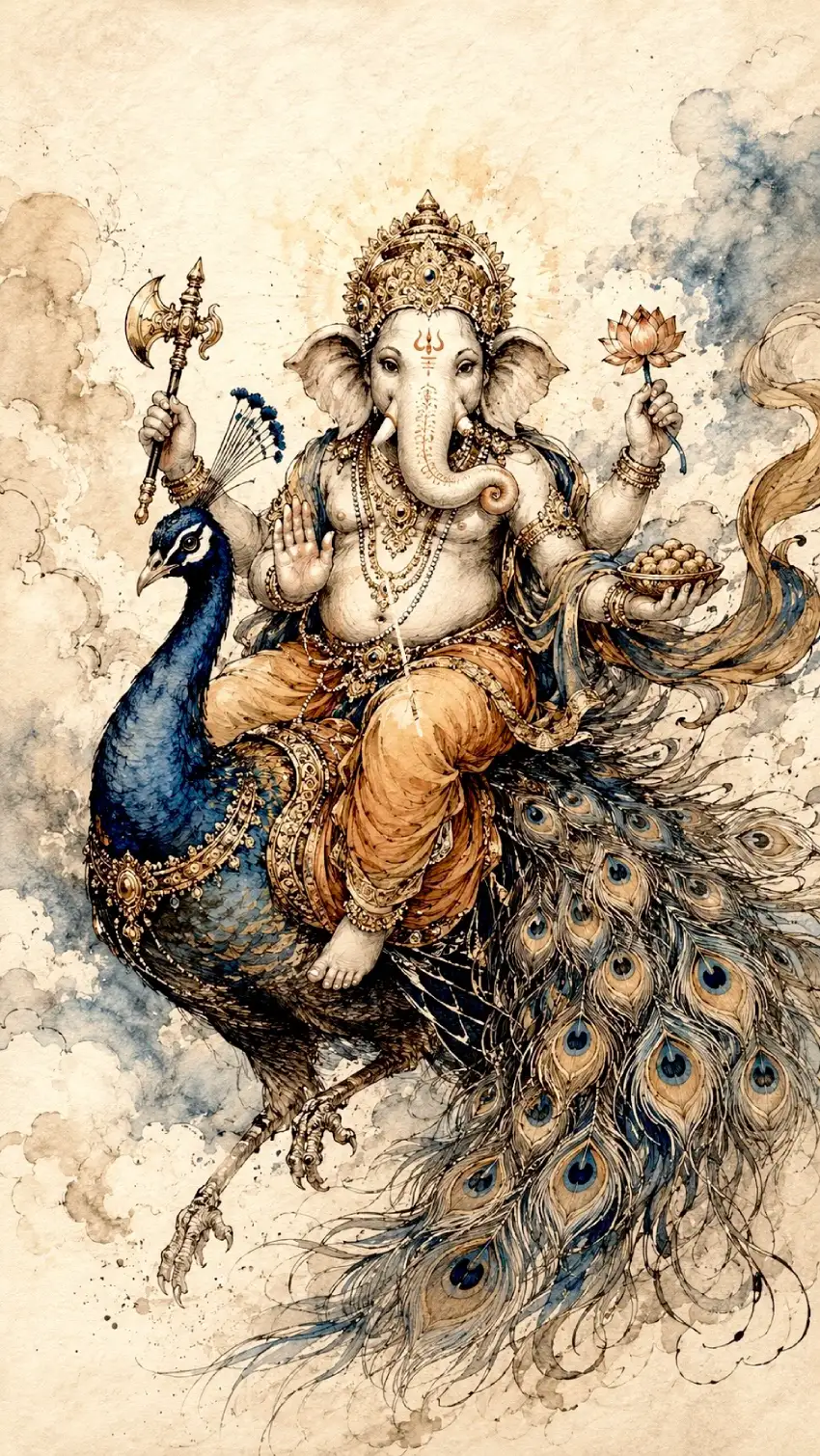
The Peacock-Riding Form of Divine Wisdom
A peacock is a symbol of beauty, colour and majesty. Yet beauty alone does not make it sacred. Its deeper significance begins when it becomes the vehicle of divine wisdom.
This is the striking image associated with Mayureshwar Ganapati, the form of Lord Ganesha connected with the peacock and the sacred land of Morgaon in Maharashtra.
The name Mayureshwar is commonly understood as “Lord of the Peacock.” In the Ganesha Purana, Mayureshvara is described as one of Ganesha’s four major incarnations associated with the four cosmic ages, appearing in the Treta Yuga. He rides a peacock and defeats the powerful demon Sindhu.
The story is not only about a divine battle. It presents a profound spiritual idea: when destructive power grows beyond control, divine wisdom appears to restore balance.
For devotees, Mayureshwar is therefore more than a beautiful form of Ganesha. He represents courage, divine authority, disciplined power and the triumph of righteousness over forces that disturb harmony.
Who Is Mayureshwar Ganapati?
Mayureshwar, also written Mayureshvara or Moreshwar, is a celebrated form of Lord Ganesha associated particularly with Morgaon in Pune district, Maharashtra.
He occupies a special position in the Ashtavinayak tradition. The Shri Mayureshwar Temple at Morgaon is traditionally regarded as the first and concluding shrine of the Ashtavinayak pilgrimage. Maharashtra’s Department of Tourism also identifies Morgaon as the first and last stop of this pilgrimage circuit.
There is an important distinction worth understanding.
The Ganesha Purana presents Mayureshvara as one of four yuga-related incarnations of Ganesha. The Mudgala Purana, meanwhile, gives a different system of eight principal manifestations, such as Vakratunda, Ekadanta, Mahodara, Gajanana, Lambodara, Vikata, Vighnaraja and Dhumravarna. Mayureshvara should therefore not simply be described as one of the eight Mudgala Purana incarnations.
This distinction is important for presenting Ganesha traditions accurately.
The Meaning of Mayureshwar’s Name
The Sanskrit Mayūra means peacock, while Īśvara means lord or divine master.
Thus, Mayureshvara can be understood as “Lord of the Peacock.”
The name reflects the distinctive mythology of this form. Unlike the familiar image of Ganesha riding his mouse, Mayureshwar is associated with the majestic peacock.
The name is also connected with Morgaon itself. The region has long been associated with peacocks, and the Marathi name Morgaon is traditionally connected with mor, meaning peacock.
The peacock gives this form a particularly regal character.
It suggests that divine power does not always have to appear in the same familiar form. Ganesha can reveal different aspects of divine consciousness according to the needs of the age and the purpose of his manifestation.
The Story of Mayureshwar Ganapati
The central story of Mayureshwar is connected with the demon Sindhu.
According to the Ganesha Purana tradition, Ganesha appeared as Mayureshvara during the Treta Yuga. In this manifestation, he was born to Shiva and Parvati and took the peacock as his vehicle. His purpose was to confront Sindhu, a powerful demonic force whose strength had become a threat to the divine order.
The story contains a long sequence of divine encounters before the final confrontation. Mayureshvara demonstrates his extraordinary power and establishes his authority over forces that challenge the cosmic order. Eventually, the decisive battle with Sindhu takes place. Mounted on the peacock, Mayureshwar confronts the demon and defeats him. The victory restores balance and establishes Mayureshwar as a powerful manifestation of Ganesha. The story can be understood on two levels. On the outer level, it is the story of a divine being overcoming a destructive force.
On the inner level, it reminds devotees that strength without wisdom can become destructive. Divine power is meaningful when it is directed toward dharma, balance and the protection of what is good. This is one reason Mayureshwar has such a compelling spiritual presence. He is not simply a peaceful deity seated in meditation. He is also the divine force that rises when disorder must be confronted.
The Divine Form of Mayureshwar
Traditional descriptions of Mayureshvara vary according to the textual and devotional tradition being followed.
The Ganesha Purana’s presentation describes Mayureshvara as white in complexion, six-armed and riding a peacock.
The sacred image at Morgaon has its own distinctive iconographic tradition. The Chinchwad Devasthan Trust describes the present deity as having four hands and three eyes, with the upper hands holding the pasha and ankusha, while another hand holds a modaka. The temple’s present murti does not exactly correspond in appearance to every feature described in the Purana.
This is an important example of why scriptural description and temple iconography should not automatically be treated as identical.
Devotional artists may also portray Mayureshwar with additional visual richness. A peacock may appear prominently beside or beneath Ganesha, its magnificent feathers spreading across the composition.
The image you have chosen for ShaktiShraddha follows this artistic tradition particularly strongly. It presents Ganesha with a majestic peacock, rich ornaments, a crown, lotus and other divine attributes. This should be understood as devotional artistic interpretation, rather than as an exact archaeological reproduction of the Morgaon murti.
The Symbols and Attributes of Mayureshwar
The Peacock
The peacock is the defining symbol of Mayureshwar.
It immediately distinguishes this form from the more familiar mouse-riding representations of Ganesha.
In the mythology, the peacock is not merely decorative. It is connected with Mayureshvara’s divine mission and victory over Sindhu.
Artistically, the peacock also gives the composition a sense of movement, majesty and splendour.
The Pasha and Ankusha
The pasha, or noose, and ankusha, or goad, are traditional attributes found in the Morgaon description of Mayureshwar. The goad can be understood devotionally as a symbol of direction and discipline. The noose can remind the devotee of restraint and the need to overcome attachments.
The Modaka
The modaka is closely associated with Ganesha. Its sweetness can be understood as a reminder that spiritual discipline is not merely about struggle. Wisdom and devotion ultimately lead toward an inner sweetness that cannot be measured by material possessions.
The Third Eye
The Morgaon tradition identifies three eyes in the sacred form. The third eye naturally evokes the broader Hindu symbolism of higher perception: the ability to see beyond immediate appearances and recognise a deeper reality.
The Spiritual Meaning of Mayureshwar
The deepest teaching of Mayureshwar lies in the relationship between power and wisdom.
A peacock is magnificent. It displays colour, beauty and confidence. Yet Mayureshwar does not allow splendour to become vanity. Divine wisdom remains the master.
This creates a beautiful spiritual message.
True strength should remain guided by consciousness.
Life often gives people opportunities to gain authority, money, recognition or influence. But these things can become harmful when they are separated from wisdom.
Mayureshwar reminds us that victory is not simply about defeating an opponent.
The greater victory is gaining mastery over the forces within ourselves that create confusion, fear, anger, pride or destructive ambition.
His story therefore encourages:
- courage without cruelty
- confidence without arrogance
- power with responsibility
- ambition guided by dharma
- beauty joined with wisdom
- determination supported by self-control
For a devotee, Mayureshwar can become a powerful reminder that divine strength is ultimately meant to restore harmony.
Why Devotees Are Drawn to Mayureshwar
Mayureshwar carries the reassuring presence of Ganesha while also expressing a more majestic and warrior-like dimension.
Devotees traditionally turn toward Ganesha at important beginnings and moments of uncertainty. Mayureshwar’s particular story adds another dimension: the courage to face forces that appear overwhelming.
Many worshippers regard this form as especially meaningful when they need to cultivate clarity, determination and inner courage.
The tradition does not require us to imagine spirituality as an escape from life’s difficulties.
Instead, Mayureshwar’s story suggests another possibility.
Perhaps devotion gives us the strength to meet difficulty with a steadier mind.
Mayureshwar Ganapati in Everyday Life
Modern life may look very different from the world described in Puranic stories, but the emotional struggles are surprisingly familiar.
A person may have an important career decision to make. Another may be carrying family responsibilities. Someone may be beginning a business, changing direction in life or trying to recover confidence after failure.
In such moments, Mayureshwar’s story can offer a simple thought:
Do not allow fear to become stronger than your wisdom.
The demon in a sacred story can also become a metaphor for the forces that disturb our inner balance.
The lesson is not that every problem will magically disappear.
Rather, devotion can encourage us to approach difficult situations with greater patience, courage and discrimination.
Mayureshwar’s peacock also offers a beautiful reminder. Life may contain colour, ambition and achievement, but these qualities become truly meaningful when they remain under the guidance of wisdom.
Famous Temple Associated With Mayureshwar Ganapati
Shri Mayureshwar Temple, Morgaon
The most important sacred place associated with Mayureshwar is Shri Mayureshwar Temple at Morgaon, Pune district, Maharashtra. The temple is the first and traditional concluding point of the Ashtavinayak pilgrimage. Maharashtra Tourism describes it as the most significant temple in the Ashtavinayak circuit.
The temple is also notable for its black-stone architecture and unusual Nandi image facing the shrine.
Temple/Sacred Place: Shri Mayureshwar Temple
Town: Morgaon
Taluka: Baramati
District: Pune
State: Maharashtra
PIN: 412304
Public address: Chinchwad Deosthan Trust Office, At Post Morgaon, Tal. Baramati, Dist. Pune, Maharashtra – 412304.
The official temple trust provides information about Mayureshwar, the shrine’s traditions and daily programmes. Shri Mayureshwar Temple — Chinchwad Devasthan Trust
For devotees undertaking the Ashtavinayak Yatra, Morgaon has a special importance because the pilgrimage traditionally begins and ends here.
Why Mayureshwar Makes Meaningful Sacred Art
Mayureshwar is exceptionally suited to devotional art because the form naturally combines Ganesha’s spiritual warmth with the majestic beauty of the peacock. A peacock’s flowing feathers create an extraordinary visual field. The deep blues and greens of its plumage contrast beautifully with the warm gold of Ganesha’s ornaments.
This makes Mayureshwar particularly suitable for:
- large canvas artwork
- framed devotional paintings
- premium wall art
- home temple artwork
- meditation-space decor
- Indian cultural art collections
- meaningful spiritual gifts
A detailed Mayureshwar artwork can become more than decoration. It can serve as a visual reminder of courage, wisdom and devotion. The artwork does not need to be treated as an object with guaranteed supernatural powers. Its value can be much more personal: every time one sees the image, the story of Mayureshwar can bring the mind back to the qualities the form represents. A home temple, a carefully created Mayureshwar painting can become a dignified focal point for prayer. A living room or study, it can introduce an unmistakably Indian spiritual character while also functioning as a work of traditional-inspired art.
Mayureshwar Ganapati and Sacred Art at ShaktiShraddha
At ShaktiShraddha, sacred art can become a bridge between devotion, culture and visual beauty.
Mayureshwar is particularly powerful in this context because his form gives an artist so much to explore: the elephant-headed deity, the majestic peacock, divine ornaments, traditional symbolism and the atmosphere of Maharashtra’s Ganapatya tradition.
A detailed framed artwork can bring the story into a prayer room.
A large canvas can make the peacock and its sweeping feathers the centre of a spiritual space.
A high-resolution digital artwork can allow devotees and admirers of Indian culture around the world to create their own sacred-art setting.
For families living outside India, such artwork can also become a visual connection with India’s religious and artistic heritage.
The purpose is not simply to place an attractive picture on a wall.
It is to preserve the feeling and meaning behind the image.
Mayureshwar and Devotional Placement at Home
There is no single universal Hindu rule that determines where every image of Mayureshwar must be placed.
According to commonly followed Vastu traditions, devotional images are often kept in a clean, peaceful and respectful area such as a home temple or prayer room.
A meditation space or quiet study can also provide an appropriate setting for sacred artwork.
Different Vastu traditions give different recommendations regarding directions and placement. These should therefore be treated as traditional guidance rather than universal scriptural commandments.
Most importantly, the artwork should be maintained respectfully and placed where it can be appreciated as a sacred representation.
The Lasting Message of Mayureshwar Ganapati
Mayureshwar’s story begins with divine power and a formidable enemy, but its deeper meaning reaches far beyond an ancient battle.
The peacock represents splendour.
Ganesha represents wisdom.
The victory over Sindhu represents the restoration of order.
Together, they create a powerful image of strength guided by higher understanding.
That message remains meaningful even today.
We all face moments when fear seems powerful, circumstances feel uncertain or our own emotions become difficult to control. Mayureshwar reminds us that courage does not mean the absence of difficulty. It means meeting difficulty without surrendering our inner balance.
Perhaps that is why this form of Ganesha continues to inspire devotees and artists alike.
A beautiful Mayureshwar artwork can preserve that feeling in a visible form. Whether placed in a home temple, meditation room, study or carefully designed living space, it can serve as a quiet reminder of wisdom, courage and devotion.
At ShaktiShraddha, sacred art seeks to keep that connection alive—bringing the stories of India’s divine traditions into contemporary spaces without losing their reverence, beauty or cultural meaning.
May the image of Mayureshwar Ganapati, the Lord associated with the peacock, remind us that true power becomes beautiful when it is guided by wisdom.
7. FAQ
Who is Mayureshwar Ganapati?
Mayureshwar, or Mayureshvara, is a form of Lord Ganesha associated with the peacock. In the Ganesha Purana, he is described as a Treta Yuga incarnation who defeats the demon Sindhu.
What does Mayureshwar mean?
Mayureshwar comes from Mayūra, meaning peacock, and Īśvara, meaning lord. It is commonly understood as “Lord of the Peacock.”
What is the story of Mayureshwar Ganapati?
According to the Ganesha Purana tradition, Ganesha manifested as Mayureshvara in the Treta Yuga, rode a peacock and defeated the powerful demon Sindhu.
Which scripture describes Mayureshwar?
The Ganesha Purana is particularly important for the Mayureshvara avatar. It presents Mayureshvara as one of Ganesha’s four yuga-related incarnations. This should not be confused with the separate eight-avatar system of the Mudgala Purana.
Which temple is associated with Mayureshwar Ganapati?
The most important temple associated with this form is the Shri Mayureshwar Temple at Morgaon in Pune district, Maharashtra. It is traditionally the first and concluding shrine of the Ashtavinayak pilgrimage.
What does the peacock represent in Mayureshwar Ganapati?
The peacock is central to Mayureshwar’s identity because the Ganesha Purana associates this incarnation with the peacock as his vehicle. It also gives the form a distinctive visual expression of majesty and divine power.
Is Mayureshwar Ganapati suitable for a home temple?
A respectful depiction of Mayureshwar can certainly be used as devotional artwork in a home temple or prayer space. Placement practices may vary according to family tradition and regional Vastu customs.
What does Mayureshwar represent in devotional art?
Mayureshwar represents a powerful meeting of wisdom, courage, divine authority and beauty. The peacock-riding form is especially suited to artwork that celebrates Ganesha’s majestic and protective dimension.