
Kshipraprasada Ganapati
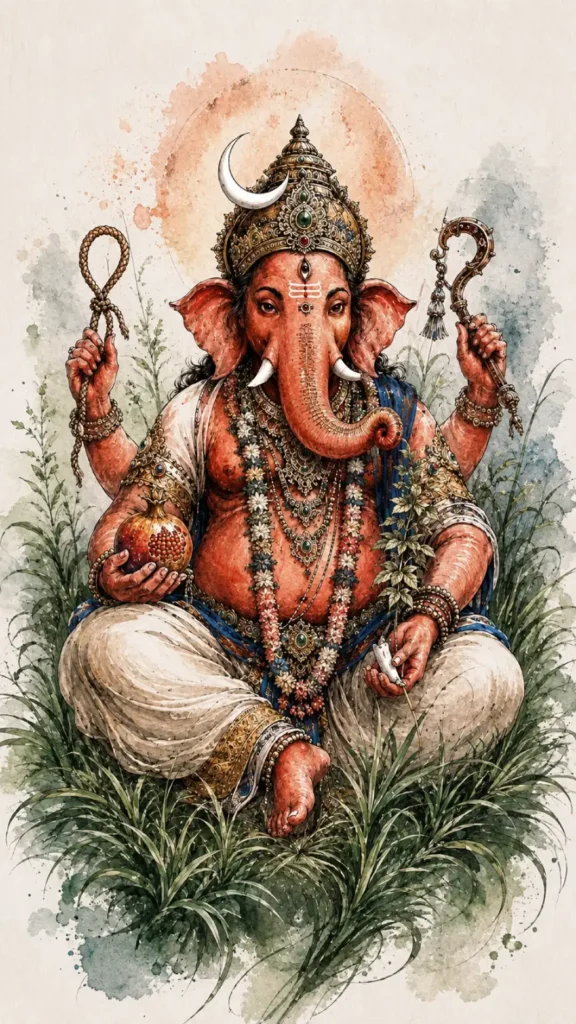
The Swift Grace of Lord Ganesha
There are moments in life when we do not ask for everything to change. We simply wish for clarity to arrive in time.
A difficult decision may need wisdom. A new beginning may need courage. A troubled mind may long for reassurance. In such moments, the symbolism of Kshipra Prasada Ganapati carries a particularly beautiful message: divine grace can be immediate, but true grace also teaches us how to respond wisely.
Kshipra Prasada Ganapati is traditionally counted as the twentieth among the 32 forms of Lord Ganesha described in the Ganapati tradition. His distinctive form is associated with swiftness, responsiveness and the bestowal of grace. Traditional descriptions portray him with a crimson-red complexion, six arms, a crescent moon and a third eye, seated upon a seat of sacred kusha grass.
This is not simply another artistic form of Ganesha. It is an invitation to reflect on the relationship between sincere effort, divine grace and the right moment.
Who Is Kshipra Prasada Ganapati?
Kshipra Prasada Ganapati is a particular manifestation of Lord Ganesha, the beloved elephant-headed deity worshipped throughout Hindu traditions.
He belongs to the celebrated group of the 32 forms of Ganapati, each presenting a distinct visual and spiritual aspect of Ganesha.
The word Kshipra conveys the sense of something swift, quick or immediate. Prasada has a richer devotional meaning. It can refer to grace, benevolence, favour or the peaceful generosity of the Divine.
Together, the name points toward Ganesha as the swift bestower of grace.
This does not have to be understood as a promise that every wish will instantly become reality. Rather, devotees can understand the form as expressing the hope that when the heart turns sincerely toward the Divine, guidance and grace may arrive without unnecessary delay.
Kshipra Prasada Ganapati is therefore especially evocative for moments of urgency, transition and uncertainty.
The Meaning of Kshipra Prasada Ganapati’s Name
The name itself contains the central teaching of this form.
Kshipra — swift, quick or immediate.
Prasada — grace, favour, benevolence or divine blessing.
Ganapati — the Lord of the ganas, one of the great names of Ganesha.
The phrase Kshipra Prasada can therefore be understood devotionally as “swift grace” or “the one who bestows grace swiftly.”
Yet there is an important spiritual nuance.
Swift grace does not necessarily mean receiving exactly what we ask for. Sometimes grace may appear as a solution. Sometimes it may appear as courage to endure a difficulty. At other times, it may be the clarity to recognise that a particular path is not right.
This makes Kshipra Prasada Ganapati an especially meaningful symbol in a world where people often expect immediate answers.
His symbolism reminds us that speed and wisdom need not be opposites.
The Story and Traditional Origin of Kshipra Prasada Ganapati
Kshipra Prasada Ganapati is not primarily known through a single dramatic birth story like some of Ganesha’s other celebrated manifestations.
His identity comes from the traditional cycle of Ganapati’s 32 forms, whose iconographic descriptions are associated with the Mudgala Purana tradition and were also transmitted through later iconographic works such as the Sri Tattvanidhi.
Within this tradition, each form expresses a particular quality of Ganapati.
Kshipra Prasada Ganapati embodies the idea of rapid divine response.
The imagery is therefore purposeful. His energetic red complexion, multiple hands and distinctive attributes create an impression of a deity who is not distant or inactive, but alert and responsive.
There is also a moral dimension to the traditional understanding of this form. The same principle of swift response that makes divine grace reassuring also suggests that actions have consequences. Devotion is therefore not merely about asking for favours. It is about becoming more conscious of one’s choices.
The deeper story is consequently one of grace joined with responsibility.
The Divine Form of Kshipra Prasada Ganapati
Traditional iconography gives this form a striking appearance.
Kshipra Prasada Ganapati is described with a red or crimson complexion and six arms. He bears a crescent moon upon his head and is described as three-eyed, connecting his imagery symbolically with the wider Shaiva dimension of Ganesha. He is associated with a kusha-grass seat, while his large belly expresses the expansive nature of the manifested universe.
Each element contributes to the visual personality of the deity.
The crimson body gives the form warmth, vitality and presence. It makes the image visually powerful while reinforcing the idea of active divine energy.
The crescent moon introduces a contrasting sense of coolness and composure.
The third eye suggests awareness beyond ordinary perception. It can be understood as a reminder that true clarity is not merely seeing what is immediately before us, but recognising what lies beneath appearances.
The six arms allow several sacred attributes to be represented simultaneously, creating an image of abundance without suggesting excess.
The Symbols and Attributes of Kshipra Prasada Ganapati
The traditional meditation description associates Kshipra Prasada Ganapati with six important attributes: the broken tusk, elephant goad, lotus, Kalpalata, noose and a lemon-like fruit.
The Broken Tusk
The tusk is one of Ganesha’s most recognisable symbols.
In devotional interpretation, the broken tusk can remind us that wisdom sometimes requires sacrifice. What appears incomplete can still become an instrument of higher purpose.
The Ankusha — Elephant Goad
The ankusha is a tool of direction and control.
In Ganesha’s hand, it can represent the ability to redirect the mind when it becomes distracted or loses its way.
Swift action without direction can create confusion. The goad therefore adds an important balance to the idea of speed.
The Pasha — Noose
The noose represents restraint and the ability to draw something closer.
Devotionally, it can be understood as the power to restrain harmful tendencies while bringing the wandering mind back toward its higher purpose.
The Lotus
The lotus is a familiar Hindu symbol of purity and spiritual unfolding.
Its beauty arises even though its roots remain in muddy water. It therefore offers a powerful reminder that difficult circumstances do not have to determine the quality of one’s inner life.
Kalpalata
The Kalpalata, or wish-fulfilling creeper associated with the divine Kalpavriksha tradition, represents abundance and the flowering of aspirations.
Its presence can be read more deeply than simply as a symbol of getting what one wants. It invites reflection on which desires are worthy of cultivation.
The Fruit
Traditional descriptions differ slightly in how this attribute is translated, with the Sanskrit Bijapura commonly interpreted as a citron-like fruit. Some modern devotional artworks instead depict a pomegranate or similar fruit.
This is important when looking at sacred art: artistic representations do not always reproduce every textual detail identically.
The uploaded ShaktiShraddha artwork, for example, presents the deity in a richly detailed contemporary devotional style. Its fruit, vegetation and ornamental treatment create an artistic interpretation of the traditional form rather than claiming to be a literal archaeological reconstruction.
That distinction allows sacred art to remain both beautiful and culturally responsible.
The Spiritual Meaning of Kshipra Prasada Ganapati
The deepest message of Kshipra Prasada Ganapati is not simply “receive quickly.”
It is “recognise grace when it comes, and become ready to act wisely.”
In modern life, we often associate speed with success. Faster communication, faster decisions and faster results have become normal expectations.
Kshipra Prasada Ganapati introduces another kind of speed: the speed with which confusion can give way to clarity.
His symbolism encourages:
- responsiveness without impulsiveness
- ambition without restlessness
- prayer without passivity
- action without arrogance
- desire balanced by discernment
- confidence grounded in devotion
This makes the form particularly meaningful for anyone standing at a crossroads.
Why Devotees Are Drawn to Kshipra Prasada Ganapati
Devotees traditionally turn toward Ganesha when beginning important undertakings, seeking wisdom and remembering the need to overcome obstacles.
Kshipra Prasada Ganapati gives this devotional relationship a distinctive emphasis on timely grace.
Someone facing an uncertain professional decision may find meaning in his symbolism. A family beginning a new chapter may feel connected to his association with auspicious beginnings. Someone simply carrying an anxious mind may find comfort in the image of a compassionate deity whose very name speaks of swift grace.
These are spiritual and devotional meanings, not guarantees of specific worldly outcomes.
The beauty of the tradition lies precisely there: prayer does not remove personal responsibility. Instead, it can help a person approach responsibility with greater faith and steadiness.
Kshipra Prasada Ganapati in Everyday Life
The modern world moves quickly, but the human heart has not necessarily become better at handling uncertainty. Careers change rapidly. Families carry complicated responsibilities. Important decisions are sometimes made while the mind is tired. Kshipra Prasada Ganapati can become a visual reminder to pause before reacting. His ankusha can remind us to direct the mind. His pasha can remind us not to become captive to every fear. His lotus can remind us to remain inwardly clean even when circumstances are difficult. His broken tusk can remind us that meaningful achievement sometimes requires sacrifice, and his name itself can remind us to remain open to grace. The teaching is remarkably contemporary: respond quickly when necessary, but never allow urgency to destroy wisdom.
Famous Temple Associated With Kshipra Prasada Ganapati
A particularly relevant dedicated shrine is Sree Kshipra Prasada Ganapathy Temple in Chathapuram, Kalpathy, Palakkad, Kerala.
Temple/Sacred Place: Sree Kshipra Prasada Ganapathy Temple
Location: Chathapuram, Kalpathy, Palakkad
State: Kerala
Public Address: QJWX+3C2, Chathapuram, Kalpathy, Palakkad, Kerala 678003, India
The shrine is situated within the historic Kalpathy area, a culturally important temple landscape of Palakkad. Kerala Tourism’s material for the Kalpathy Ratholsavam specifically identifies the Kshipra Prasada Ganapathy Temple as a nearby landmark, while local listings identify the shrine at Chathapuram, Kalpathy.
For readers interested in broader Ganesha pilgrimage traditions, Karpaga Vinayagar Temple at Pillayarpatti, Tamil Nadu is another important historic Ganesha shrine. However, it should not be described as a universally established dedicated temple of Kshipra Prasada Ganapati. The Tamil Nadu Government identifies Pillayarpatti as an ancient rock-cut Ganesha temple whose principal deity is Karpaga Vinayagar.
This distinction matters. A responsible sacred-art article should not turn a broader Ganesha association into an unsupported claim about a particular manifestation.
Why Kshipra Prasada Ganapati Makes Meaningful Sacred Art
Some divine forms are visually beautiful. Others are visually beautiful and carry an immediately understandable spiritual idea.
Kshipra Prasada Ganapati belongs to the second category.
The crimson complexion creates a strong focal presence. The six arms create visual rhythm. The crescent moon and third eye add Shaiva depth. The lotus, noose, goad, tusk and sacred creeper provide layers of symbolism that invite the viewer to look again.
This makes the form especially suited to premium devotional wall art, framed artwork and statement canvas pieces.
The ShaktiShraddha artwork shown here also brings an organic, botanical atmosphere into the composition. The surrounding greenery softens the grandeur of the deity and gives the image a contemplative quality.
For a prayer room, meditation corner or carefully designed spiritual space, such artwork can become more than decoration. It can become a visual reminder of faith, resilience and timely grace.
For international Indian homes, it can also carry another meaning: a beautiful connection to Hindu visual culture and inherited spiritual traditions.
The artwork itself does not guarantee blessings. Its value lies in what it helps the viewer remember.
Kshipra Prasada Ganapati, Vastu and Sacred Placement
There is no single universally binding Hindu rule that determines where every depiction of Ganesha must be placed.
According to commonly followed Vastu traditions, devotional artwork is most naturally placed in a clean prayer room, home temple or meditation space where it can be approached respectfully.
A beautifully framed depiction can also work as a spiritual focal point in a living area or personal workspace, particularly when the intention is contemplative rather than merely decorative.
The most important principle is respect: the artwork should be kept clean and treated as sacred imagery rather than as an ordinary decorative object.
Claims that a particular placement will automatically produce wealth, remove negative energy or guarantee success should be treated cautiously.
Bringing the Meaning of Kshipra Prasada Ganapati Into the Home
A sacred image has a quiet power that does not depend upon exaggerated promises.
Every time the eyes rest upon Kshipra Prasada Ganapati, the viewer may remember a different aspect of his symbolism.
Act with courage. Think with clarity. Restrain what distracts you. Remain open to grace.
That is where sacred art becomes personally meaningful.
A carefully created Kshipra Prasada Ganapati artwork from ShaktiShraddha can therefore be chosen not merely because the image is striking, but because its symbolism speaks to a particular season of life.
A detailed framed artwork can become part of a home temple. A larger canvas can establish a serene devotional focal point. A high-resolution artwork can allow families in India or abroad to create a personal sacred space around a form that carries deep cultural meaning.
The purpose is not to promise that art changes destiny.
It is to allow meaning, beauty and devotion to live together in the spaces where everyday life unfolds.
The Enduring Message of Kshipra Prasada Ganapati
Life rarely tells us exactly when the answer will arrive. Sometimes we wait. Sometimes we act. Sometimes we pray. Sometimes we discover that what we thought was an obstacle was actually redirecting us toward something wiser. Kshipra Prasada Ganapati stands within the rich Ganapati tradition as a powerful symbol of swift grace and responsive divine presence. His six hands remind us that life contains many responsibilities at once. His goad teaches direction. His noose teaches restraint. His lotus teaches purity. His tusk recalls purposeful sacrifice.
His sacred creeper evokes the flowering of aspiration, and his name carries the simplest message of all:
Grace may come swiftly, but wisdom teaches us how to receive it.
That is what makes Kshipra Prasada Ganapati such a compelling subject for sacred art. In a ShaktiShraddha artwork, his presence can transform a wall into a quiet place of remembrance—a place where beauty meets devotion, and where the ancient idea of divine grace can remain part of modern life.
Three trusted external references
Traditional iconographic reference for Kshipra Prasada Ganapati
Kerala Tourism reference to the Kalpathy sacred landscape
Tamil Nadu Government reference to Pillayarpatti Temple
7. FAQ
1. Who is Kshipra Prasada Ganapati?
Kshipra Prasada Ganapati is the twentieth form among the traditional 32 forms of Ganesha. He represents the swift bestowal of divine grace.
2. What does Kshipra Prasada Ganapati mean?
Kshipra means swift or immediate, while Prasada refers to grace or divine benevolence. The name therefore expresses the idea of Ganesha as the swift bestower of grace.
3. How many arms does Kshipra Prasada Ganapati have?
Traditional iconographic descriptions portray Kshipra Prasada Ganapati with six arms.
4. What does Kshipra Prasada Ganapati hold?
Traditional descriptions associate him with the broken tusk, elephant goad, lotus, Kalpalata, noose and a citron-like fruit. Artistic depictions may vary in how these attributes are rendered.
5. What does Kshipra Prasada Ganapati symbolize?
He symbolizes timely grace, responsiveness, discernment, disciplined action and the ability to meet difficult situations with faith and clarity.
6. Which temple is associated with Kshipra Prasada Ganapati?
A dedicated shrine known as Sree Kshipra Prasada Ganapathy Temple is located in Chathapuram, Kalpathy, Palakkad, Kerala.
7. Is Kshipra Prasada Ganapati suitable for a home temple?
Yes. A respectful depiction can be placed in a clean home temple or prayer space. It can also serve as a visual reminder of faith, clarity and divine grace.
8. Why is Kshipra Prasada Ganapati meaningful as sacred art?
His distinctive six-armed form, crimson complexion, crescent moon and symbolic attributes create a visually rich subject while expressing the devotional idea of swift divine grace.