
Ekakshara Ganapati
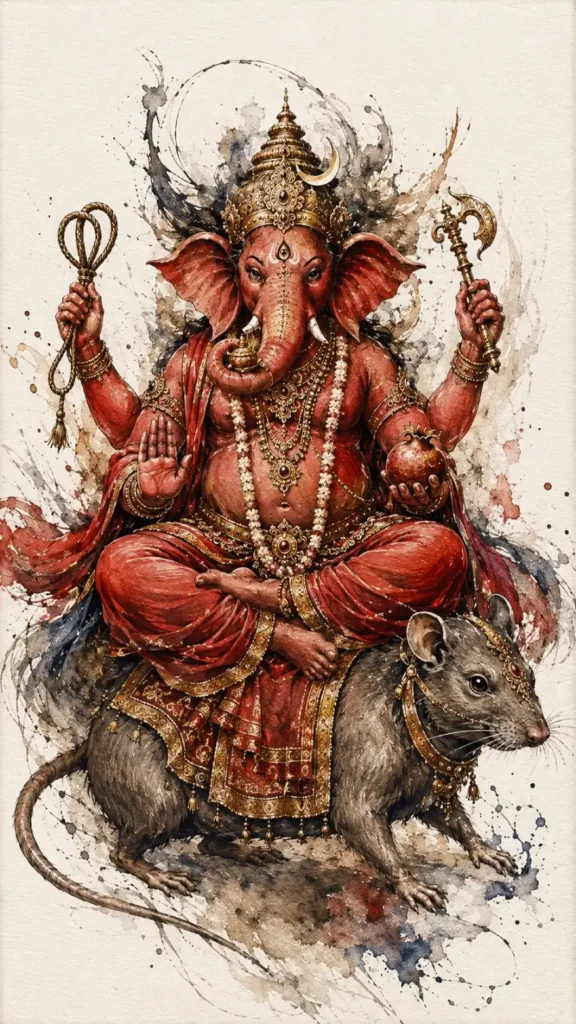
The Ganesha of the Sacred Single Syllable
There are moments when the mind becomes crowded with too many thoughts. We move from one concern to another, from one desire to another, rarely allowing ourselves to become completely still.
Hindu spiritual traditions have long understood the power of sound to gather the scattered mind.
Among the many forms of Lord Ganesha, Ekakshara Ganapati carries a particularly contemplative meaning. His name points toward the idea of the single sacred syllable—the concentrated sound associated with Ganapati’s divine essence. Rather than emphasizing a dramatic battle or a grand mythological episode, this form invites the devotee inward, toward concentration, awareness and the quiet power of sacred sound.
Ekakshara Ganapati is traditionally described as a red-complexioned, four-armed form of Ganesha, seated in a meditative posture upon Mushika, the mouse, with a crescent moon adorning his crown. Traditional descriptions associate his hands with the pomegranate, noose, goad and boon-giving gesture.
For ShaktiShraddha, this makes Ekakshara Ganapati especially meaningful as sacred art: a powerful visual expression of focus, spiritual presence and the divine contained within simplicity.
Who Is Ekakshara Ganapati?
Ekakshara Ganapati is one of the traditionally recognized forms of Lord Ganesha and is associated with the sacred single-syllable bīja, or seed sound, Gam (गं).
The word eka means “one,” while akshara can refer to a syllable or sacred imperishable sound. Thus, Ekakshara Ganapati may be understood as Ganapati associated with the single sacred syllable.
The form is particularly interesting because it expresses Ganesha not simply as the beloved remover of obstacles, but as a focus of contemplative awareness.
Traditional descriptions place him among the principal forms of Ganapati and give him a distinctive iconography: red complexion, three eyes, four arms, crescent moon, lotus posture and Mushika as his vehicle.
The emphasis is therefore less on external grandeur and more on the concentration of divine meaning into one sacred sound.
The Meaning of Ekakshara Ganapati’s Name
The name itself provides the key to understanding this form.
Eka means “one.”
Akshara means “syllable” or, in broader spiritual usage, an imperishable sacred sound.
Together, Ekakshara conveys the idea of the One Syllable.
In Ganapati traditions, the seed syllable Gam is associated with Ganesha. A bīja is not simply an ordinary word. In devotional and tantric traditions, a seed syllable is understood as a concentrated expression of divine presence.
Ekakshara Ganapati therefore represents a beautiful spiritual principle: what appears small can contain something immeasurably profound.
A single sound can become a point of concentration.
A single image can become a focus for prayer.
A single moment of stillness can change the quality of an entire day.
That is the deeper beauty of Ekakshara Ganapati.
The Story of Ekakshara Ganapati
Unlike forms of Ganesha that are defined by a major independent mythological episode, Ekakshara Ganapati is primarily understood through mantra, meditation and iconographic tradition. There is no single universally accepted Puranic story in which Ekakshara Ganapati appears as a separate incarnation to defeat one particular demon. This distinction is important. Creating such a story simply to make the form more dramatic would blur the difference between established tradition and later invention.
Instead, the significance of Ekakshara Ganapati comes from the relationship between Ganapati and sacred sound. Ganesha is already revered as the deity invoked at the beginning of auspicious undertakings. Ekakshara Ganapati takes this principle inward. The devotee does not merely ask for an obstacle to be removed externally; the mind itself becomes the field of spiritual practice.
Distraction, restlessness and uncertainty can become inner obstacles. The single sacred syllable becomes a means of gathering attention. The image of the deity becomes a visual support for contemplation, and Ganapati becomes not only the Lord who stands before the obstacle, but the divine presence through which one learns to approach obstacles with greater awareness. This is why the form feels particularly suited to meditation and mantra-oriented devotion.
The Divine Form of Ekakshara Ganapati
The traditional iconography of Ekakshara Ganapati is remarkably rich despite the apparent simplicity of the form.
He is generally described with a red complexion, a color traditionally associated with energy, vitality and divine activity.
He has three eyes, an unusual feature that gives this form a contemplative and elevated character. The third eye is also a visual connection with the wider Shaiva symbolism surrounding Ganesha.
A crescent moon may appear upon his crown. This detail gives the form a distinctly sacred and meditative appearance.
He is traditionally shown seated in Padmasana, the lotus posture, upon Mushika, his mouse vehicle. This combination creates a fascinating visual contrast: the immense elephant-headed deity rests upon a small creature.
Traditional iconographic descriptions also identify him as a four-armed form.
In sacred art, these elements come together to create an image that feels both powerful and inward-looking.
The Symbols and Attributes of Ekakshara Ganapati
Each attribute contributes another layer to the form.
The Pomegranate
Traditional descriptions associate one hand with a pomegranate, known as bījāpura in Sanskrit iconographic terminology.
Its many seeds enclosed within one fruit can be appreciated symbolically as an image of abundance contained within unity. It is a fitting attribute for a form whose very name points toward the concentration of many meanings into one sacred syllable.
The Noose
The pasha, or noose, is one of Ganesha’s familiar attributes.
In devotional interpretation, the noose can represent the power to draw the wandering mind back toward its proper direction.
It can also remind us that attachment can bind the individual when awareness is absent.
The Goad
The ankusha, or goad, represents direction and control.
Just as a goad guides an elephant, its presence in Ganesha’s hand can be understood as a reminder that spiritual discipline sometimes requires gentle but firm direction.
The mind needs both restraint and guidance.
The Boon-Giving Gesture
The Varada Mudra, or gesture of granting, gives the form an especially compassionate quality. It represents generosity and divine grace within the traditional visual language of Hindu iconography.
The gesture does not need to be interpreted as a promise of material rewards. Instead, it can be contemplated as an invitation to approach the divine with trust and humility.
The Spiritual Meaning of Ekakshara Ganapati
The deepest message of Ekakshara Ganapati is concentration through sacred awareness.
Modern life constantly pulls attention in different directions. Notifications, conversations, responsibilities, ambitions and worries compete for the mind.
Ekakshara Ganapati offers a contrasting image.
One syllable.
One point of attention.
One moment of stillness.
The form reminds us that spiritual depth does not always require complexity. Sometimes the most meaningful practice is the ability to return to one essential thought again and again.
The sacred syllable Gam becomes a symbol of this inward gathering.
For devotees, this form may therefore represent mental steadiness, focused devotion, disciplined attention and the search for the divine within sound.
Why Devotees Are Drawn to Ekakshara Ganapati
Ekakshara Ganapati can be especially meaningful to people who feel drawn toward mantra, meditation and contemplative worship. Students may appreciate the symbolism of focused attention. Those beginning a new discipline may find meaning in the image of a mind brought back to one purpose. People living demanding professional lives may connect with the reminder that constant activity does not necessarily produce inner clarity.
Devotees traditionally approach Ganesha with reverence at beginnings, and Ekakshara Ganapati adds another dimension to that devotion: beginning from within. Rather than promising a particular worldly result, this form invites a devotional relationship with concentration, awareness and sacred sound.
Ekakshara Ganapati in Everyday Life
The teaching of Ekakshara Ganapati can be surprisingly relevant to contemporary life. Imagine beginning the morning with a mind already filled with unfinished tasks. Before the day has properly started, there are messages to answer, decisions to make and responsibilities waiting. The symbolism of Ekakshara Ganapati offers a simple counterpoint.
Pause.
Gather the mind.
Return to what truly matters.
This does not mean abandoning ambition or responsibility. It means approaching them with greater inner order.
For someone building a career, the form can represent focused effort rather than scattered ambition.
For a parent, it can symbolize patience and attentive presence.
For someone beginning meditation, it can represent the discipline of returning whenever the mind wanders.
For anyone passing through uncertainty, it can become a reminder that clarity often begins by becoming quiet enough to listen.
This is where an ancient sacred form becomes a living presence in modern life.
Famous Temple Associated With Ekakshara Ganapati
There is no universally recognized major temple dedicated exclusively to Ekakshara Ganapati in the same way that particular regional forms of Ganesha have dedicated shrines.
For devotees wishing to experience a major living tradition of Ganesha worship, an appropriate and well-known destination is Shreemant Dagdusheth Halwai Ganpati Temple in Pune, Maharashtra. The temple is dedicated to Lord Ganesha generally, rather than specifically to Ekakshara Ganapati.
Temple: Shreemant Dagdusheth Halwai Ganpati Temple
City: Pune
State: Maharashtra, India
Address: Ganpati Bhavan, 250, Budhwar Peth, Pune, Maharashtra 411002.
The temple is particularly famous for its longstanding public Ganapati tradition and the large-scale devotional celebrations associated with it. Its importance lies in the living worship of Ganesha rather than in a claim that its principal deity is specifically Ekakshara Ganapati.
Shreemant Dagdusheth Halwai Ganpati Temple — Official Website
For the specific iconography and traditional description of Ekakshara Ganapati, Hindupedia — Ekakshara-Ganapati provides a concise traditional reference, while DrikPanchang — Ekakshara Ganapati records the commonly given iconographic details.
Vastu and Home Placement of Ekakshara Ganapati
According to commonly followed Vastu traditions, images of Ganesha are often placed in spaces associated with prayer, devotion and positive daily activity. For Ekakshara Ganapati, a home temple, prayer room or meditation space is especially natural because of the form’s contemplative symbolism.
A beautifully framed representation can also work in a quiet study or personal workspace where its visual presence serves as a reminder of concentration. Placement traditions vary across regions and households, so they should not be treated as universal Hindu scripture. More important than treating the artwork as a magical object is maintaining a respectful, clean and devotional environment around it.
Why Ekakshara Ganapati Makes Meaningful Sacred Art
Ekakshara Ganapati has an unusual artistic strength: every element has something to say.
The red complexion creates warmth and vitality.
The elephant face communicates wisdom and divine strength.
The crescent moon introduces a contemplative Shaiva dimension.
The four hands create visual balance.
The Mushika beneath him introduces humility and contrast.
And the surrounding symbolism gives the viewer multiple details to discover slowly.
This makes Ekakshara Ganapati particularly suited to premium framed artwork, canvas wall art and devotional pieces for meditation spaces or home temples.
The ShaktiShraddha artwork shown with this article presents the deity in a richly detailed, red-toned artistic interpretation, with an ornate crown, crescent moon, four arms, sacred attributes and Mushika beneath him. Its expressive watercolor-inspired treatment gives the traditional form an intimate contemporary character.
Such an artwork does not need to promise supernatural results to be meaningful.
It can simply become a visual reminder of faith.
A quiet focal point during prayer.
A representation of Indian sacred heritage.
Or an elegant devotional presence within a contemporary home.
For Indian families living abroad, it can also carry another layer of meaning: a connection to traditions, stories and visual culture that can be passed naturally from one generation to another.
Bringing the Single Sacred Sound Into the Home
Ekakshara Ganapati teaches through concentration.
He reminds us that the sacred does not always announce itself through something enormous or complicated. Sometimes it is contained in one sound, one image, one prayer, one moment of attention.
That is what makes this form so compelling.
In a world where attention is constantly divided, Ekakshara Ganapati represents the beauty of gathering it again.
A sacred artwork inspired by this form can carry that idea into the spaces where life actually happens—the prayer room, meditation corner, study or living space.
At ShaktiShraddha, the purpose of sacred art is not simply to reproduce an image of a deity. It is to preserve meaning, beauty and devotion in visual form.
Ekakshara Ganapati is particularly suited to that vision: an ancient form whose message is remarkably contemporary.
One sacred syllable. One focused mind. One quiet reminder that the divine can be approached through attention itself.
7. FAQ
Who is Ekakshara Ganapati?
Ekakshara Ganapati is a traditional form of Lord Ganesha associated with the single sacred syllable and the Ganesha bīja Gam (गं). He is especially connected with contemplative and mantra-oriented devotion.
What does Ekakshara Ganapati mean?
Ekakshara means “one syllable” or “single sacred syllable.” In the Ganapati tradition, it is associated with the seed syllable Gam.
What does Ekakshara Ganapati symbolize?
He is particularly associated with concentrated awareness, sacred sound, meditation, disciplined attention and the inward gathering of the mind.
What does Ekakshara Ganapati traditionally look like?
Traditional descriptions portray him with a red complexion, three eyes, four arms, a crescent moon on his crown, lotus posture and Mushika as his vehicle. His attributes include a pomegranate, noose, goad and boon-giving gesture.
Is there a temple dedicated specifically to Ekakshara Ganapati?
There is no universally recognized major temple dedicated exclusively to this form. Ekakshara Ganapati is primarily known through traditional iconography and devotional practice associated with the forms of Ganesha.
Is Ekakshara Ganapati suitable for a home temple?
Yes. Its contemplative character makes it particularly meaningful for a home shrine, prayer room or meditation space, provided the image is treated with appropriate devotional respect.
Why is Ekakshara Ganapati meaningful as wall art?
Its distinctive red form, crescent moon, four arms, sacred attributes and Mushika create a visually rich composition while its symbolism gives the artwork a deeper spiritual meaning.
What is the main spiritual lesson of Ekakshara Ganapati?
The central lesson is the power of focused awareness: instead of allowing the mind to remain scattered, return repeatedly to one sacred point of attention.