
Ekadanta Ganapati
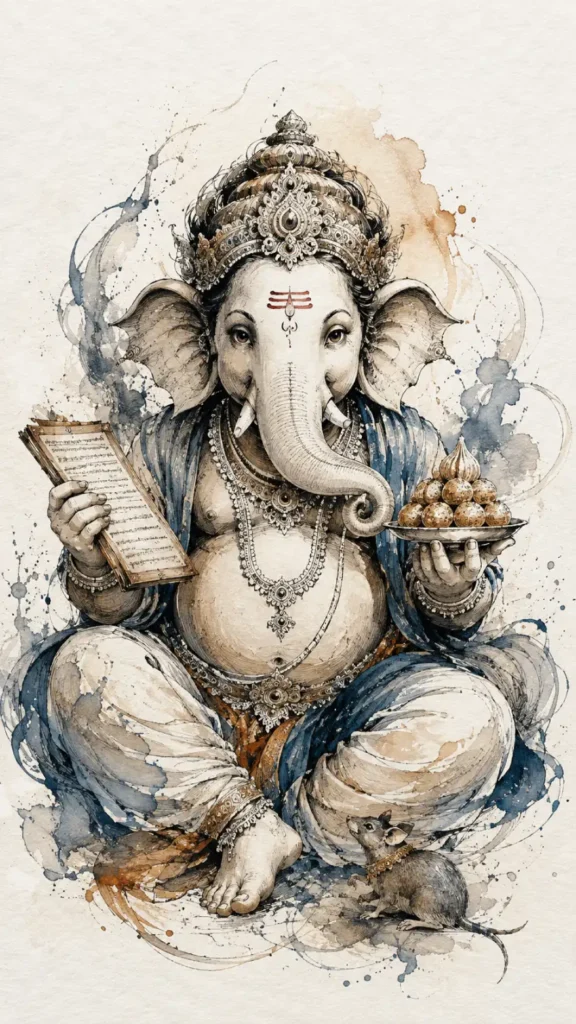
The One-Tusked Lord Who Teaches the Strength of Inner Mastery
There is a quiet power in a form that carries a mark of incompleteness. One tusk remains. The other is absent. Yet Ekadanta Ganapati does not appear diminished. His single tusk becomes a reminder that wisdom does not depend upon having everything we once possessed. Sometimes, what appears to be a loss becomes part of a deeper strength.
Among the many sacred manifestations of Lord Ganesha, Ekadanta Ganapati holds a particularly profound place. The name means “the One-Tusked Lord,” but within the tradition associated with the Mudgala Purana, Ekadanta represents much more than a distinctive physical feature. He is connected with the overcoming of Madāsura, the embodiment of arrogance and conceit, and with the deeper spiritual movement from pride toward humility and self-mastery.
This makes Ekadanta especially meaningful in an age when achievement, recognition and personal identity can easily become sources of attachment.
Who Is Ekadanta Ganapati?
Ekadanta Ganapati is a distinctive form of Lord Ganesha, traditionally associated with the eight important incarnations of Ganesha described in the Mudgala Purana.
In that tradition, Ekadanta is the second of the eight major manifestations, following Vakratunda. The Mudgala Purana associates this form with the overcoming of Madāsura, whose name is connected with pride, arrogance or intoxication with one’s own power. His vehicle is traditionally described as the mouse.
The word Ekadanta comes from Sanskrit:
- Eka — one
- Danta — tusk or tooth
Thus, Ekadanta literally means “the One-Tusked One.”
The name is also one of the celebrated names of Ganesha in the wider Hindu tradition. It is important, however, to distinguish between Ganesha as Ekadanta by name and the more specific Ekadanta form described within iconographic traditions.
The distinction becomes particularly important when creating devotional artwork. Different traditions and artistic lineages may portray Ganesha with variations in complexion, objects and details.
The Meaning of Ekadanta’s Name
At the simplest level, Ekadanta refers to Ganesha’s single visible tusk.
But the symbolism goes deeper.
A broken or missing tusk can remind the devotee that spiritual strength is not the same as physical perfection. Human life contains change, loss, limitation and imperfection. Yet none of these necessarily prevents wisdom from becoming complete.
Traditional interpretations also connect the single tusk with one-pointedness and discrimination—the ability to remain centred on what is essential instead of being scattered by endless desires.
The Mudgala Purana gives Ekadanta an especially philosophical dimension. The form is associated with the essential nature of Brahman and with the overcoming of Madāsura. In this framework, the story is not merely about a divine hero defeating a demon. It is also about consciousness overcoming the arrogance that makes the individual believe that power, achievement or identity exists independently of the divine order.
The Story of Ekadanta Ganapati
The story of Ekadanta is closely connected with Madāsura, whose defining quality is pride. Madāsura acquires extraordinary power and gradually becomes consumed by the very strength he has gained. Instead of allowing power to serve dharma, he begins to use it as an expression of superiority. His arrogance disturbs the balance of the worlds, and the divine beings seek a way to restore order.
Ganesha manifests as Ekadanta.
The encounter is significant because Ekadanta does not represent power merely as physical force. He represents a higher intelligence capable of confronting pride at its root.
The confrontation eventually leads Madāsura to recognize the limits of his own power. Rather than simply ending the story with destruction, the tradition gives it a more inward conclusion: Madāsura submits before Ekadanta.
A verse associated with the Mudgala Purana records Madāsura addressing Ekadanta as the one whose nature encompasses Maya and Brahman. This makes the conclusion particularly meaningful—the demon who had become intoxicated with his own power finally recognizes a reality greater than himself.
The spiritual lesson is subtle. Pride is not overcome merely by becoming stronger than another person. It is overcome when the mind recognizes that individual achievement is not the entirety of existence. Ekadanta therefore becomes a symbol of inner mastery rather than outward domination. The story can be read as an invitation to ask:
Am I using my abilities wisely, or have I become attached to the image of myself as powerful?
That question remains as relevant today as it is in the ancient narrative.
The Divine Form of Ekadanta Ganapati
Traditional iconographic descriptions of Ekadanta Ganapati commonly present him as a four-armed form of Ganesha, distinguished by his single tusk. One established iconographic description gives him a blue-black complexion and four hands carrying a broken tusk, rosary, sweet and axe.
The exact artistic treatment can vary between traditions.
Devotional artists may soften the complexion, alter the intensity of the expression, or interpret the surrounding atmosphere according to their artistic lineage. Such variations should be understood as artistic interpretation rather than automatically treated as scriptural requirements.
The essential identity remains the elephant-headed Lord with one tusk and the characteristic attributes associated with this form.
The mouse, his traditional vāhana, is also important. Despite its small size, the mouse represents a striking contrast to Ganesha’s immense form. It reminds us that divine intelligence can master even restless and seemingly insignificant forces.
The Symbols and Attributes of Ekadanta
Each element traditionally associated with Ekadanta can be understood as part of a larger spiritual vocabulary.
The Single Tusk
The single tusk is the defining feature.
It can be contemplated as a symbol of focus, resilience and the ability to preserve what is essential even after something has been lost.
It also creates a powerful visual paradox: something apparently broken becomes one of the most recognizable signs of divine identity.
The Broken Tusk
In the broader Ganesha tradition, several stories explain how Ganesha came to have one tusk. Among the best-known are narratives involving Parashurama and another tradition connecting the tusk with Ganesha’s writing of the Mahabharata.
These stories belong to different narrative traditions and should not be unnecessarily merged into the specific Madāsura story of the Mudgala Purana.
For sacred art, the important point is that the tusk carries a rich history of associations with sacrifice, determination, knowledge and transcendence of limitation.
The Rosary
The akṣamālā, or rosary, represents spiritual practice, contemplation and disciplined attention.
It is a gentle reminder that wisdom is not produced by occasional inspiration alone. It develops through steady practice.
The Axe
The axe, or kuṭhāra, can be understood symbolically as the power to cut through obstacles, attachment and destructive tendencies.
In the context of Ekadanta, it resonates especially well with the overcoming of pride.
The Sweet
The sweet traditionally held by Ganesha represents the sweetness associated with spiritual fulfilment.
It also gives the otherwise philosophical image a warmth that is characteristic of Ganesha’s devotional personality.
Traditional Ekadanta iconographic reference
The Spiritual Meaning of Ekadanta Ganapati
The deepest message of Ekadanta is humility without weakness. The form does not teach that achievement is wrong. Instead, it suggests that achievement becomes dangerous when it produces arrogance. This is precisely why Madāsura is such a meaningful opponent. A person may become successful and still remain humble. Another person may achieve much less and yet become deeply attached to ego. The real obstacle is therefore not success itself but identification with success.
Ekadanta teaches:
- strength should be accompanied by humility;
- knowledge should not create arrogance;
- achievement should not become identity;
- loss does not necessarily destroy wholeness;
- concentration is stronger than scattered desire;
- inner discipline can transform pride into wisdom.
In this sense, Ekadanta is not simply the Ganesha who has one tusk. He is the Ganesha who teaches us what remains when the unnecessary falls away.
Why Devotees Are Drawn to Ekadanta Ganapati
Devotees may find Ekadanta particularly meaningful when reflecting upon ego, ambition, personal achievement and self-discipline. Someone beginning a demanding professional journey may see in him a reminder to remain grounded. A person who has experienced failure may find comfort in the symbolism of the single tusk: something may have changed, but one’s deeper strength can remain. Someone who has achieved recognition may contemplate Madāsura and ask whether success is beginning to influence character. Devotional traditions do not require the worshipper to be perfect before approaching Ganesha. The value of the form lies partly in its invitation to recognize one’s own inner obstacles honestly.
Ekadanta Ganapati in Everyday Life
Modern life gives pride many opportunities to disguise itself. It can appear as the need to always be right, the desire for recognition, professional competition, social-media comparison or the constant pressure to prove one’s worth. Ekadanta offers another way of thinking. Before an important decision, one can pause and ask whether the decision comes from clarity or from the need to prove something. Before reacting to criticism, one can ask whether the ego has been wounded.
After success, one can remember the people, circumstances and opportunities that made that success possible. And after failure, one can remember that an apparent imperfection does not make a person incomplete. This is where an ancient form becomes surprisingly contemporary. Ekadanta does not ask us to abandon ambition. He asks us to keep ambition under the guidance of wisdom.
Famous Temple Associated With Ekadanta Ganapati
There is no universally recognized major temple dedicated exclusively to the Ekadanta incarnation in the same way that particular temples are associated with specific Ganesha manifestations.
For readers wishing to visit a major living centre of Ganesha worship, an appropriate broader association is the Shree Siddhivinayak Ganapati Mandir in Prabhadevi, Mumbai. This is a temple dedicated to Lord Ganesha generally, not a temple specifically identified as an Ekadanta shrine.
The temple’s official history records its first consecration on 19 November 1801. Its principal black-stone Siddhivinayak image is especially distinctive for its right-curving trunk and four hands.
Temple: Shree Siddhivinayak Ganapati Mandir
Location: Prabhadevi, Mumbai, Maharashtra
Address: S.K. Bole Marg, Prabhadevi, Mumbai, Maharashtra 400028, India
Why It Is Famous: One of Mumbai’s most prominent and widely visited Ganesha temples.
Connection with Ekadanta: The connection is through the broader worship of Lord Ganesha rather than a claim that the principal idol is specifically the Ekadanta incarnation.
Official Shree Siddhivinayak Ganapati Mandir
Ekadanta Ganapati and Devotional Placement at Home
Ekadanta can naturally become part of a home temple, prayer room or meditation space.
According to commonly followed devotional practices, sacred images are best placed in a clean, respectful and well-maintained area where they can be approached with attention rather than treated merely as decoration.
Specific Vastu rules for the exact Ekadanta form vary across traditions, so they should not be presented as universal Hindu scripture.
For ShaktiShraddha artwork, the more important consideration is devotional atmosphere: a location where the image can serve as a quiet visual reminder of humility, focus and wisdom.
Why Ekadanta Ganapati Makes Meaningful Sacred Art
Ekadanta is especially compelling as spiritual art because his visual identity immediately carries a story.
The single tusk creates a powerful focal point.
The elephant face conveys wisdom and dignity. The rosary introduces contemplation. The axe suggests the removal of inner obstacles. The sweet adds warmth. The mouse brings an unexpected sense of humility beneath the grandeur of the divine form.
This combination gives Ekadanta artwork a distinctive character.
A carefully rendered Ekadanta Ganapati painting can work beautifully as framed devotional art, a refined wall piece, a meditation-space artwork or part of a home temple collection.
For someone living outside India, such an artwork can also become a visual connection to Hindu heritage and Indian sacred traditions.
The value of sacred art is not that the printed or painted object automatically possesses supernatural powers. Its value lies in what it can help us remember.
A beautiful image can become a focal point for prayer.
It can remind a family of its traditions.
It can create a peaceful atmosphere in a meditation space.
And it can preserve a sacred story in visual form.
Bringing Ekadanta Ganapati Into ShaktiShraddha Art
At ShaktiShraddha, the appeal of Ekadanta lies in the meeting of devotion, symbolism and visual beauty.
A thoughtfully created Ekadanta artwork does more than reproduce the familiar image of Ganesha. It gives visual form to an ancient teaching: that humility is a form of strength, that loss does not erase wholeness, and that achievement becomes meaningful when guided by wisdom.
The soft expression, the single tusk, the traditional attributes and the calm presence of Ganesha can transform a devotional illustration into something deeply personal.
A finely detailed framed Ekadanta Ganapati artwork can become a graceful presence in a prayer room or living space. A high-resolution devotional artwork can also allow devotees and admirers of Indian spiritual art around the world to keep this sacred form close in their own surroundings.
The intention is not simply to decorate a wall. It is to keep a meaningful idea within sight.
The Enduring Message of Ekadanta Ganapati
Ekadanta reminds us that completeness is not always the absence of brokenness.
Sometimes wisdom begins when we stop hiding what life has changed.
The one-tusked Ganesha stands before Madāsura not merely as a stronger power, but as a higher consciousness. Pride bows when it recognizes something greater than itself.
That is why Ekadanta remains meaningful today.
In a world that constantly asks us to display achievement, status and success, this ancient form quietly asks another question:
Can we remain humble while becoming strong?
Perhaps that is the beauty of Ekadanta.
His single tusk is not a symbol of something missing.
It is a symbol of what remains essential.
And when that meaning is brought into sacred artwork, the image can become more than a beautiful representation of Ganesha. It can become a daily visual reminder of focus, humility, resilience and inner wisdom—the very qualities that give Ekadanta Ganapati his enduring place in Hindu devotional tradition.
7. FAQ
Who is Ekadanta Ganapati?
Ekadanta Ganapati is the One-Tusked form of Lord Ganesha. In the Mudgala Purana, he is one of Ganesha’s eight principal incarnations and is associated with overcoming Madāsura, the embodiment of arrogance or conceit.
What does Ekadanta mean?
Ekadanta comes from eka, meaning “one,” and danta, meaning “tusk” or “tooth.” It means the One-Tusked Lord.
What is the story of Ekadanta Ganapati?
According to the Mudgala Purana tradition, Ekadanta manifests to overcome Madāsura, whose immense power has become corrupted by pride. Madāsura ultimately recognizes Ekadanta’s greater spiritual authority and submits before him.
What does Ekadanta Ganapati symbolize?
Ekadanta is particularly associated with humility, self-mastery, focused awareness and overcoming arrogance. His single tusk can also be contemplated as a symbol of resilience and preserving what is essential.
What does Ekadanta Ganapati traditionally hold?
Traditional iconographic descriptions commonly show the four-armed form holding a broken tusk, rosary, sweet and axe. Iconographic variations can occur between artistic and regional traditions.
Which scripture is associated with Ekadanta Ganapati?
The Mudgala Purana is especially important because it describes Ekadanta as one of Ganesha’s eight major incarnations and connects him with the defeat of Madāsura.
Is Ekadanta Ganapati suitable for a home temple?
Yes, Ekadanta can be represented respectfully in a home temple or prayer space. Specific Vastu rules for this particular form vary by tradition and should not be treated as universal Hindu scripture.
Why is Ekadanta Ganapati meaningful in devotional art?
His single tusk and traditional attributes create a distinctive visual form while expressing deeper ideas of humility, resilience, focus and spiritual discipline. This makes Ekadanta particularly suitable for meaningful devotional paintings and sacred wall art.