
Dhundhi Ganapati
The Divine Seeker Who Guides the Search Within
There are moments when life feels like a search.
We search for an answer when the path ahead is uncertain. We search for wisdom when knowledge alone is not enough. We search for the right direction when several roads appear equally possible.
Hindu devotional tradition gives a beautiful name to this movement of seeking: Dhundhi.
Dhundhi Ganapati is a distinctive form of Lord Ganesha, traditionally counted as the twenty-sixth among the thirty-two forms of Ganapati. He is particularly associated with searching, discovering, spiritual inquiry and the removal of obstacles that stand between a seeker and what is truly worth finding. His connection with the sacred city of Kashi gives this form an even deeper dimension.
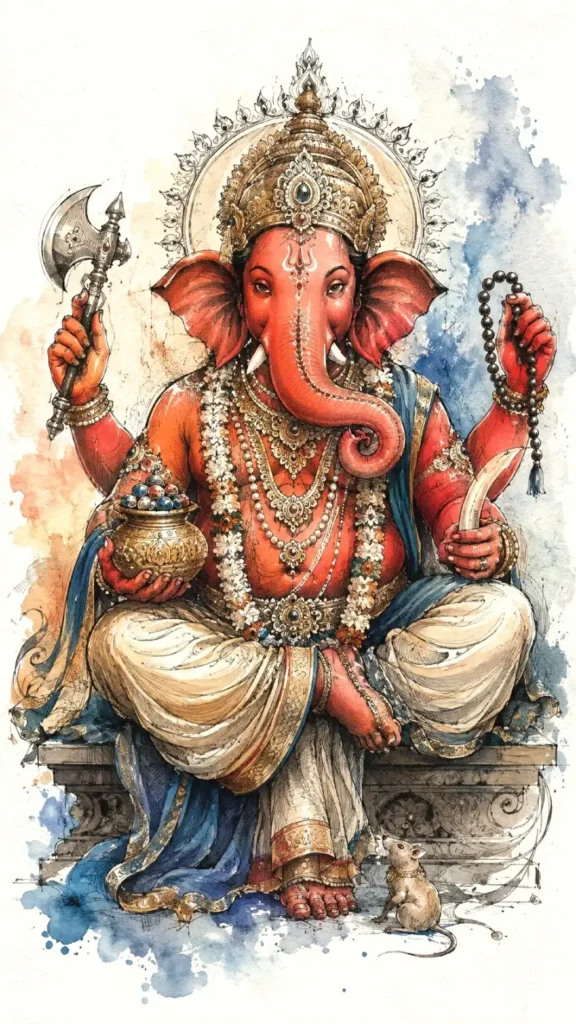
The traditional image of Dhundhi Ganapati is equally meaningful: a red-complexioned, four-armed Ganesha holding a rosary, an axe, his own broken tusk and a vessel filled with precious gems. Each object transforms the image into a visual teaching about disciplined effort, wisdom, discernment and the treasures discovered through sincere seeking.
Who Is Dhundhi Ganapati?
Dhundhi Ganapati is one of the Dvatrimshat Ganapati, the traditional group of thirty-two forms of Lord Ganesha.
Rather than representing thirty-two separate gods, these forms offer different ways of contemplating the many dimensions of Ganapati. Dhundhi is especially connected with the idea of searching and discovering.
The name is linked with the Sanskrit root associated with searching. A traditional account of Dhundhi Ganapati of Kashi explains the name through the idea of seeking or searching.
This gives the form an unusual spiritual character.
Ganesha is already revered as the deity who helps devotees approach beginnings with clarity. Dhundhi adds another dimension: the wisdom to search for what truly matters.
He is therefore meaningful not only when someone wants an obstacle removed, but also when the greater challenge is understanding what lies behind the obstacle.
The Meaning of Dhundhi Ganapati’s Name
The simplest meaning associated with Dhundhi is “the one who searches” or “the one connected with searching.”
But within devotional interpretation, the meaning becomes richer.
Searching can mean looking for an answer. It can mean seeking knowledge. It can mean searching for one’s true direction. At a deeper level, it can mean the spiritual search for truth.
The Kashi tradition gives this name a particularly beautiful interpretation. In the story associated with Dhundhi Ganapati, Ganesha himself goes to Kashi in search of the divine messengers who had previously been sent there. Later, Shiva praises him as Dhundhi because of this searching.
Thus the name does not suggest passive waiting.
It suggests intelligent seeking.
The Story of Dhundhi Ganapati
One of the most important stories connected with Dhundhi Ganapati comes through the Kashi Khanda tradition of the Skanda Purana.
The story begins with King Divodasa, who ruled Kashi with remarkable commitment to dharma. His kingdom became so orderly and prosperous that the gods found no fault in his conduct. Lord Shiva, however, longed to return to Kashi.
Yet there was a difficulty.
Divodasa’s rule had been established under a divine arrangement, and removing him could not simply be achieved through force. Shiva therefore sent several divine beings to Kashi, hoping that someone might find a way to change the situation.
The Yoginis went first. They became so enchanted by Kashi that they did not return.
Surya was sent next. He too remained in Kashi.
Brahma followed, but he also became absorbed in the sacred city.
Several of Shiva’s attendants were sent afterward, and they too established themselves in Kashi rather than returning to Mandara.
Finally, it was Ganesha’s turn.
Ganesha entered Kashi in the form of an elderly Brahmin astrologer. He quickly gained the confidence of the people and eventually became known to the royal household. Through his conversations and predictions, he helped create a change in the king’s state of mind.
The story then moves toward its resolution. Vishnu approaches King Divodasa and guides him toward renunciation. Divodasa eventually establishes a Shiva Lingam, gives up his kingdom and is taken to Kailasa. Shiva can then return to Kashi.
When Shiva returns, he praises Ganesha for accomplishing the task.
This is where the spiritual meaning of Dhundhi becomes especially powerful.
Ganesha did not overcome the situation through physical force. He used intelligence, observation, timing and wisdom.
The story therefore presents an important lesson: sometimes the obstacle before us cannot be overcome by pushing harder. It requires us to understand the situation more deeply.
The Divine Form of Dhundhi Ganapati
The traditional Dhundhi Ganapati described in the dhyana tradition has a distinctive four-armed form.
He is generally portrayed with a red complexion and four arms. His four hands hold:
- a Rudraksha mala, or rosary
- an axe
- his broken tusk
- a vessel filled with jewels
These details are not merely decorative. They form the visual language through which the form communicates its meaning.
The image you have presented also reflects this traditional visual vocabulary: a seated, richly ornamented Ganesha with four arms, the rosary and axe clearly visible, and the jewel vessel held close to his body.
Artists may vary details such as crown design, jewellery, clothing, throne, background and colour intensity. Such details belong to artistic interpretation rather than necessarily representing fixed scriptural requirements.
The Symbols and Attributes of Dhundhi Ganapati
The Rudraksha Mala — The Discipline of Seeking
The rosary represents repetition, concentration and sustained spiritual practice.
Searching for truth is rarely a single moment of inspiration. It often requires patience.
The mala therefore reminds the devotee that genuine understanding grows through regular practice, contemplation and attention.
The Axe — Cutting Through Obstacles
The axe is a familiar attribute of several forms of Ganesha.
In Dhundhi Ganapati’s symbolism, it can be understood as the power to cut through whatever obstructs the seeker’s progress.
Sometimes the obstacle is external.
Sometimes it is confusion, attachment, fear or an unwillingness to see clearly.
The Broken Tusk — Wisdom Through Sacrifice
The broken tusk is one of Ganesha’s most recognisable symbols.
It can remind devotees that wisdom is not always gained without sacrifice. Something may have to be surrendered—pride, attachment, hesitation or an old way of thinking—before deeper understanding can emerge.
The Jewel-Filled Vessel — The Treasure We Discover
The vessel containing precious gems provides a beautiful contrast to the axe.
One hand removes.
Another reveals.
The symbolism suggests that when obstacles are understood and cleared, something valuable can be discovered within the journey itself: knowledge, discrimination, spiritual maturity and inner clarity.
The Spiritual Meaning of Dhundhi Ganapati
At the heart of Dhundhi Ganapati is the idea of seeking with wisdom.
The form does not simply tell us to search harder. It encourages us to search intelligently.
What are we actually seeking?
What is worth pursuing?
Which obstacles are external, and which ones are created by our own mind?
These questions make Dhundhi Ganapati especially meaningful for spiritual seekers and for anyone passing through an uncertain period of life.
His connection with Kashi deepens the symbolism further. Kashi is traditionally understood as a sacred city associated with Shiva, pilgrimage and liberation. Dhundhi Ganapati therefore becomes part of a larger spiritual landscape in which the journey itself has meaning.
The Kashi tradition even places Dhundhi at the centre of a network of 56 Vinayaka forms, with the different forms associated with the protection and sacred geography of the city.
Why Devotees Are Drawn to Dhundhi Ganapati
Dhundhi Ganapati can be especially meaningful to those who are seeking clarity, knowledge, direction or spiritual understanding. A student may see in him the discipline required to continue learning. A person facing a difficult decision may find inspiration in his symbolism of thoughtful searching.
A spiritual seeker may connect with the deeper idea of looking beyond the surface of life. Devotional traditions may associate Ganesha with the removal of obstacles, but such worship should not be understood as a guarantee of particular worldly results. The deeper value lies in the relationship between devotion and personal effort. Dhundhi Ganapati does not make the search unnecessary. He makes the search sacred.
Dhundhi Ganapati in Everyday Life
Modern life is filled with searching.
People search for meaningful work, better decisions, emotional balance, knowledge, purpose and a sense of direction.
Yet constant information does not necessarily produce wisdom.
Dhundhi Ganapati offers a different reminder: not every answer is found by gathering more information. Some answers emerge when we learn how to look.
His rosary can remind us to slow down.
His axe can remind us to remove what no longer serves us.
His broken tusk can remind us that growth sometimes requires sacrifice.
His jewel vessel can remind us that what we discover through sincere effort may be more valuable than what we initially set out to find.
This makes Dhundhi Ganapati an especially thoughtful form for a meditation space, study area or personal prayer corner.
Famous Temple Associated With Dhundhi Ganapati
Dhundiraj Vinayak Temple, Varanasi
City: Varanasi
State: Uttar Pradesh
Address: Vishwanath Gali, Lahori Tola, Varanasi, Uttar Pradesh 221001
The most important sacred association of Dhundhi Ganapati is Kashi, or Varanasi.
The Dhundiraj Vinayak shrine is situated close to the main entrance area of the Kashi Vishwanath Temple precinct. The official Kashi district portal describes the shrine as an important beginning point for pilgrims entering the sacred landscape of Kashi and gives its public address as Vishwanath Gali, Lahori Tola, Varanasi, Uttar Pradesh 221001.
This connection should be understood carefully.
The Dhundhi Ganapati of the thirty-two-form tradition and Dhundhiraj/Dhundhi Vinayaka of Kashi’s sacred geography belong to closely connected Ganapati traditions, but the two should not be casually treated as identical descriptions.
Kashi’s Dhundhiraj tradition is especially important because the Kashi Khanda associates Dhundhi with the sacred protection and pilgrimage structure of the city. Traditional accounts hold that devotees seek Dhundhiraj before proceeding toward the darshan of Vishwanath.
Dhundhi Ganapati in a Home Shrine
There is no need to make exaggerated claims about supernatural placement of Dhundhi Ganapati artwork.
A devotional image can simply be placed where it can be approached respectfully and kept clean—such as a home temple, prayer room, meditation corner or study space.
For someone drawn to the symbolism of Dhundhi, a study or meditation environment can feel particularly appropriate because the form represents the search for knowledge and deeper understanding.
According to commonly followed devotional practice, the intention behind keeping sacred art is more important than turning its placement into a rigid formula.
Why Dhundhi Ganapati Makes Meaningful Sacred Art
Dhundhi Ganapati has an unusually strong visual identity.
The red complexion creates warmth and presence. The four arms allow the artist to tell a complete symbolic story. The rosary introduces a contemplative quality, while the axe introduces strength and decisiveness. The jewel vessel adds richness and visual depth.
For sacred art, this combination offers something particularly valuable: every major visual element has a story behind it.
A detailed Dhundhi Ganapati painting can become more than an attractive image. It can become a visual reminder of the discipline of seeking, the courage to remove obstacles and the wisdom to recognise what is truly valuable.
A carefully rendered artwork can work beautifully as framed devotional art, a meditation-space image or an elegant piece of Indian spiritual wall art.
For ShaktiShraddha, this is where the artistic and devotional journeys naturally meet. The purpose is not to suggest that a painting itself guarantees blessings. Rather, the artwork can preserve the meaning, beauty and presence of a sacred form within a contemporary home.
A high-resolution Dhundhi Ganapati artwork can also be meaningful for families living outside India who wish to maintain a visual connection with Hindu devotional culture.
Dhundhi Ganapati — The Beauty of the Sacred Search
Dhundhi Ganapati teaches a quiet but powerful truth: the search itself can become a spiritual path. His rosary speaks of discipline. His axe speaks of discernment. His broken tusk speaks of sacrifice and wisdom. His jewel vessel speaks of the treasures that become visible when we learn to search with clarity. Kashi gives this form an extraordinary sacred setting—a city where pilgrimage, devotion, death, liberation and the presence of Shiva have been woven together for centuries.
Perhaps this is why Dhundhi Ganapati feels so relevant even today. We are all searching for something. The important question is not simply whether we will find it, but what kind of person we become while searching. A thoughtfully created Dhundhi Ganapati artwork can bring that question into the home. It can become a quiet focal point for prayer, reflection and remembrance—a meeting place between India’s sacred visual tradition and the contemporary spaces in which we live.
In that sense, sacred art does not need to promise a miracle.
Sometimes its greatest gift is simpler: It helps us remember what we are seeking.
7. FAQ
Who is Dhundhi Ganapati?
Dhundhi Ganapati is traditionally counted as the 26th of the thirty-two forms of Lord Ganesha. He is associated with searching, discovery, spiritual inquiry and overcoming obstacles.
What does the name Dhundhi Ganapati mean?
Dhundhi is associated with the idea of searching or seeking. In the Kashi tradition, the name is connected with Ganesha’s search for those sent by Shiva.
What does Dhundhi Ganapati hold in his four hands?
Traditional descriptions give him a Rudraksha rosary, axe, broken tusk and jewel-filled vessel.
What does Dhundhi Ganapati symbolize?
He can be understood as a symbol of wise seeking, spiritual inquiry, disciplined effort, discernment and the discovery of deeper value.
Which temple is associated with Dhundhi Ganapati?
The strongest sacred association is with Dhundhiraj Vinayak in Kashi/Varanasi, Uttar Pradesh, near the Kashi Vishwanath Temple precinct.
Is Dhundhi Ganapati one of the 32 forms of Ganesha?
Yes. Dhundhi Ganapati is traditionally listed as the 26th form in the Dvatrimshat Ganapati tradition.
Is Dhundhi Ganapati suitable for a home temple?
Yes. Devotees who feel connected with his symbolism may respectfully keep Dhundhi Ganapati artwork in a home temple, prayer room, meditation space or study area.
What does Dhundhi Ganapati represent in devotional art?
His four attributes create a rich visual narrative: the mala represents disciplined practice, the axe suggests removing obstacles, the broken tusk evokes wisdom and sacrifice, and the jewel vessel represents valuable discoveries.