
Dhumravarna Ganapati
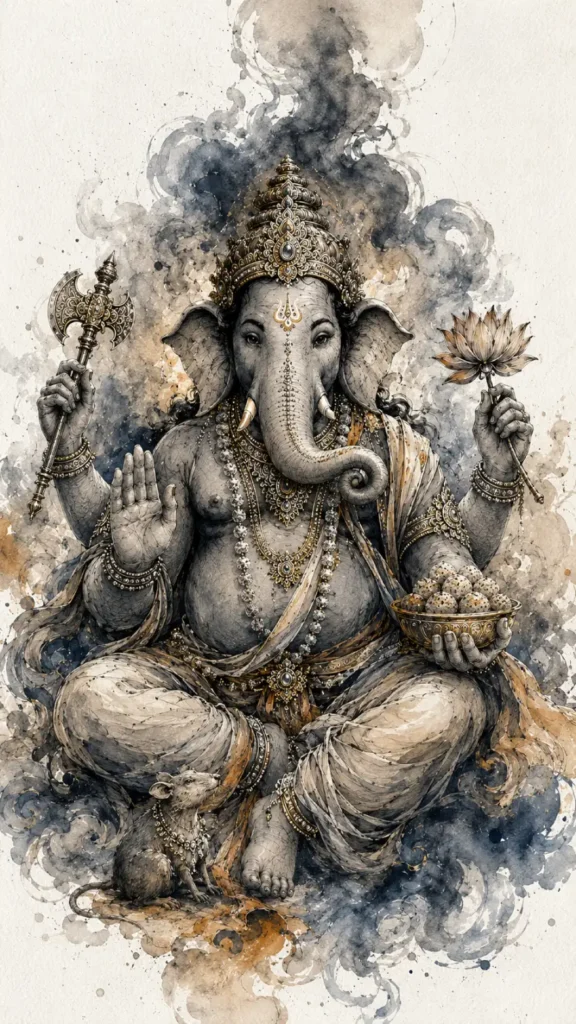
The Smoke-Coloured Lord Who Conquers Ego
There is a kind of darkness that does not come from the night. It comes from within us.
It appears when success makes us feel superior, when knowledge becomes arrogance, or when achievement makes us forget gratitude. Hindu spiritual traditions have long recognized that the greatest obstacles are not always outside us. Sometimes, they are hidden inside the mind.
Dhumravarna Ganapati represents this profound spiritual truth.
Described in the Mudgala Purana as the eighth of Ganesha’s principal incarnations, Dhumravarna is the smoke-coloured form of Lord Ganesha associated with overcoming Abhimanāsura or Ahamkārāsura, the personification of pride and ego. In the traditional account, this powerful form restores balance not merely by defeating an external demon, but by confronting the destructive force of inflated self-importance.
His story offers a message that remains deeply relevant: true greatness begins when pride becomes humility.
Who Is Dhumravarna Ganapati?
Dhumravarna Ganapati is one of the eight principal manifestations of Lord Ganesha described in the Mudgala Purana, an important scripture of the Ganapatya tradition. The eight forms are presented as divine manifestations that overcome different destructive tendencies represented by asuras, or powerful demonic beings. Dhumravarna is the final form in this eightfold sequence and is connected with the overcoming of ego and pride.
The name Dhumravarna comes from Sanskrit.
- Dhumra means smoke, smoky, or grey.
- Varna means colour, complexion, or appearance.
Thus, Dhumravarna can be understood as “the One of smoke-coloured complexion.”
The smoky appearance is more than a visual description. In devotional interpretation, smoke can suggest something difficult to see through. In the same way, ego can cloud a person’s understanding. It can make success appear permanent, knowledge appear complete, and personal achievement seem more important than the greater reality of life.
Dhumravarna therefore represents the divine wisdom that clears this inner cloud.
The Meaning of Dhumravarna’s Name
The name Dhumravarna immediately draws attention to his unusual complexion.
Unlike the bright red, golden, or vermilion forms often seen in popular Ganesha worship, this manifestation is associated with a smoky or grey appearance. Traditional interpretations connect the smoky colour with the mysterious space between visibility and obscurity. One devotional explanation describes dhumra as smoke and varna as complexion, emphasizing the distinctive identity of this form.
This gives the name a beautiful inner meaning.
The smoke does not permanently hide the light. It only makes the light difficult to see.
Likewise, pride may cover wisdom, but it does not destroy wisdom completely. When arrogance is recognized and surrendered, clarity can return.
Dhumravarna’s name therefore becomes a spiritual reminder to look beyond outward achievement and examine the condition of the heart.
The Story of Dhumravarna Ganapati
The story of Dhumravarna is closely connected with Ahankara, the sense of “I” or ego.
Traditional retellings associated with the Mudgala Purana describe the demon as Abhimanāsura or Ahamkārāsura, names connected with pride, self-importance, and ego. Different retellings vary in details, so these names should not be treated as completely separate stories without qualification.
The story begins with the growth of pride.
Ahamkara does not always appear as obvious wickedness. It can begin quietly. A person receives power and begins to believe that power makes them superior. Someone gains knowledge and begins to look down upon others. Someone achieves success and forgets the people, circumstances, and grace that helped make that success possible.
This is the danger represented by Ahankarasura. In the traditional narrative, the asura becomes enormously powerful and his pride spreads through the worlds. The gods find themselves unable to restore balance through ordinary means and turn toward Lord Ganesha.
Ganesha appears in his formidable form as Dhumravarna. The confrontation is not simply a battle between two physical beings. It represents a struggle between divine wisdom and uncontrolled ego. Dhumravarna confronts the demon’s power and ultimately brings his arrogance under control. Some traditional retellings emphasize that the demon is subdued rather than simply destroyed. This is spiritually significant. The lesson is not that a person must destroy the self. It is that the false pride of the ego must be brought under wisdom. When pride bows before truth, transformation becomes possible. That is one of the deepest messages of Dhumravarna Ganapati.
The Divine Form of Dhumravarna Ganapati
The most important visual characteristic of Dhumravarna is his smoke-coloured or grey complexion.
The Mudgala Purana tradition also associates this incarnation with a horse as his vehicle, often described in secondary accounts as a blue horse. Dhumravarna is also associated with the Shiva aspect within the theological sequence of the eight Mudgala manifestations. This makes Dhumravarna visually different from many familiar forms of Ganesha.
Artists may portray him with a powerful, majestic presence. His expression can appear serious or intense rather than purely playful. The smoky complexion can be rendered in shades of ash, charcoal, grey, silver, or muted earth tones.
However, artistic representations can vary.
The supplied ShaktiShraddha artwork, for example, presents Dhumravarna with a grey-toned elephant form, ornate crown, axe, lotus, offering bowl, blessing gesture, and a small mouse companion. These elements create a beautiful devotional interpretation. For strict iconographic accuracy, however, the mouse should not automatically be described as Dhumravarna’s canonical vehicle in the Mudgala Purana, where the form is associated with a horse. Broader Ganesha iconography frequently includes the mouse, so its appearance in artwork can be understood as an artistic expression of Ganesha’s wider symbolism. This distinction allows sacred art to remain both beautiful and intellectually honest.
The Symbols and Attributes of Dhumravarna
The Smoky Complexion
The grey or smoky body is the defining visual feature. Spiritually, it can remind devotees that appearances can be uncertain and that the mind itself can become clouded. The divine presence remains beyond the temporary confusion.
The Horse
In the Mudgala Purana tradition, Dhumravarna’s vehicle is a horse. The horse naturally suggests movement, strength, speed, and dynamic energy. In the context of Dhumravarna, it can be understood as a powerful image of divine action overcoming stagnation and imbalance.
The Ganesha Form
Although this manifestation has a distinctive purpose, Dhumravarna remains Ganesha: the divine intelligence that confronts obstacles and restores order.
His elephant head continues to evoke qualities commonly associated with Ganesha—strength joined with intelligence, patience joined with power, and the ability to move through difficult circumstances without losing awareness.
The Weapons and Sacred Objects
Artists often give Dhumravarna weapons and attributes associated with Ganesha’s broader iconography. The axe, for example, can be understood symbolically as cutting through attachment and harmful tendencies.
Other objects may vary according to artistic, regional, or devotional traditions. They should not automatically be presented as fixed scriptural requirements.
The Spiritual Meaning of Dhumravarna Ganapati
Dhumravarna’s greatest teaching is humility.
Pride can be surprisingly difficult to recognize because it often hides behind success.
A person may say, “I know more than everyone else.”
Another may think, “I achieved everything entirely by myself.”
Someone else may believe, “I no longer need advice.”
These thoughts can slowly separate a person from gratitude, compassion, and self-awareness.
Dhumravarna teaches that genuine strength does not require constant superiority.
The person who can accept correction is stronger than the person who refuses it. The person who can acknowledge another’s contribution is richer in character than the person who claims every achievement alone.
In this sense, Dhumravarna is not a frightening deity of destruction. He is a powerful reminder that ego must become smaller so wisdom can become larger.
Why Devotees Are Drawn to Dhumravarna
Dhumravarna is especially meaningful to those reflecting on pride, self-discipline, humility, and inner transformation.
Devotees may traditionally look toward this form while contemplating the danger of excessive ego. His story can inspire a person to become more grateful, more receptive to learning, and more conscious of how personal ambition affects relationships.
This does not mean that worship should be understood as a guarantee of success or protection.
The deeper value lies in reflection.
Dhumravarna encourages devotees to ask:
“Am I using my success wisely?”
“Has my knowledge made me humble or arrogant?”
“Can I accept that I still have something to learn?”
These questions can transform devotion into self-understanding.
Dhumravarna Ganapati in Everyday Life
The story of Dhumravarna is remarkably relevant to modern life.
Consider a professional who receives a promotion. The promotion is a wonderful achievement, but problems begin when success turns into disrespect toward colleagues.
Consider a business owner whose company grows rapidly. Confidence helps the business succeed, but arrogance can make the owner stop listening to customers or employees.
A student may perform exceptionally well and begin believing that others have nothing to teach them.
Even spiritual practice can become connected with ego if a person starts thinking, “I am more spiritual than everyone else.”
Dhumravarna reminds us that ego can enter almost anywhere—even places where we expect wisdom to live.
The answer is not to reject ambition. It is to combine ambition with humility.
Work hard. Learn continuously. Accept achievement with gratitude. Give credit generously. Remain open to correction.
That is one practical way to carry Dhumravarna’s teaching into modern life.
Famous Temple Associated With Dhumravarna Ganapati
Dhumravarna Ganpati Mandir, Nashik
A temple specifically named Dhumravarna Ganpati Mandir is located in Nashik, Maharashtra. Available temple listings place it on Jai Bhavani Road in the Nashik Road area.
Temple/Sacred Place Name: Dhumravarna Ganpati Mandir
City: Nashik
State: Maharashtra
Public Address: 2, Jai Bhavani Road, Gandhi Nagar Airport Area, Nashik Road, Nashik, Maharashtra 422214, India.
The temple is notable because it is directly identified with Dhumravarna Ganapati rather than merely being a general Ganesha shrine. Local and devotional sources associate the temple with the Dhumravarna form and his story of overcoming ego.
Because publicly available listings provide somewhat different postal descriptions for the same Jai Bhavani Road location, visitors should verify the current address and access details locally before travelling.
For devotees interested specifically in Dhumravarna rather than Ganesha worship in general, this shrine offers a meaningful point of connection with the form’s modern devotional presence.
Dhumravarna Ganapati and Devotional Art
Dhumravarna is particularly compelling as sacred art because his symbolism is visually distinctive.
The smoky complexion creates an atmosphere of depth and contemplation. Grey, charcoal, muted gold, ivory, and earthy tones can produce an elegant devotional aesthetic without losing the sacred character of the deity.
A Dhumravarna Ganapati artwork can become more than decoration. It can serve as a visual reminder of humility.
A framed artwork can create a quiet focal point in a prayer room. A large canvas can bring the powerful presence of the deity into a meditation space. A detailed digital artwork can preserve the intricate crown, ornaments, facial expression, and smoky atmosphere in high resolution.
The artwork accompanying this article demonstrates how traditional Ganesha symbolism can be interpreted through a refined Indian artistic language. The grey complexion, elaborate ornaments, sacred gesture, lotus, offering, and surrounding smoke-like brushwork create an atmosphere of strength and introspection.
For ShaktiShraddha, this makes Dhumravarna especially suited to premium framed devotional art, canvas wall art, and high-resolution digital artwork.
The purpose of such art is not to promise supernatural results. Its value lies in beauty, cultural memory, devotion, and the spiritual idea it keeps visible in everyday surroundings.
Dhumravarna Ganapati in a Home or Prayer Space
According to commonly followed devotional and Vastu traditions, images of Ganesha are often placed in a clean and respectful prayer area or home temple.
For Dhumravarna artwork, a dedicated prayer space, meditation corner, study area, or quiet part of the home can provide an especially meaningful setting because the form’s central theme is introspection and humility.
There is no need to treat one particular placement as a universal Hindu rule.
The most important principle is respectful presentation: keep the artwork clean, place it in a dignified setting, and let it serve as a reminder of devotion and inner discipline.
Why Dhumravarna Ganapati Still Matters Today
The ancient story of Dhumravarna speaks to a problem that has not disappeared.
Human beings still struggle with recognition, status, competition, achievement, and pride.
Modern life may have changed its surroundings, but the inner challenge remains familiar.
Dhumravarna reminds us that achievement becomes meaningful when it is accompanied by humility. Knowledge becomes beautiful when it produces wisdom rather than superiority. Power becomes noble when it is used responsibly.
His smoky form therefore carries a quiet paradox: what looks dark can lead us toward greater clarity.
Perhaps that is why Dhumravarna Ganapati remains such a compelling form of Ganesha.
He does not merely ask us to overcome obstacles outside ourselves.
He asks us to look honestly at the obstacle within.
Conclusion
Dhumravarna Ganapati stands as a powerful expression of Lord Ganesha’s ability to confront the most subtle forms of inner darkness.
His smoke-coloured form represents a world where clarity can be hidden but never permanently lost. His confrontation with Ahankarasura reminds us that pride can become destructive when achievement separates us from humility. And his ultimate victory points toward a simple spiritual truth: when ego becomes quieter, wisdom can speak more clearly.
For a modern devotee, Dhumravarna can therefore become a daily reminder to remain grateful, teachable, balanced, and compassionate.
For an admirer of Indian sacred art, his distinctive grey complexion and powerful symbolism offer extraordinary visual possibilities.
A carefully created Dhumravarna Ganapati artwork can bring that story into a home, prayer room, meditation space, or thoughtful collection—not as a promise of miracles, but as a beautiful reminder of a timeless value.
Let the image of Dhumravarna remind us that true greatness is not in making ourselves appear larger, but in becoming humble enough to recognize something greater than ourselves.
That is the spirit ShaktiShraddha seeks to preserve through sacred Indian art: not simply an image of the divine, but a meaningful story, a cultural inheritance, and a visual expression of devotion that can remain close to the heart.
7. FAQ
Who is Dhumravarna Ganapati?
Dhumravarna Ganapati is the eighth principal incarnation of Lord Ganesha described in the Mudgala Purana. He is associated with overcoming Abhimanāsura or Ahamkārāsura, the personification of pride and ego.
What does Dhumravarna mean?
Dhumravarna means “smoke-coloured” or “smoky in complexion.” Dhumra means smoke or smoky, while varna refers to colour or complexion.
What is the story of Dhumravarna Ganapati?
Dhumravarna appears to confront Ahankara, represented as a powerful demon whose pride creates disorder. Ganesha ultimately subdues this force, teaching that uncontrolled ego must yield to wisdom and humility.
Which scripture mentions Dhumravarna Ganapati?
Dhumravarna is especially associated with the Mudgala Purana, where he is the eighth of Ganesha’s eight principal incarnations.
What does Dhumravarna Ganapati symbolize?
Dhumravarna primarily symbolizes the overcoming of ego, pride, vanity, and self-importance. His story encourages humility, self-awareness, and spiritual clarity.
What is the vehicle of Dhumravarna Ganapati?
In the Mudgala Purana tradition, Dhumravarna is associated with a horse, commonly described in secondary sources as a blue horse.
Is Dhumravarna the same as Dhumraketu?
They are sometimes conflated in secondary devotional writing, but the traditions should be distinguished carefully. The Mudgala Purana presents Dhumravarna as the eighth of its eight principal forms, while the Ganesha Purana has Dhumraketu among its own four major incarnations.
Can Dhumravarna Ganapati artwork be placed in a home temple?
Yes. A Dhumravarna artwork can be placed respectfully in a home temple, prayer room, or meditation space. Its deeper value is as a visual reminder of Ganesha’s teachings about humility and overcoming inner obstacles.