
Mahotkata Ganapati
The Mighty Form of Ganesha Who Restores Dharma
There are moments when gentleness alone is not enough.
When arrogance grows powerful, when injustice spreads, and when the balance between dharma and adharma begins to weaken, Hindu sacred traditions often describe the Divine appearing in a stronger and more formidable form.
Mahotkata Ganapati is one such majestic manifestation of Lord Ganesha.
Known also as Mahotkata Vinayaka, this powerful form belongs to the ancient cycle of Ganesha’s manifestations described in the Ganesha Purana. He is associated with the Krita Yuga, the first of the four traditional cosmic ages, and is described as the son of Sage Kashyapa and Aditi.
Unlike the familiar four-armed form of Ganesha seen in countless temples and homes, Mahotkata is traditionally described as a mighty, many-armed manifestation. His story is closely connected with the destruction of powerful demonic forces and the restoration of righteous order.
But Mahotkata’s importance goes deeper than his formidable appearance.
His story asks an enduring question:
What should we do when strength becomes necessary?
The answer offered by this form of Ganesha is clear—strength must remain guided by wisdom, humility, and dharma.
Who Is Mahotkata Ganapati?
Mahotkata Ganapati is one of the four major incarnations of Lord Ganesha associated with the four Yugas in the Ganesha Purana.
The four manifestations are traditionally connected with different cosmic ages. Mahotkata belongs to the Krita Yuga, while the later manifestations are associated with the Treta, Dvapara, and Kali Yugas.
In this incarnation, Ganesha is born to Sage Kashyapa and Aditi.
Mahotkata is not simply another name for the familiar household form of Ganesha. He represents a particular divine manifestation whose purpose is connected with confronting destructive forces and restoring balance.
Traditional descriptions portray him as a red-complexioned, ten-armed form of Ganesha. His vehicle is described differently in traditional sources, with the lion being a prominent association and other accounts giving an elephant.
This variation is a reminder that Hindu sacred iconography has developed through different textual, regional, temple, and artistic traditions.
The Meaning of the Name Mahotkata
The name Mahotkata carries a sense of greatness, intensity, power, and formidable strength.
The word utkata can convey meanings such as powerful, immense, extraordinary, or fierce. With maha, meaning “great” or “immense,” the name evokes the idea of great and overwhelming divine power.
This is particularly appropriate for this manifestation of Ganesha.
The familiar image of Ganesha often brings to mind wisdom, auspicious beginnings, compassion, and the removal of obstacles.
Mahotkata reveals another dimension.
He reminds us that wisdom is not weakness.
Compassion does not mean helplessness.
And spiritual peace does not mean refusing to confront what is wrong.
Sometimes dharma requires courage.
The Story of Mahotkata Ganapati
The story of Mahotkata unfolds during the Krita Yuga.
Powerful demonic forces had begun disturbing the order of the worlds. Among the principal adversaries were the brothers Narantaka and Devantaka, who had acquired tremendous strength through austerity and divine blessings.
Their power, however, became separated from righteousness.
Instead of using their strength responsibly, they became forces of oppression and disorder.
It was in this setting that the divine manifestation of Mahotkata appeared.
Sage Kashyapa and Aditi were devoted to the Divine, and Mahotkata was born to them as a manifestation of Ganesha.
Even from an early age, the extraordinary nature of the child became evident.
Mahotkata was not an ordinary child. His divine identity was gradually revealed through his extraordinary strength and his encounters with the forces that opposed dharma.
As the conflict intensified, Mahotkata confronted the demonic powers that had disturbed the worlds.
The struggle was not merely a contest between physical strength. It represented the deeper conflict between dharma and arrogance.
Mahotkata ultimately overcame the demonic forces, including Narantaka, Devantaka, and Dhumraksha. The victory restored order and demonstrated that destructive power cannot ultimately stand against divine wisdom and righteous purpose.
The story therefore carries a lesson that remains remarkably relevant.
Power becomes dangerous when it serves the ego.
Power becomes sacred when it serves dharma.
The Divine Form of Mahotkata Ganapati
The traditional Mahotkata form has a particularly majestic character. Descriptions associated with the Ganesha Purana tradition portray him with a red complexion and ten arms. The many arms communicate the extraordinary range of divine action associated with this incarnation. The elephant head retains the fundamental symbolism of Ganesha. The elephant is associated with intelligence, strength, memory, patience, and the ability to move through difficult terrain.
In Mahotkata, these familiar qualities appear in a more powerful and warrior-like expression. The red complexion can be understood as an expression of active divine energy and force. The multiple arms suggest that the Divine is capable of responding to many challenges at once. The weapons and attributes traditionally associated with such imagery communicate readiness to confront forces that disturb righteousness.
About the ShaktiShraddha Artwork
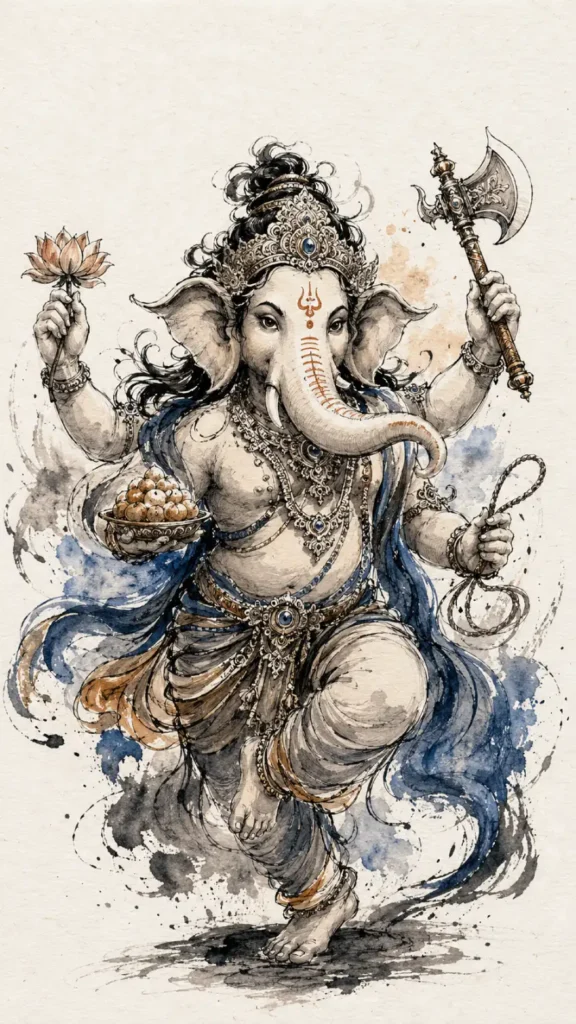
The artwork accompanying this article presents an artistic interpretation of Mahotkata Ganapati.
It shows Ganesha with four visible arms, a lotus, axe, noose, bowl of modaks, elaborate jewellery, a magnificent crown, and flowing blue garments.
This should not be presented as a literal reconstruction of the scriptural Mahotkata iconography.
Rather, it is a devotional artistic interpretation inspired by the majestic and protective character of Mahotkata.
This distinction is important.
Sacred Indian art has always allowed artists to interpret divine forms through different visual languages. Sculpture, miniature painting, folk traditions, temple art, modern devotional painting, and contemporary spiritual art can all express the same sacred idea in different ways.
The Symbols and Attributes of Mahotkata Ganapati
The visual language surrounding Ganesha carries layers of meaning.
The Elephant Head
The elephant head represents wisdom, intelligence, memory, and tremendous inner strength.
In Mahotkata’s form, these qualities are expressed with particular intensity.
Multiple Arms
The many arms traditionally associated with Mahotkata symbolize extraordinary divine capability.
They suggest that the Divine can act in numerous ways to restore balance.
The Axe
The axe is a familiar attribute of Ganesha.
Symbolically, it can be understood as the power to cut through attachment, confusion, and obstacles.
In the Mahotkata tradition, the weapon also belongs to the more formidable character of the incarnation.
The Lotus
The lotus represents purity and spiritual awakening.
It grows from muddy surroundings while remaining beautifully untouched by them.
As a devotional symbol, it reminds us that spiritual clarity can emerge even from difficult circumstances.
Modaks
The modak remains one of the most beloved offerings associated with Ganesha.
It represents sweetness and the joy that comes from spiritual fulfilment.
Its presence in devotional artwork brings a gentle dimension to an otherwise powerful form.
The Spiritual Meaning of Mahotkata Ganapati
The deepest message of Mahotkata is strength guided by wisdom.
It is easy to admire power.
It is much harder to use power responsibly.
The story of Mahotkata presents a contrast between divine strength and demonic arrogance.
Narantaka and Devantaka possess tremendous power, but their strength becomes destructive because it is separated from dharma.
Mahotkata possesses even greater divine power, yet his purpose is not personal domination.
His strength serves restoration.
This makes Mahotkata an inspiring form for contemplation.
He reminds us to develop courage without becoming arrogant.
To become capable without becoming cruel.
To stand firmly without losing compassion.
And to confront difficulties without allowing anger to control the mind.
Why Devotees Are Drawn to Mahotkata Ganapati
Many devotees are naturally drawn to Mahotkata because of his powerful and majestic character. This is a form of Ganesha that speaks particularly strongly to the idea of courage in difficult circumstances. Devotional traditions may regard Mahotkata as a reminder of strength, determination, righteous action, and the overcoming of destructive tendencies. His story can be especially meaningful for people passing through periods of change or uncertainty. A devotee beginning a difficult undertaking may see in Mahotkata a reminder to act courageously. Someone facing personal obstacles may contemplate his determination.
Someone carrying significant responsibility may find meaning in his example of strength guided by purpose. The value lies not in promising a supernatural result, but in allowing the story to shape one’s inner attitude.
Mahotkata Ganapati in Everyday Life
Ancient stories often survive because their emotional truths remain relevant.
We may not face mythical demons in modern life, but we encounter fear, pride, anger, uncertainty, competition, disappointment, and difficult decisions.
A person may have to defend an important principle at work.
A parent may have to make a difficult decision for the family.
An entrepreneur may need courage after repeated setbacks.
Someone beginning a new chapter may be uncertain about what lies ahead.
Mahotkata can become a powerful symbol for these moments.
His message is not simply:
“Be strong.”
It is:
“Become strong enough to remain true to what is right.”
That is a much deeper form of courage.
A Temple Tradition Connected With Mahotkata
Mahotkata does not have a universally recognized major temple dedicated exclusively to this exact incarnation in the manner of the famous Ashtavinayak shrines.
One important place worth mentioning is Ranjangaon Mahaganapati Temple in Maharashtra, one of the traditional Ashtavinayak pilgrimage sites.
The principal deity there is Mahaganapati, and the temple’s central legend concerns Lord Shiva worshipping Ganesha before confronting Tripurasura.
There is also a longstanding local tradition connecting a more extraordinary Mahotkata form with an image said to be associated with the temple. However, this belongs to temple lore and should not be presented as an undisputed historical fact.
Therefore, ShaktiShraddha should describe Ranjangaon as a major Mahaganapati pilgrimage centre with a local Mahotkata tradition, rather than simply calling it “the Mahotkata Ganapati Temple.”
The temple is located at:
Ranjangaon, Shirur, Pune District, Maharashtra, India – 412209.
This careful distinction makes the article more trustworthy and avoids turning local tradition into established scripture. Maharashtra Tourism officially recognizes Ranjangaon as one of the Ashtavinayak temples dedicated to Mahaganapati.
Mahotkata Ganapati and Sacred Art
Mahotkata is a fascinating subject for sacred Indian art because his identity combines two seemingly different qualities.
He is Ganesha—the beloved deity associated with wisdom, auspicious beginnings, and devotion.
At the same time, he is Mahotkata—the mighty manifestation associated with divine strength and the restoration of dharma.
That combination creates enormous artistic possibilities.
A Mahotkata artwork can emphasize:
- majestic ornamentation
- powerful posture
- divine weapons
- elephant-headed wisdom
- rich Indian decorative patterns
- dramatic movement
- sacred symbolism
- traditional colours
- contemporary Indian aesthetics
A detailed framed artwork can work beautifully in a prayer room or meditation space.
A larger canvas can become a visual centrepiece in a living room or spiritual corner.
A high-resolution digital artwork can also allow devotees and admirers of Indian culture to bring the image into their personal spaces in a more flexible way.
The purpose of such artwork is not to promise supernatural benefits.
Its value lies in meaning.
A sacred image can remind us of the qualities we wish to cultivate.
In Mahotkata’s case, that may be courage, strength, wisdom, discipline, and the ability to stand firmly for dharma.
Mahotkata Ganapati for the Home
A devotional representation of Mahotkata can be placed respectfully in a home temple, prayer room, meditation space, study, or other clean and peaceful area.
According to commonly followed household traditions, devotional images are generally treated with cleanliness and respect.
Some Vastu traditions prefer the northeast or east for a prayer area, but such practices vary between traditions and households. They should not be presented as universal scriptural commandments.
The most meaningful placement is often simply the place where the artwork can be viewed with attention and reverence.
Why Mahotkata Ganapati Still Matters
The world changes, but the human struggle between courage and fear, wisdom and arrogance, dharma and selfishness remains.
That is why Mahotkata Ganapati continues to offer a meaningful spiritual image.
He teaches that strength is not meant merely to make us powerful.
It is meant to make us capable of doing what is right.
He reminds us that obstacles may require determination, but determination must remain guided by wisdom.
And he shows that the greatest victory is not simply defeating an external enemy.
It is learning how to prevent pride, anger, fear, and ego from becoming enemies within ourselves.
For ShaktiShraddha, this makes Mahotkata more than an intriguing form of Ganesha.
He becomes a visual expression of courage with consciousness.
The supplied ShaktiShraddha artwork captures that spirit through an ornate, flowing interpretation of Ganesha. The lotus, weapons, modaks, jewellery, blue drapery, and expressive movement create an image that feels both devotional and contemporary.
Placed in a home or personal spiritual space, such artwork can serve as a quiet reminder of the values Mahotkata represents.
Not a promise.
Not a superstition.
But a beautiful reminder of faith, strength, and the responsibility that comes with strength.
And that is where sacred art becomes truly meaningful.
A divine image does not need to shout.
Sometimes it simply needs to be present—to remind us, every day, of the qualities we wish to carry within ourselves.
7. FAQ
Who is Mahotkata Ganapati?
Mahotkata Ganapati, also known as Mahotkata Vinayaka, is a powerful manifestation of Lord Ganesha described in the Ganesha Purana and associated with the Krita Yuga.
What does Mahotkata mean?
Mahotkata conveys the sense of something exceptionally powerful, mighty, immense, or formidable.
What is the story of Mahotkata Ganapati?
Mahotkata appears as the son of Sage Kashyapa and Aditi and confronts destructive demonic forces, including Narantaka, Devantaka, and Dhumraksha, restoring order and dharma.
Which scripture describes Mahotkata Ganapati?
Mahotkata is described in the Ganesha Purana, particularly within its narrative tradition concerning Ganesha’s manifestations across the four Yugas.
How is Mahotkata Ganapati traditionally depicted?
Traditional descriptions commonly associate Mahotkata with a red complexion and ten arms. Different traditions can vary in details such as his vahana.
What does Mahotkata Ganapati symbolize?
Mahotkata represents powerful action guided by wisdom, courage, discipline, and the restoration of dharma.
Can Mahotkata Ganapati artwork be kept at home?
Yes. A respectful depiction can be placed in a home temple, prayer room, meditation space, or another clean and peaceful area according to one’s family tradition.
Is the ShaktiShraddha image an exact scriptural depiction of Mahotkata?
No. The ShaktiShraddha image is best described as an artistic devotional interpretation of Mahotkata Ganapati. It uses four visible arms and contemporary artistic details, while traditional descriptions of Mahotkata commonly mention ten arms.