
Dhumketu Ganapati
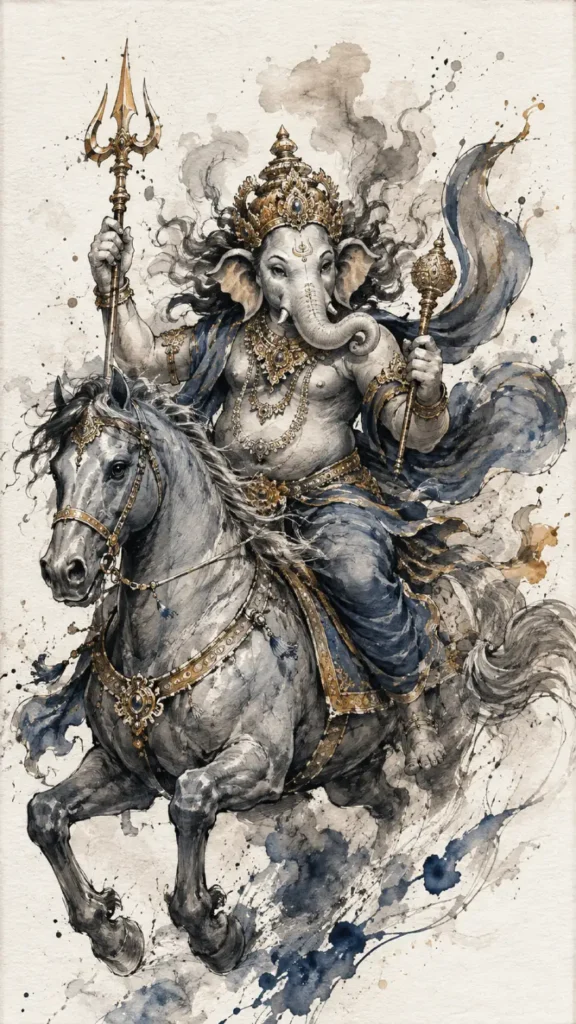
The Divine Form That Rides Through the Darkness
There are moments in life when the path ahead feels perfectly clear.
And then there are moments when everything seems covered in mist.
We may know that something must change, yet we cannot see what lies beyond the change. We may feel surrounded by confusion, uncertainty, or forces that seem larger than ourselves.
Hindu sacred tradition has many ways of expressing this journey from darkness toward clarity.
Among the lesser-known forms of Lord Ganesha, Dhumraketu Ganapati carries one of the most striking images of all: the elephant-headed Lord appearing with a smoky complexion and riding a powerful horse.
It is an image filled with movement.
Unlike the familiar peaceful form of Ganesha seated with His mouse vehicle, Dhumraketu appears as a dynamic and formidable manifestation. His presence belongs to the cosmic story of the Kali Yuga, and His form is traditionally connected with the restoration of dharma when disorder has grown powerful.
The result is a form of Ganapati that feels ancient, mysterious, majestic, and deeply symbolic.
For ShaktiShraddha, Dhumraketu is not simply another name of Ganesha.
He is a reminder that even when the world appears clouded by darkness, divine wisdom can still move forward.
Who Is Dhumraketu Ganapati?
Dhumraketu Ganapati is a form of Lord Ganesha described in the Ganesha Purana in connection with the Kali Yuga.
The Ganesha Purana presents four major manifestations of Ganapati across the four yugas. In this traditional framework, Ganesha appears as Mahotkata in the Satya Yuga, Mayureshvara in the Treta Yuga, Gajanana in the Dvapara Yuga, and Dhumraketu in the Kali Yuga.
Dhumraketu is therefore associated with the final and most troubled of the four ages.
His traditional description is distinctive. He is portrayed with a smoke-coloured complexion and a horse as His vehicle. The text is especially notable because this is very different from the familiar household image of Ganesha riding a mouse.
The contrast itself carries meaning.
The mouse suggests subtle movement, intelligence, and the ability to enter even the smallest spaces. The horse, by comparison, evokes speed, strength, movement, and decisive action.
Dhumraketu is therefore a form of Ganapati presented with a powerful sense of forward movement.
He is not the Ganesha of stillness alone.
He is Ganesha in motion.
The Meaning of Dhumraketu’s Name
The name Dhumraketu comes from Sanskrit.
Dhūmra is associated with smoke, smoky colour, or greyish appearance. Ketu can signify a sign, banner, or distinguishing mark and also carries associations with celestial phenomena such as a comet.
The name therefore creates a vivid image: the smoke-marked or smoke-bannered one.
This is more than a description of colour.
Smoke is something that makes vision uncertain. It can hide what is in front of us. At the same time, smoke tells us that something is happening beneath the surface.
There is fire somewhere.
There is movement somewhere.
Something is changing.
This makes the name Dhumraketu especially appropriate for contemplation. The form can be understood as a divine presence appearing within an age in which clarity and dharma have become increasingly obscured.
The darkness is not the final truth.
Something greater is moving within it.
The Story of Dhumraketu Ganapati
Dhumraketu’s story is best understood within the larger cycle of the four yugas.
In Hindu cosmological thought, time is not always imagined as a straight line moving endlessly toward progress. Instead, the universe passes through recurring cycles of creation, preservation, decline, dissolution, and renewal.
Kali Yuga represents the final stage of the traditional four-age cycle.
It is associated with the weakening of dharma and the increasing influence of disorder, confusion, and spiritual forgetfulness.
Within the Ganesha Purana’s account of Ganesha’s manifestations, Dhumraketu belongs to this age.
His appearance carries a sense of divine response.
When righteousness becomes obscured and destructive forces gain strength, the divine does not abandon creation. Instead, the appropriate form of divine power manifests.
Dhumraketu therefore represents more than a dramatic warrior image.
He represents the return of divine order when disorder has gone too far.
This is one reason His form can feel so powerful even to someone encountering it for the first time.
He does not represent fear for its own sake.
He represents the courage required to face what must be transformed.
Dhumraketu Ganapati and the Kali Yuga
The connection between Dhumraketu and Kali Yuga is central to understanding this form.
The Kali Yuga is traditionally regarded as an age in which dharma becomes increasingly difficult to uphold. Human beings become more vulnerable to confusion, attachment, selfishness, and spiritual forgetfulness.
Yet Hindu tradition does not present this decline as the end of everything.
The larger cycle continues.
Dhumraketu belongs to that vision of eventual restoration.
His form reminds us that divine power may appear differently according to the needs of an age.
Sometimes Ganesha is gentle.
Sometimes He is playful.
Sometimes He appears as a teacher.
And in Dhumraketu, He appears as a powerful force moving through a troubled world.
This makes the form especially meaningful when contemplated as a symbol of renewal after darkness.
The Divine Form of Dhumraketu Ganapati
The most distinctive feature of Dhumraketu is His smoke-coloured form.
Traditional descriptions associate Him with a complexion resembling smoke, giving Him a visual identity unlike many familiar representations of Ganesha.
His second defining feature is His horse.
The horse changes the entire character of the image.
A seated Ganesha naturally creates a feeling of peace and stability. Dhumraketu on horseback creates a sense of purpose.
The Lord appears ready to move.
He appears to be crossing the distance between what the world has become and what it is meant to become.
Traditional descriptions commonly give Dhumraketu two arms, although textual variations exist within discussions of the Ganesha Purana. This is an important example of why sacred iconography should be approached carefully rather than assuming that every modern painting represents a fixed scriptural description.
The accompanying ShaktiShraddha artwork takes this traditional identity and gives it a grand artistic interpretation.
Here Dhumraketu appears as a majestic elephant-headed divine rider, surrounded by flowing blue-grey fabric, atmospheric strokes, and the energy of a horse in motion.
The result is not intended to claim that every weapon, ornament, or artistic detail is prescribed by scripture.
Instead, it is a devotional interpretation inspired by the traditional identity of Dhumraketu.
That distinction allows sacred art to remain both reverent and creatively beautiful.
The Horse of Dhumraketu — A Symbol of Divine Movement
The horse deserves special attention.
It is perhaps the most visually memorable aspect of Dhumraketu Ganapati.
A horse carries the imagination forward.
It represents movement, speed, strength, and readiness.
In Dhumraketu’s context, the horse can be contemplated as the vehicle of divine action.
There are times when patience is needed.
There are other times when remaining still becomes its own form of weakness.
Dhumraketu represents that second moment.
His horse suggests that when the time for action arrives, divine consciousness does not remain paralysed by uncertainty.
It moves.
For a devotee, this can become a beautiful personal meditation:
When the path becomes unclear, do not allow confusion to become surrender. Move forward with wisdom.
The Spiritual Meaning of Dhumraketu Ganapati
At the heart of Dhumraketu is a simple but profound message:
Darkness can surround the path without destroying the light within us.
The smoky complexion can be contemplated as a symbol of an obscured world.
The horse represents movement through that obscurity.
The elephant head represents the enduring wisdom of Ganapati.
Together, they create an image of wisdom moving through uncertainty.
This makes Dhumraketu particularly meaningful for people going through periods of change.
A new career.
A difficult decision.
A personal transformation.
The end of one chapter.
The beginning of another.
We often want clarity before taking the first step.
But life does not always give us that luxury.
Sometimes clarity comes because we begin moving with sincerity, discipline, courage, and faith.
Dhumraketu can therefore be contemplated not simply as a destroyer of obstacles, but as a reminder to move beyond confusion without losing wisdom.
Why Devotees Are Drawn to Dhumraketu Ganapati
Dhumraketu is not as widely represented in household worship as familiar forms such as Siddhivinayak or Vakratunda.
That rarity is part of its appeal.
For devotees who explore the deeper forms of Ganapati, Dhumraketu opens a different side of Ganesha’s personality.
He is powerful.
He is mysterious.
He is dynamic.
And He belongs to a cosmic story far larger than everyday concerns.
Many worshippers may find this form meaningful when reflecting upon courage, dharma, transformation, and the strength required to move through uncertain times.
It is important, however, not to turn these traditional associations into promises of guaranteed worldly results.
Devotion is not a transaction.
The value of contemplating Dhumraketu lies in the meaning the form awakens within the devotee.
Dhumraketu Ganapati in Everyday Life
The ancient image of Ganesha riding through a troubled age can speak surprisingly well to modern life. We live surrounded by constant information. Yet information does not always bring wisdom. We may have hundreds of choices and still not know which direction to take. We may work harder than ever and still feel uncertain about where our efforts are leading. We may appear successful while privately carrying fear about the future. This is where the symbolism of Dhumraketu becomes deeply relevant.
The world may be cloudy. The answer may not yet be visible. But the next right step can still be taken. Dhumraketu reminds us that courage does not mean having no fear. It means refusing to let fear decide everything. His image can therefore become a quiet reminder:
Move with purpose. Think clearly. Hold firmly to dharma. Do not mistake temporary darkness for the absence of divine order.
Famous Temple Associated With Dhumraketu Ganapati
Dhumraketu does not have a universally recognized major temple that can honestly be described as His principal dedicated shrine. For this reason, ShaktiShraddha should not manufacture a “Dhumraketu temple” simply to fill a content section. A more authentic approach is to acknowledge the form’s textual identity while directing devotees toward a major living centre of Ganapati worship.
Shree Siddhivinayak Ganapati Mandir
Location: Prabhadevi, Mumbai, Maharashtra
Address: Khed Galli, Khed Galli, Prabhadevi, Mumbai, Maharashtra 400028, India
The famous Siddhivinayak temple is devoted to Siddhivinayak, not specifically to Dhumraketu. It is nevertheless one of India’s best-known centres of Ganesha devotion and offers an important living context for understanding the continuing place of Ganapati worship.
For visitors, the significance is therefore broader: this is a place where devotion to Ganesha continues as a living tradition rather than simply as mythology preserved in books. For ShaktiShraddha, that distinction matters.
Why Dhumraketu Ganapati Makes Meaningful Sacred Art
Some forms of the divine naturally invite contemplation.
Dhumraketu is one of them.
Imagine the elephant-headed Lord moving across a field of clouds and smoke, His horse surging forward, His garments flowing behind Him, and His presence cutting through an atmosphere of uncertainty. It is an image that immediately tells a story. The artwork accompanying this article embraces exactly that feeling. The deep blue-grey tones create an atmosphere of mystery. The antique-gold ornaments introduce warmth and sacred grandeur. The horse gives the composition movement, while the elephant-headed figure remains calm and commanding at its centre.
This makes Dhumraketu particularly suited to statement devotional art.
A large canvas can bring out the movement of the horse.
A framed print can highlight the intricate details of the deity.
A high-resolution digital artwork can allow the image to become part of a personal meditation or prayer space.
In a home, such art does not need to be treated as a magical object.
Its beauty lies in what it reminds us of.
Faith.
Courage.
Dharma.
Movement.
And the possibility of renewal.
Dhumraketu Ganapati as a ShaktiShraddha Artwork
At ShaktiShraddha, sacred art is meant to do more than reproduce an image of a deity.
It should preserve a feeling.
Dhumraketu is especially suited to this philosophy.
His form carries an unusual combination of strength and stillness.
The horse is moving, but the deity remains composed.
The surroundings may appear turbulent, yet the divine centre remains steady.
That contrast is what makes the form so beautiful.
A Dhumraketu Ganapati artwork can become a visual presence in a home that quietly expresses resilience: the ability to remain centred while life continues to change around us.
For a prayer room, it can become a contemplative image.
For a meditation space, a reminder of inner clarity.
For a living room, a powerful piece of Indian spiritual art.
And for someone living outside India, it can also carry a deeper cultural connection — a visual link to the stories, symbols, and devotional imagination of Hindu tradition.
Dhumraketu Ganapati — The Meaning That Remains
Dhumraketu Ganapati is one of the most intriguing forms within the broader sacred imagination of Ganesha.
He does not arrive with the familiar softness of the household Ganapati alone.
He arrives with movement.
With mystery.
With the atmosphere of an age passing through darkness.
His smoky form reminds us that clarity is not always immediate.
His horse reminds us that movement is sometimes necessary.
His identity as Ganapati reminds us that wisdom must guide that movement.
And his connection with Kali Yuga points toward a larger Hindu vision: dharma may become obscured, but it is never forgotten by the divine order of existence.
Perhaps that is why this lesser-known form can feel so relevant today.
Every person has moments when life seems covered in smoke.
We cannot always see the whole road.
But we can still choose the next step.
We can still choose courage over fear, wisdom over confusion, and dharma over convenience.
That is the quiet strength at the heart of Dhumraketu.
And when that meaning is brought into sacred artwork, the image becomes more than decoration.
It becomes a visual reminder.
A reminder that even in uncertain times, one can continue moving forward with faith.
That is the spirit ShaktiShraddha seeks to preserve through its sacred Indian artwork — bringing the beauty of the divine form into contemporary spaces while keeping its deeper cultural and devotional meaning alive.
7. FAQ
Who is Dhumraketu Ganapati?
Dhumraketu Ganapati is a form of Lord Ganesha associated with the Kali Yuga in the Ganesha Purana. He is traditionally described with a smoky complexion and a horse as His vehicle.
What does the name Dhumraketu mean?
Dhumraketu comes from Sanskrit and is associated with the ideas of smoke or smoky appearance and ketu, meaning a sign, banner, or distinguishing mark.
Which scripture mentions Dhumraketu Ganapati?
Dhumraketu is primarily associated with the Ganesha Purana, which describes different manifestations of Ganesha in connection with the four yugas.
What is the vehicle of Dhumraketu Ganapati?
Dhumraketu is traditionally associated with a horse, making His iconography very different from the familiar Ganesha who rides a mouse.
Is Dhumraketu the same as Dhumravarna?
They are sometimes treated as the same in popular discussions, but this should be approached carefully. Dhumraketu belongs to the Ganesha Purana’s four-yuga framework, while Dhumravarna is an incarnation described in the Mudgala Purana’s separate system of eight Ganesha incarnations.
What does Dhumraketu Ganapati symbolize?
Dhumraketu can be contemplated as a symbol of divine action during an age of spiritual uncertainty, restoration of dharma, courage, transformation, and movement through darkness toward renewal.
Can Dhumraketu Ganapati artwork be kept at home?
Yes. A Dhumraketu Ganapati artwork can be placed respectfully in a home temple, prayer room, meditation area, or another clean and peaceful space according to one’s family and devotional tradition.
Is Dhumraketu Ganapati suitable as wall art?
Yes. Because of the dynamic horse, smoky atmosphere, and powerful form of Ganesha, Dhumraketu is particularly striking as large-format canvas, framed devotional artwork, or premium Indian spiritual wall art.