
Trimukha Ganapati
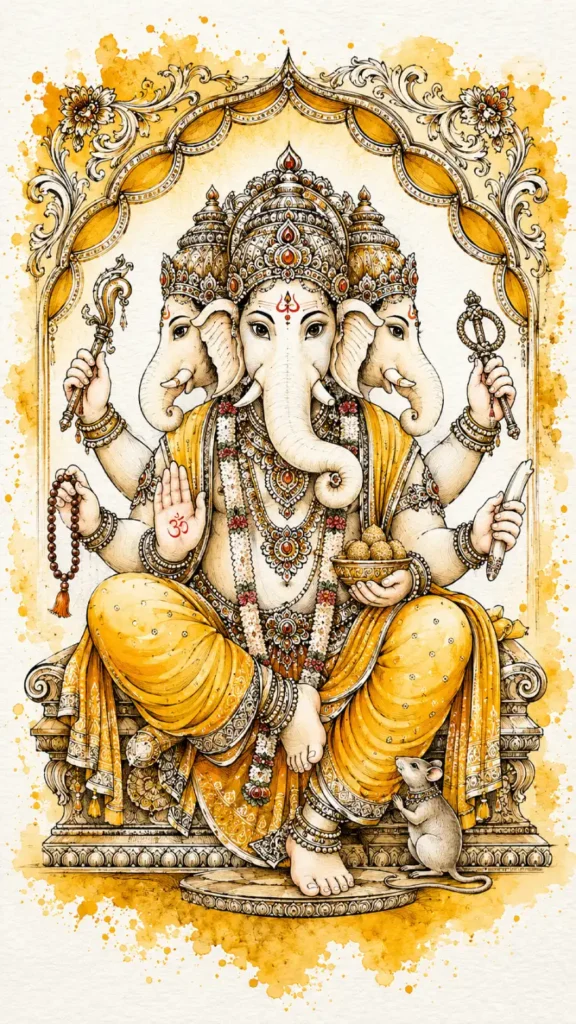
The Three-Faced Lord of Expanded Vision
There are moments in life when one view is simply not enough.
A decision may have a history behind it, a reality unfolding in the present, and consequences that are still hidden from sight. In such moments, the symbolism of a deity with three faces becomes especially compelling.
Trimukha Ganapati is the three-faced form of Lord Ganesha found among the traditional thirty-two forms of Ganapati. His unusual appearance is not merely an artistic variation. The classical meditation description gives him three elephant faces, six arms, a radiant red complexion and a seat upon a golden lotus. His hands carry sacred objects while two front hands offer the gestures of blessing and fearlessness.
For a devotee, this form invites a deeper question: Can wisdom become wider when we learn to look at life from more than one direction?
That is where the quiet beauty of Trimukha Ganapati begins.
Who Is Trimukha Ganapati?
Trimukha Ganapati is one of the thirty-two traditional forms of Ganesha associated with the Mudgala Purana tradition. In the commonly transmitted sequence of these forms, Trimukha appears as the twenty-eighth manifestation, following Dvimukha Ganapati and preceding Simha Ganapati.
The name itself is straightforward:
- Tri means three.
- Mukha means face or countenance.
- Ganapati is a revered name of Ganesha, the Lord of the ganas.
Thus, Trimukha Ganapati means “the three-faced Ganapati.”
The importance of this form lies less in a separate mythological biography and more in its dhyana, or meditative iconography. Unlike famous Ganesha stories such as his birth or his role in overcoming particular obstacles, Trimukha Ganapati does not have one universally accepted independent narrative that explains his manifestation.
That distinction matters.
The form should therefore be understood through its traditional visual description, symbolism and place within the wider Ganapati tradition rather than through an invented story.
The Meaning of Trimukha Ganapati’s Name
The three faces immediately distinguish Trimukha Ganapati from the familiar single-faced form of Ganesha.
In devotional interpretation, three faces can naturally suggest expanded awareness—the ability to consider more than one dimension of a situation before acting. Some modern explanations connect the three faces with past, present and future. This is best treated as a symbolic interpretation, rather than a direct statement of the classical dhyana description.
The traditional source emphasizes the form itself: three elephant faces, six arms, sacred implements, protective and blessing gestures, and a radiant lotus seat.
For spiritual reflection, this makes Trimukha Ganapati particularly beautiful.
He can remind us that wisdom is not always about finding an immediate answer. Sometimes wisdom means learning to see more completely.
The Story of Trimukha Ganapati
Trimukha Ganapati is slightly different from many popular forms of Ganesha because there is no single famous Purāṇic story that narrates his birth, battle or manifestation in the way devotees know the stories of other divine forms.
His story is therefore found primarily through traditional iconography and meditation tradition.
Within the thirty-two-form tradition, each manifestation presents Ganesha through a distinct combination of form, colour, posture, attributes and spiritual emphasis. Trimukha arrives late in that sequence, after Dvimukha Ganapati, the two-faced form.
The progression itself is visually meaningful.
Dvimukha presents two faces. Trimukha expands that imagery into three. The form then moves onward to Simha Ganapati, whose iconography introduces another dramatic expression of divine strength.
This does not mean that the texts explicitly describe these forms as a chronological spiritual evolution. Rather, the sequence provides a devotional framework in which Ganesha appears through many different expressions.
Trimukha’s message is therefore not dependent upon a single dramatic legend.
His form is the teaching.
The three faces ask the devotee to widen perception. The six hands express several capacities working together. The lotus seat evokes purity and spiritual elevation. The gestures of fearlessness and blessing bring the form back to its compassionate nature.
The Divine Form of Trimukha Ganapati
The classical description of Trimukha Ganapati is unusually rich.
He has three elephant faces and six arms. His complexion is described as red, compared poetically with the radiance of the palāśa flower. He is seated upon a golden lotus, giving the entire form an elevated and luminous character.
The six arms hold:
- a sharp ankusha, or elephant goad
- a rudraksha mala, or rosary
- a pasha, or noose
- a vessel filled with amrita, the celestial nectar
- Varada Mudra, the gesture of granting or offering
- Abhaya Mudra, the gesture associated with fearlessness
The traditional dhyana description specifically connects these attributes with Trimukha Ganapati’s form.
This is important when creating or purchasing devotional artwork.
Not every three-faced Ganesha image is necessarily Trimukha Ganapati. The combination of three faces + six arms + traditional attributes + lotus seat + red complexion is what gives the form its distinctive iconographic identity.
The accompanying ShaktiShraddha artwork beautifully emphasizes this multi-dimensional character through the three faces, six arms, ornate crown, lotus-like seat and graceful devotional composition.
The Symbols and Attributes of Trimukha Ganapati
Each object in the traditional form can be contemplated as a spiritual idea.
The Three Faces
The three faces are the most immediately recognizable feature.
Rather than treating them as simply an unusual physical form, devotees can contemplate them as a reminder of wider awareness. Life rarely has only one dimension. Actions have causes, present realities and consequences.
The three faces can therefore inspire thoughtful observation before action.
The Ankusha
The ankusha, or goad, is traditionally associated with directing and guiding.
Symbolically, it can remind us that the mind sometimes needs direction. Wisdom is not merely possessing knowledge; it is learning how to guide one’s attention and actions.
The Pasha
The pasha, or noose, appears frequently in Ganesha iconography.
It may be contemplated as a symbol of restraint and the forces that bind the individual. Desire, attachment, fear and habit can all become forms of inner bondage.
The Rudraksha Mala
The rosary points naturally toward japa, remembrance and disciplined attention.
Its presence gives Trimukha Ganapati a contemplative dimension. Amid the many demands of life, the mind needs moments of repetition, prayer and stillness.
The Amrita Vessel
The vessel of amrita, or nectar, is one of the most striking attributes of this form.
Rather than reducing it to a promise of physical immortality, it can be understood devotionally as an image of that which transcends ordinary limitation—spiritual nourishment, higher understanding and the search for what is lasting.
Abhaya and Varada Mudras
One hand offers Abhaya, associated with fearlessness.
Another displays Varada, the gesture of generosity or boon-giving.
Together, these gestures create a gentle balance: courage on one side and grace on the other.
The Spiritual Meaning of Trimukha Ganapati
The deepest message of Trimukha Ganapati is expanded awareness guided by wisdom.
The form encourages us to pause before reacting.
When a professional decision seems urgent, we can ask what brought us here, what is happening now and where our choice may lead.
When family relationships become difficult, we can look beyond the immediate disagreement and consider the emotions, history and intentions involved.
When personal ambition becomes intense, we can ask not only, “What do I want?” but also, “What kind of person am I becoming while pursuing it?”
These are modern reflections rather than literal scriptural definitions of the three faces. Yet they remain faithful to the visual language of the form: look more deeply, act consciously and move forward without fear.
Why Devotees Are Drawn to Trimukha Ganapati
Many devotees are naturally attracted to Ganesha because he represents auspicious beginnings, intelligence and the overcoming of obstacles.
Trimukha adds another dimension to that relationship.
His unusual form appeals to those who value discernment, reflection and a broader perspective. The rosary suggests concentration. The goad suggests direction. The noose suggests awareness of attachment. The nectar vessel suggests higher nourishment. Abhaya and Varada bring reassurance and generosity into the composition.
Devotees may therefore find this form especially meaningful during periods of transition, study, decision-making or inner reflection. These meanings should be understood as devotional symbolism, not guarantees of supernatural results.
Trimukha Ganapati in Everyday Life
Trimukha Ganapati offers a beautiful symbolic counterpoint. Pause. Look again. See more than one side. The three-faced form can become a visual reminder that a mature decision requires perspective. For someone beginning a new career, it may inspire thoughtful planning rather than impulsive action. For a family facing change, it can represent patience and the willingness to understand different viewpoints.
For someone pursuing spiritual growth, the rosary and contemplative expression can serve as reminders to make space for silence and prayer. The deity does not remove the need for human effort. Instead, the symbolism can encourage us to approach that effort with greater awareness.
Famous Sacred Place Associated With Trimukha Ganapati
There is no universally recognized major temple dedicated specifically to the six-armed, lotus-seated Trimukha Ganapati described in the thirty-two-form tradition. It would therefore be misleading to invent a dedicated temple or claim that a famous Ganesha shrine specifically houses this exact form.
There is, however, a fascinating textual connection with Kashi (Varanasi).
The Kashi Khanda section of the Skanda Purana lists a Vinayaka named Trimukha within the network of fifty-six Vinayakas of Kashi. The text places this Trimukha in the third circle of Vinayakas, northeast of Shalakatankata.
Importantly, this Kashi Trimukha should not automatically be identified with the Trimukha Ganapati of the thirty-two-form dhyana tradition. The Skanda Purana describes the Kashi Trimukha as having monkey, lion and elephant faces. That is a different iconographic description from the three elephant-faced, six-armed form discussed in this article. This distinction is precisely the kind of detail that helps preserve authenticity in sacred-art writing.
Kashi Sacred-Place Information
Sacred Location: Kashi / Varanasi
City: Varanasi
State: Uttar Pradesh, India
Connection: Trimukha Vinayaka is listed among the Vinayakas protecting the sacred city in the Kashi Khanda of the Skanda Purana.
Dedicated Temple: No universally recognized standalone Trimukha Ganapati temple is established by the source cited here.
For pilgrims exploring the Ganesha tradition of Kashi, the official Kashi portal also records the Dhundiraj Ganesh Temple near the Kashi Vishwanath precinct, illustrating the important place of Ganesha worship within the sacred geography of Varanasi.
Read the Skanda Purana passage on Trimukha Vinayaka Explore the official Kashi information on Dhundiraj Ganesh Temple.
Trimukha Ganapati in Sacred Art
Some divine forms are immediately recognizable. Trimukha Ganapati is memorable in a different way. Three faces create a powerful central composition. Six arms allow the artist to arrange sacred attributes around the figure without losing visual balance. The red complexion creates warmth, while the lotus seat introduces a sense of elevation and purity. The result is especially suited to detailed devotional painting and premium framed artwork.
For a home shrine, a carefully rendered Trimukha Ganapati image can become a quiet focal point for prayer and reflection. In a living room or meditation space, it can also function as a cultural and spiritual artwork whose meaning becomes richer as one understands the symbolism behind it.
The ShaktiShraddha artwork shown with this article captures exactly why this form works so beautifully as sacred art: the three faces immediately invite attention, while the layered ornaments, six arms and traditional attributes reward closer viewing. A high-resolution version can be particularly meaningful for those who want to preserve the fine details of the form in a framed print or premium wall artwork.
The artwork does not need to be presented as possessing supernatural powers. Its value lies in what it reminds us of—wisdom, awareness, devotion, courage and the beauty of India’s sacred visual traditions.
A Thoughtful Place for Trimukha Ganapati at Home
There is no universally established Vastu rule specifically prescribing one direction for Trimukha Ganapati based on the traditional sources discussed above. For a home temple, the most important consideration is respectful placement in a clean, peaceful devotional space. According to commonly followed household traditions, a prayer room or dedicated worship area is a natural setting for Ganesha artwork. If the artwork is placed elsewhere, such as a living room, study or meditation corner, it can be treated as devotional art and a visual reminder of the values associated with the form. Where a family follows a particular sampradaya or established Vastu tradition, that tradition should take precedence over generalised internet advice.
Why Trimukha Ganapati Makes Meaningful Sacred Art
Sacred art becomes especially powerful when its beauty carries an idea.
Trimukha Ganapati offers several layers to contemplate:
Three faces — wider awareness.
Six arms — many capacities held in harmony.
Ankusha — direction and discipline.
Pasha — awareness of attachment.
Rudraksha mala — remembrance and contemplation.
Amrita vessel — higher nourishment and transcendence.
Abhaya — courage without fear.
Varada — generosity and grace.
Lotus seat — spiritual elevation.
This makes Trimukha Ganapati an excellent subject for a premium framed devotional artwork, canvas wall art or carefully detailed Indian spiritual painting. For an Indian home, it can create a connection with an ancient sacred-art vocabulary. For an NRI household or an international collector, it can also become a meaningful expression of India’s religious and artistic heritage.
ShaktiShraddha’s approach can allow the artwork to stand between devotion and design: traditional enough to retain its sacred identity, yet refined enough to become part of a thoughtfully curated contemporary space.
The Deeper Beauty of Trimukha Ganapati
Trimukha Ganapati does not need a dramatic legend to command attention. His teaching is already present in his face.
Three directions of vision.
Six hands carrying different symbols.
A lotus beneath him.
Fearlessness in one gesture.
Grace in another.
The form quietly reminds us that life becomes clearer when we stop looking at it from only one angle. In a world filled with speed, reaction and distraction, that message feels remarkably relevant. To bring Trimukha Ganapati into one’s surroundings through sacred art is therefore not simply to display an unusual form of Ganesha. It is to keep a visual reminder of expanded awareness, thoughtful action and devotion close to the heart.
That is the spirit in which a ShaktiShraddha Trimukha Ganapati artwork can become more than decoration—a beautiful meeting point between faith, Indian heritage, craftsmanship and everyday reflection.
Explore D’Source’s illustrated reference on the traditional 32 forms of Ganesha
7. FAQ
Who is Trimukha Ganapati?
Trimukha Ganapati is the three-faced form of Lord Ganesha traditionally included among the thirty-two forms of Ganapati. The classical description gives him three elephant faces, six arms, a red complexion and a golden lotus seat.
What does Trimukha Ganapati mean?
The Sanskrit name means “three-faced Ganapati.” The three faces are often contemplated symbolically as expanded awareness, although interpretations such as past, present and future should not be presented as the literal wording of the traditional dhyana description.
What does Trimukha Ganapati hold?
The traditional description associates his six arms with an ankusha, rudraksha mala, pasha, vessel of amrita, Abhaya Mudra and Varada Mudra.
Which scripture is associated with Trimukha Ganapati?
Trimukha Ganapati belongs to the traditional group of thirty-two Ganapati forms associated with the Mudgala Purana. Detailed visual descriptions of the forms are also preserved in later iconographic traditions such as the Sri Tattvanidhi.
Is Trimukha Ganapati the same as the Trimukha Vinayaka of Kashi?
Not necessarily. The Skanda Purana’s Kashi Khanda describes a Trimukha Vinayaka with monkey, lion and elephant faces. This differs from the three elephant-faced, six-armed Trimukha Ganapati of the thirty-two-form tradition.
Is Trimukha Ganapati suitable for a home temple?
A Trimukha Ganapati artwork can certainly be used respectfully in a home prayer space. There is no need to claim a special supernatural or Vastu effect simply because the artwork depicts this form.
What does Trimukha Ganapati symbolize in devotional art?
The form can be contemplated as a symbol of expanded awareness, thoughtful decision-making, courage, grace and spiritual reflection. These are devotional interpretations of its iconography rather than guaranteed supernatural effects.
Why is Trimukha Ganapati meaningful as wall art?
Its three faces and six arms create a distinctive and visually rich composition. The form also carries multiple layers of symbolism, making it particularly suitable for detailed framed devotional art, canvas work and meditation-space artwork.