
Tryakshara Ganapati
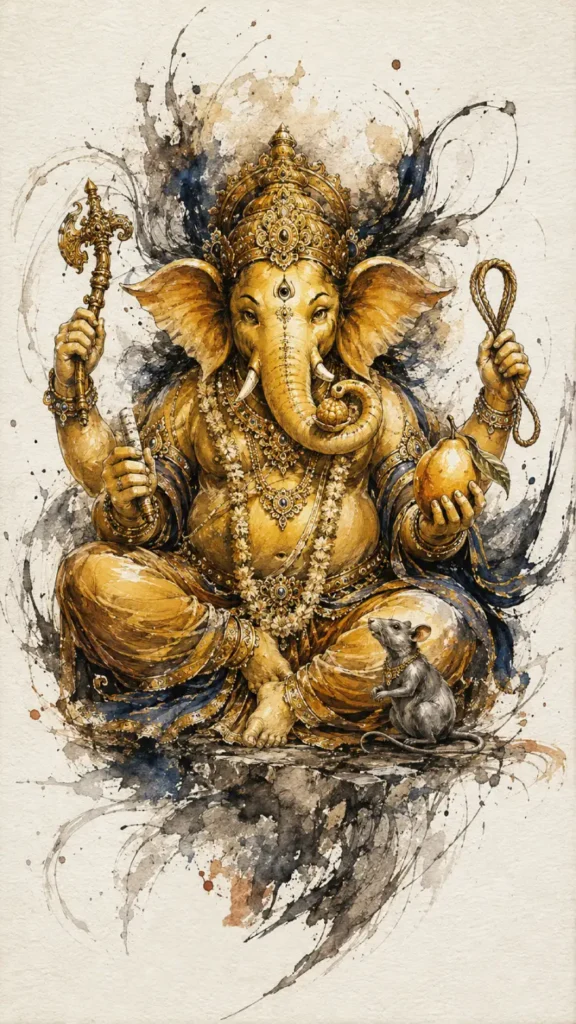
The Golden Ganesha of A-U-M
There is a sacred idea in Hindu spirituality that cannot be held in the hand, yet has been heard, chanted and contemplated for centuries: A-U-M.
Three sounds arise, flow into one another and resolve into silence.
Among the many forms of Lord Ganesha, Tryakshara Ganapati gives this profound symbolism a beautiful divine form. He is traditionally described as the nineteenth among the thirty-two forms of Ganapati, with a radiant golden complexion, four arms and distinctive attributes that invite contemplation.
His name itself points toward the sacred three letters—A, U and M—within AUM.
That makes Tryakshara Ganapati especially fascinating for sacred art. He is not only an image of the beloved elephant-faced Lord. He represents the meeting of form and sound, devotion and meditation, beauty and spiritual meaning.
For ShaktiShraddha, this is precisely what makes Tryakshara Ganapati such a compelling form to bring into a carefully created devotional artwork.
Who Is Tryakshara Ganapati?
Tryakshara Ganapati is traditionally counted as the nineteenth form among the thirty-two forms of Lord Ganesha.
The name Tryakshara is formed from the idea of “three” and akshara, a letter, syllable or sacred sound. The form is therefore associated with the three sounds A, U and M, which together constitute AUM or OM.
Traditional iconographic descriptions portray Tryakshara Ganapati with a golden complexion, four arms, a third eye and large ears, along with the noose, elephant goad, broken tusk and mango. His trunk holds the sweet modaka.
The traditional dhyana description is particularly important because it gives artists and devotees a framework for understanding the form rather than treating Tryakshara Ganapati as simply another variation of Ganesha.
Traditional Tryakshara Ganapati iconography and dhyana description
The Meaning of Tryakshara Ganapati’s Name
The heart of this form is contained within its name.
Tryakshara can be understood as referring to the three sacred syllables or letters:
A — U — M
Together they form AUM, one of the most revered sacred sounds in Hindu spiritual traditions.
The Māṇḍūkya Upanishad gives AUM an especially profound philosophical treatment. It examines the syllable through its three phonetic elements—A, U and M—and also discusses the soundless fourth aspect beyond them.
This does not mean that every traditional interpretation of Tryakshara Ganapati should be reduced to one philosophical explanation. Rather, the association creates a powerful contemplative doorway.
Ganesha gives a divine form to an idea that is otherwise heard rather than seen.
The three sounds become three letters.
The three letters become AUM.
And AUM becomes associated with a form of Ganapati whose very name invites the devotee to look beyond the surface of the image.
A-U-M and the Spiritual Idea Behind the Form
The Māṇḍūkya Upanishad’s treatment of AUM is one of the great contemplative teachings of Hindu philosophy. It associates A, U and M with different dimensions of experience and then points beyond them toward the fourth, which is represented by silence.
Tryakshara Ganapati can be approached beautifully in this spirit.
The devotee sees the deity.
The mind remembers the sacred sound.
The sacred sound encourages stillness.
The image therefore becomes more than decoration.
It can become a reminder that behind the many forms and experiences of life there can be an underlying sense of unity.
This is one reason the form feels particularly appropriate for meditation spaces, study areas and home shrines.
The Traditional Form of Tryakshara Ganapati
Tryakshara Ganapati is traditionally described as golden in complexion.
Gold is particularly effective in sacred art because it communicates radiance without requiring an elaborate explanation. It immediately gives the deity an atmosphere of warmth, auspiciousness and luminosity.
He has four arms, with each hand carrying an attribute.
His broken tusk recalls one of the most recognizable symbols of Ganesha.
The ankusha, or elephant goad, is an instrument of direction.
The pasha, or noose, is another familiar Ganesha attribute.
The mango brings the imagery of sweetness and fruitfulness.
His trunk carries a modaka, the beloved sweet traditionally associated with Ganesha.
Traditional descriptions also emphasize his large ears, described through the imagery of fly-whisks, and the presence of a third eye.
These details give Tryakshara Ganapati an especially distinctive visual identity.
The Symbols and Attributes of Tryakshara Ganapati
The Broken Tusk
The broken tusk is not merely an unusual physical feature.
Within Ganesha iconography, the tusk has long been interpreted through ideas of wisdom, sacrifice and purposeful action.
For a devotee, it can become a reminder that growth sometimes requires letting go of something—even something that once appeared essential.
The Elephant Goad
The ankusha is traditionally used to guide an elephant.
In symbolic contemplation, it can represent direction and disciplined movement.
The message is simple: strength becomes valuable when it is guided wisely.
For modern life, that idea feels particularly relevant. Ambition without direction can scatter our energy, while disciplined effort can turn intention into meaningful action.
The Noose
The pasha is another important attribute of Ganesha.
It can be contemplated in connection with attachment and the things that hold the mind back.
Rather than interpreting it only negatively, devotees can see it as a reminder to recognize what binds attention—fear, distraction, unhealthy attachment or restless desire.
The Mango
The mango adds a gentle and beautiful quality to the form.
Fruit naturally suggests nourishment and sweetness, and in devotional imagery it provides a visual counterpoint to the more disciplined symbolism of the goad and noose.
The Modaka
The modaka held by Ganesha’s trunk is perhaps the most affectionate element of the composition.
It is traditionally associated with Ganesha and is often understood devotionally as the sweetness of spiritual knowledge.
This creates a beautiful balance within Tryakshara Ganapati:
discipline is joined with sweetness; wisdom is joined with joy.
The Spiritual Meaning of Tryakshara Ganapati
The deeper beauty of Tryakshara Ganapati lies in the relationship between sacred sound and conscious living. Life often feels divided. Work occupies one part of the day. Family occupies another. Personal ambition, responsibility, uncertainty and spiritual aspiration can all seem to pull in different directions.
Tryakshara Ganapati offers a different way of looking at this complexity. A-U-M is three sounds experienced as one sacred syllable. Likewise, the many dimensions of human life can be brought together through awareness. His golden form can remind us of clarity. His goad can remind us of direction. His noose can remind us to recognize attachment. His broken tusk can remind us of sacrifice. His modaka can remind us that wisdom is not meant to become dry or joyless. And the symbolism of A-U-M can bring all of these reflections toward a deeper sense of unity.
Why Devotees Are Drawn to Tryakshara Ganapati
Tryakshara Ganapati has a special appeal for devotees who are attracted to the contemplative side of Ganesha worship. The form may be especially meaningful to those who value:
- spiritual study
- meditation
- concentration
- sacred sound
- inner discipline
- learning
- thoughtful decision-making
- a deeper understanding of Ganesha’s symbolism
Traditional devotional sources associate this form with concentration and spiritual knowledge, but such associations are best understood as devotional aspirations rather than guaranteed worldly results. The beauty of Ganesha worship is that it does not have to be separated from everyday life. A devotee may look at Tryakshara Ganapati and simply remember to become more attentive, more patient and more conscious. Sometimes that quiet reminder is itself meaningful.
Tryakshara Ganapati in Everyday Life
Modern life rarely becomes quiet on its own. There are messages to answer, decisions to make, responsibilities to carry and ambitions to pursue. In such an environment, the symbolism of A-U-M can feel surprisingly intimate. Tryakshara Ganapati can become a visual reminder to pause. Before an important decision, one can step back from immediate reaction. Before speaking, one can listen. Before beginning a demanding task, one can gather the mind. Before ending the day, one can create a few moments of stillness. The spiritual value of sacred art often works in this subtle way.
The artwork does not need to promise a miracle. It simply needs to remind us of something we already know deep inside but may forget during a busy day.
Famous Sacred Place Associated With Tryakshara Ganapati
Traditional references commonly associate Tryakshara Ganapati with Tirumakudalu Narasipura, also known as T. Narasipura, in Karnataka. Some sources specifically identify a Tryakshara Ganapati image or shrine in the Tirumakudalu area.
Sacred Place: Tirumakudalu Narasipura / T. Narasipura
District: Mysuru region
State: Karnataka, India
Connection: Traditionally associated with worship of Tryakshara Ganapati.
Because the exact street-level public address of the specific Tryakshara Ganapati shrine is not consistently documented by authoritative sources, it would be misleading to manufacture a detailed postal address. For ShaktiShraddha, accuracy is more important than filling a field with uncertain information.
T. Narasipura itself is a significant sacred region of Karnataka, and the broader Mysuru area is also known for sculptural representations of the traditional forms of Ganapati.
Tryakshara Ganapati and the Beauty of Sacred Art
Some divine forms are naturally powerful subjects for art.
Tryakshara Ganapati is one of them.
His golden complexion creates an immediate visual presence. His elaborate crown and ornaments provide intricate detail. His four arms create a balanced composition. The mango, noose, goad, broken tusk and modaka give the viewer several symbolic details to discover.
The artwork accompanying this ShaktiShraddha article takes that traditional identity and presents it through a rich contemporary Indian sacred-art aesthetic.
The golden Ganesha is surrounded by expressive ink-and-watercolour-like strokes, giving the piece movement while keeping the deity as the visual centre.
The ornate jewellery and crown emphasize his majesty.
The flower garland softens the composition.
The small mouse at his feet introduces the familiar presence of Mushika, Ganesha’s traditional vehicle.
The result feels devotional without looking like an ordinary mass-produced religious poster.
That is where the artwork becomes especially suitable for ShaktiShraddha.
Why This Tryakshara Ganapati Artwork Is Special
The strongest selling point of this artwork is not simply “Ganesha wall art.”
It is:
A sacred representation of Ganesha connected with the profound symbolism of A-U-M, expressed through premium Indian devotional art.
That distinction matters.
Someone looking for generic Ganesha decoration can find countless images.
But someone who discovers the meaning of Tryakshara Ganapati may begin to see the artwork differently.
The golden colour is no longer merely beautiful.
The four arms are no longer simply decorative.
The noose and goad invite reflection.
The broken tusk carries symbolism.
The modaka adds sweetness.
And the entire form points toward the three sacred sounds of A-U-M.
That gives the artwork a story that can remain meaningful long after the first impression of its beauty.
Where to Place Tryakshara Ganapati Sacred Art
A Tryakshara Ganapati artwork can naturally become part of a home temple, prayer room, meditation corner or study space. According to commonly followed Vastu traditions, devotional images are generally kept in clean, respectful areas intended for prayer or contemplation. Because Vastu practices differ across traditions and regions, they should not be presented as universal Hindu scripture. For this particular artwork, a meditation or prayer area can be especially appropriate because of the form’s association with A-U-M and contemplative awareness. It can also work beautifully as sophisticated Indian spiritual decor in a living room, library or personal study. The most important consideration is not a rigid placement formula. It is reverence and intention.
A Meaningful Choice for Sacred Gifts
Tryakshara Ganapati can also make an emotionally meaningful gift.
It can be chosen for someone who loves Ganesha, appreciates Indian art, maintains a home shrine or has a personal connection with meditation and spiritual study.
A framed artwork can become a lasting presence in a home.
A canvas can give the golden form greater visual prominence.
A high-resolution digital artwork can offer flexibility for personal printing and devotional spaces.
The important thing is that the artwork is chosen because its meaning resonates with the recipient, rather than because of promises of guaranteed prosperity, protection or supernatural results.
Tryakshara Ganapati in the ShaktiShraddha Collection
At ShaktiShraddha, sacred artwork can be approached as a meeting point between faith, heritage and visual beauty.
Tryakshara Ganapati is especially suited to this philosophy.
His traditional identity gives the artwork depth.
His golden form gives it visual richness.
His connection with A-U-M gives it a contemplative dimension.
And the contemporary artistic treatment allows the image to sit naturally within modern Indian and international homes.
For someone decorating a home temple, creating a meditation space or simply collecting meaningful Indian spiritual art, this form offers something more personal than ordinary wall decoration.
It gives the room a story to remember.
The Eternal Message of Tryakshara Ganapati
Tryakshara Ganapati teaches us to look beyond the visible form.
We see the elephant-faced Lord, yet his name directs our attention toward sound.
We see gold, yet the symbolism invites us toward inner radiance.
We see four hands carrying different objects, yet together they create one coherent spiritual image.
And behind the name stands A-U-M—the three sacred sounds joined as one.
That is perhaps the most beautiful reason to bring Tryakshara Ganapati into sacred art.
The artwork can become a visual reminder of unity in a life that often feels divided.
A reminder to listen.
A reminder to focus.
A reminder to move with direction.
A reminder to recognize attachment.
A reminder that wisdom can still contain sweetness.
And ultimately, a reminder to create moments of stillness within the noise of everyday life.
For ShaktiShraddha, this makes Tryakshara Ganapati more than another beautiful depiction of Lord Ganesha.
It becomes an expression of sacred sound translated into sacred form.
And when that form is rendered with care, warmth and artistic craftsmanship, it can become a meaningful part of a home—a piece of Indian spiritual art that is not only seen, but contemplated.
7. FAQ
Who is Tryakshara Ganapati?
Tryakshara Ganapati is traditionally regarded as the nineteenth of the thirty-two forms of Lord Ganesha. His name connects him with the three sacred sounds A-U-M.
What does Tryakshara Ganapati mean?
Tryakshara refers to “three letters” or “three syllables.” In this context, it refers to A, U and M, which together form AUM.
What does Tryakshara Ganapati look like?
Traditional descriptions portray him with a golden complexion, four arms, a third eye and large ears. His attributes include a broken tusk, goad, noose and mango, while his trunk holds a modaka.
Which scripture is associated with Tryakshara Ganapati?
The thirty-two forms of Ganesha are associated with the traditional Ganapati literature, particularly the Mudgala Purana and later iconographic traditions. The dhyana description of Tryakshara Ganapati is preserved in traditional sources describing these forms.
What does A-U-M have to do with Tryakshara Ganapati?
The name Tryakshara refers to the three sounds A, U and M within AUM. The Māṇḍūkya Upanishad gives an important philosophical treatment of these three sounds and the fourth, soundless aspect.
Explore the Māṇḍūkya Upanishad and its teaching on AUM
Which temple is associated with Tryakshara Ganapati?
Tirumakudalu Narasipura in Karnataka is traditionally associated with Tryakshara Ganapati. However, documentation for an exact dedicated shrine and its street-level postal address is limited, so the association should be stated carefully.
What does Tryakshara Ganapati symbolize?
The form is particularly connected with A-U-M and can be contemplated through themes of sacred sound, concentration, awareness, spiritual knowledge and inner harmony.
Is Tryakshara Ganapati suitable for a home temple?
Yes. A respectful traditional depiction can be kept in a home temple, prayer room or meditation space according to one’s family and devotional tradition.